Swiss Art Gallery selection · Piece swissart-0110
◆
Gravure 3
Reference swissart-0110


Swiss Art Gallery
The artwork in detail
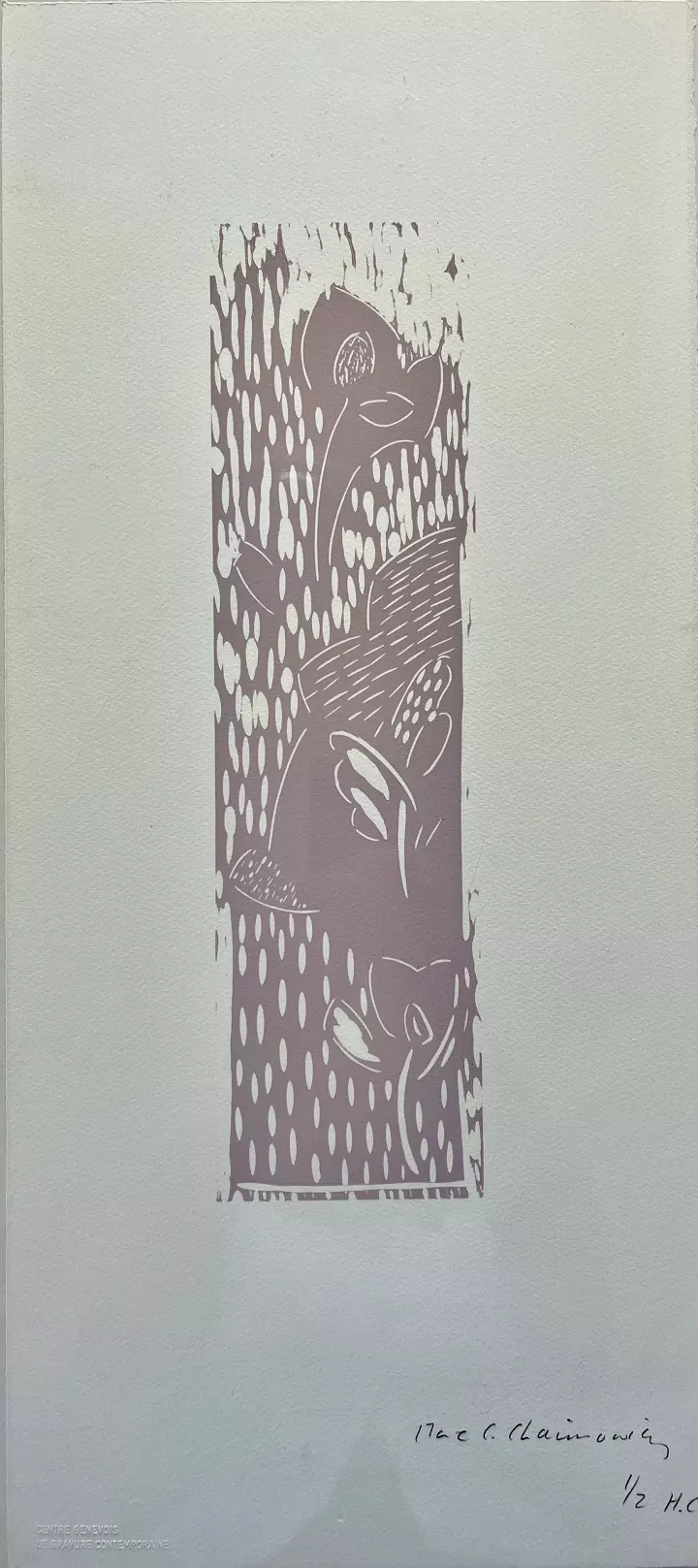
On a light sheet, largely left blank, a narrow printed form rises like a fragment of a screen, wallpaper or botanical panel. Its pronounced verticality gives the image an almost architectural presence, while the powdery mauve of the ink creates a soft, slightly faded atmosphere, somewhere between the memory of an interior and a botanical apparition. The motif is not presented as a naturalistic representation: it is constructed through the repetition of small oblong forms, distributed like a regular rainfall, which set the ground vibrating and suggest at once bark, textile, stylised foliage or a perforated surface.
Several curved lines stand out within this gridded field. In the upper section, a floral or organic silhouette unfolds around an oval marked with fine strokes; lower down, a broad oblique area crossed by parallel hatching introduces a change in rhythm and density. Forms of leaves, calyces and petals then appear, as if a botanical repertoire were dissolving into ornament. The white reserves play an essential role: they are not mere empty spaces, but incisive strokes that cut out the contours, illuminate the surface and give the motif room to breathe. The whole thus oscillates between decorative order and an indeterminate image, between repetition and singularity.
The texture of the paper, visible in the margins, softens the sharpness of the impression and preserves a tactile dimension characteristic of the print. The handwritten pencil signature, accompanied by the notation “1/2 H.C.”, and the blind stamp of the Centre genevois de gravure contemporaine place the work within the context of the 1986 Geneva edition. In Chaimowicz’s work, decoration is never mere embellishment: it becomes a mental space, charged with silence, memory and domestic presence. This print thus joins his interest in screens, wall surfaces and motifs that transform everyday space into an intimate scene. Its sensitivity lies in this ambiguity: the image seems welcoming through its chromatic softness, yet remains secretive, almost melancholic, in the way its forms elude any definitive identification.
Swiss Art Gallery selection