Swiss Art Gallery selection · Piece swissart-0111
◆
Gravure 4
Reference swissart-0111


Swiss Art Gallery
The artwork in detail
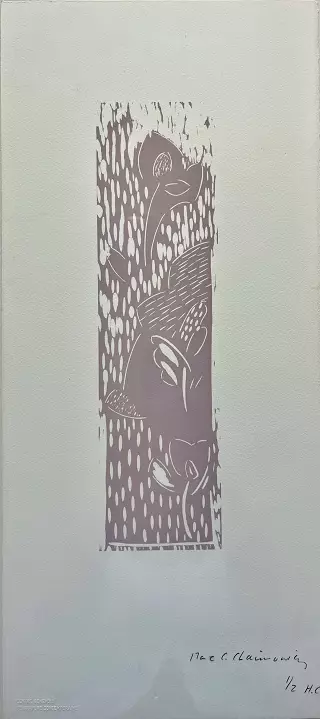
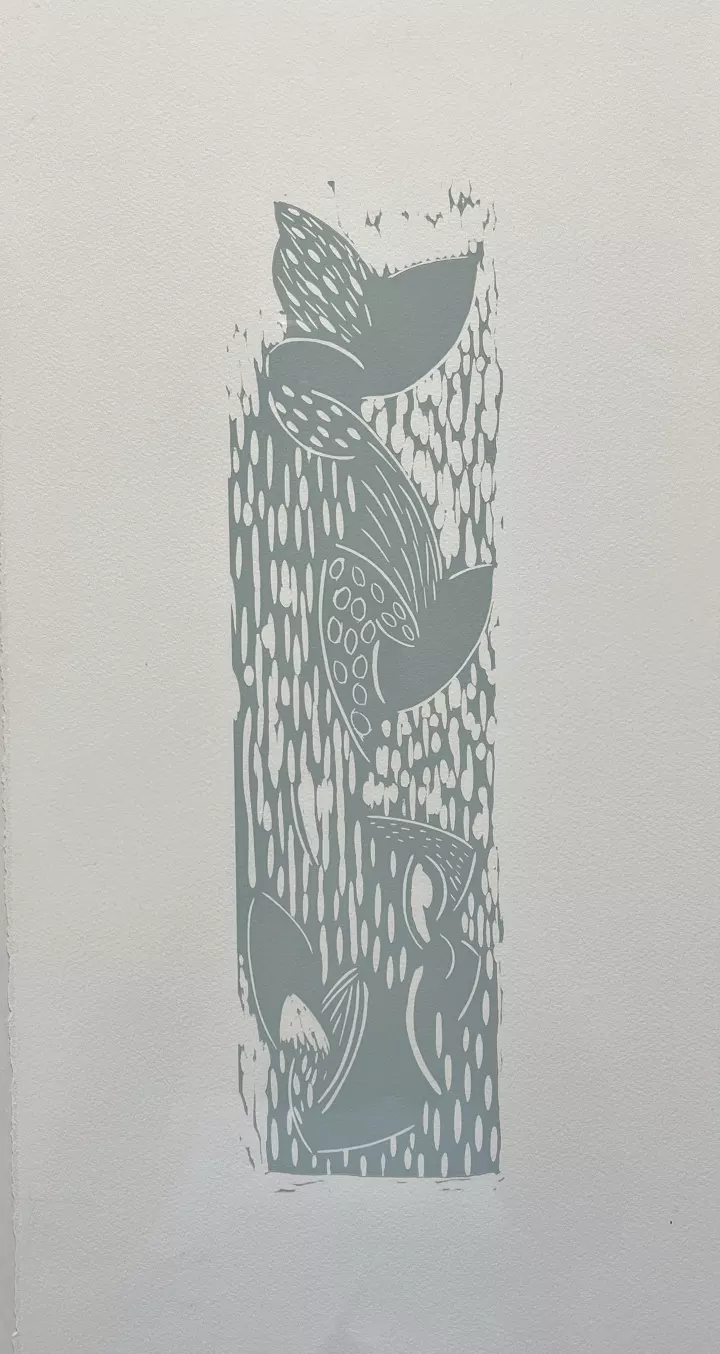
On a tall, narrow sheet, a printed form is concentrated in a vertical rectangle, placed at the centre of a vast field of paper left untouched. This disproportion is essential to the reading: the motif appears at once precious and isolated, like a fragment detached from a more expansive décor. The support’s subtly palpable texture and its generous margins give the whole a silent, almost tactile presence.
The image is constructed in a single soft, cool blue-grey tone. Several curved masses interlock, connected by supple lines and openwork areas. Their identity remains deliberately unstable: they alternately evoke leaves, feathers, fins or birds’ silhouettes. This ambiguity protects the composition from a strictly figurative reading and allows the eye to move freely among the forms.
The linocut sets calm areas of solid colour against a network of white reserves. Some are long and tapered; others take the form of small almonds or irregular punctuation marks. Their repetition animates the surface like rain, bark or the weave of a textile. The cut marks remain forthright, but they never harden the image: rather, they impart to it a hand-made rhythm, responsive to differences in density and to the accidents of the contour.
The compressed verticality of the printed field reinforces this impression of growth. The curves follow one another in a downward movement, then straighten near the large lower form. The eye thus oscillates between an overall reading and close observation of the details. The restrained hue avoids the authoritarian contrast of black and white; it establishes a diffuse light in which the paper fully participates in the image, becoming line, interval and breath.
This attention to motif and décor accords with a practice that has continually shifted the boundaries between fine art and applied arts. From the 1980s onwards, Marc Camille Chaimowicz developed environments, furniture, textiles, wallpapers and graphic works in which the intimate becomes a constructed space. Here, the print transposes this sensibility into a concentrated format: the motif possesses both the autonomy of an image and the repetitive power of a fragment of décor.
Swiss Art Gallery selection