Marc Camille Chaimowicz · 4 min read
Basel Sequence: the motif becomes a wall
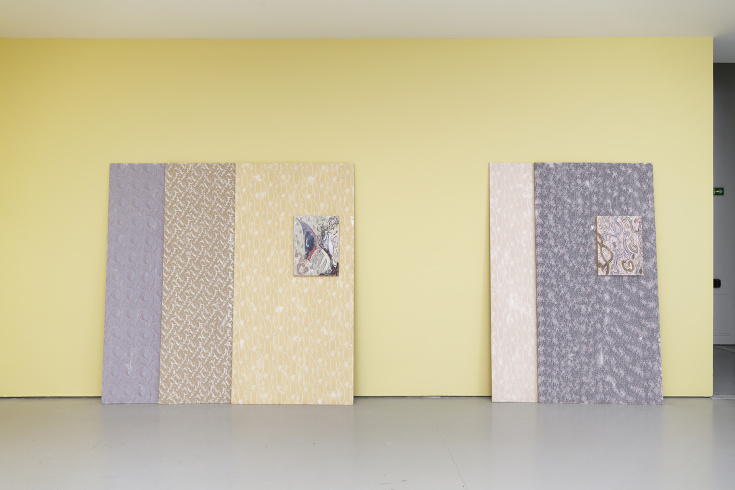
Five painted panels of 2011 place decorative motif between painting and architecture. Their scale transforms the viewer’s relationship to painting.
Published on October 3, 2026
Basel Sequence can be described as a sequence of five panels, but this definition does not settle its place in space. Marc Camille Chaimowicz’s work, dated 2011, is preserved at the Centre Pompidou. Each plywood panel measures approximately 244.48 by 121.92 centimetres. Acrylic, graphite and pastel appear on these surfaces. The museum gives variable overall dimensions. This final detail is essential: the elements are identifiable, but their relationship to space is not reduced to a single definitively measured rectangle.
The scale brings the panels close to a wall. They exceed an ordinary body’s height and can alter the perception of a place. We are far from the small painting viewed closely before moving on to the next. Visitors can experience an architectural presence while recognising painted surfaces. This hesitation does not arise from a lack of definition. It constitutes a possibility of the work: painting can take charge of a portion of space and become one of the elements organising our movement or pause.
The Centre Pompidou’s entry highlights another hesitation, between motifs and their execution. Ornament may seem to belong to the world of decorative repetition, while the painting is made by hand. This association requires a closer look at what we believe we recognise. A form evoking industrial reproduction does not necessarily lose the traces of an individual gesture. It can bring an appearance of serial production into the painting and, within that appearance, let the difference of material execution persist.
The three cited materials give the project several means of constructing its surface. Acrylic paint, graphite and pastel do not produce exactly the same kind of mark. The entry does not allow us to reconstruct the precise order of every gesture, but prevents the result from being reduced to printed paper pasted on a wall. What the work shows as motif takes shape on a worked support. Our gaze can therefore oscillate between the decorative ensemble and the particularities of what has been deposited on each panel.
In Chaimowicz’s work, this passage between decoration and artwork is no isolated accident. Exhibitions devoted to his practice bring together furniture, fabrics, paintings and installations. Basel Sequence offers a particularly clear form of this circulation. The plywood does not only carry an image; it can take on a function in the presentation. The surface approaches a display wall, while its ornament draws attention to it. What could be perceived as a simple background becomes an object to look at. The painting’s environment enters, in turn, the field of the work.
The record specifies that Basel Sequence enters the collection in 2022 through a gift from the American Friends of the Centre Pompidou. The year of creation and that of entry into the museum therefore do not coincide. This gap reminds us that a work has several chronologies: that of its making, that of its presentations, then that of its institutional preservation. The museum stabilises its identification and materials without erasing the stated variability of its installation. Preserving does not always imply fixing a single arrangement.
Before this sequence, the question of the frame can thus shift. We often seek the boundary separating a painting from its wall. Basel Sequence makes this boundary work at the visitor’s scale. Painting has a support; the support evokes a wall; the wall becomes a visual presence. The motif draws us towards the surface, then returns us to space. Chaimowicz gives ornament a capacity for organisation, and the panel a double life. It can be viewed as a work while reminding us of the forms that make looking at other works possible.