Marc Camille Chaimowicz · 4 min read
Shoes without their pairs
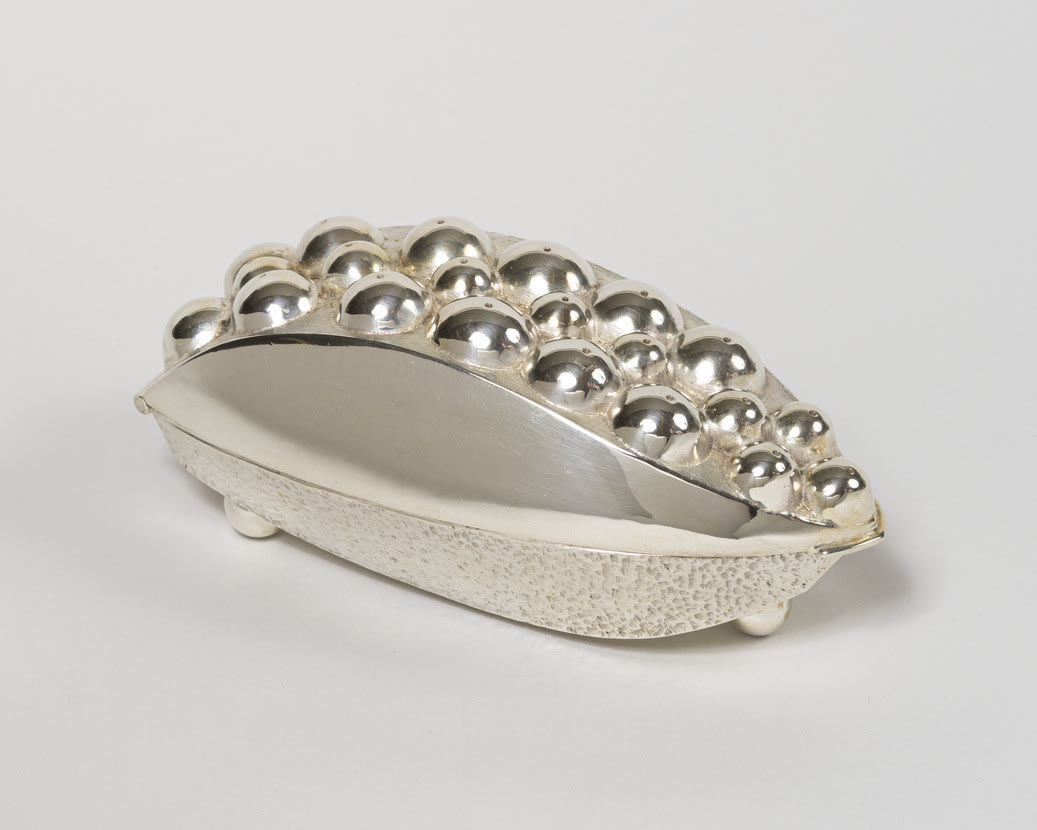
Shoe Waste? gathers worn shoes painted silver. Losing the pairs transforms an object attached to the body into a collective presence on the floor.
Published on October 3, 2026
A shoe usually calls for its pair and the foot using it. In Shoe Waste?, Marc Camille Chaimowicz breaks these associations. The Migros Museum guide describes numerous worn shoes painted silver and arranged on the floor. The pairs are undone. The object remains recognisable, but the organisation that enabled it to be worn is no longer the ensemble’s principle. We encounter shoes accompanying no immediate human movement. The gaze takes over from the body for which they seemed naturally destined.
The document gives the work a multiple dating, 1971/2005/2006. It also mentions a selection of photographs of interventions on the Thames in 1971, presented in this context. These references do not authorise us to invent each shoe’s origin or its owner’s identity. They indicate a project that returns and is accompanied by traces of earlier activity. The installation does not present itself simply as an accumulation without history. Through documents, it is connected to a period and gestures whose indications visitors can encounter.
The silver colour acts as an association between different objects. It does not make their shapes identical, but gives them a shared appearance. This gesture transforms attention. We can first see an expanse or group, then notice differences in profiles, volumes and wear. Painting produces a visual unity still traversed by material particularities. What served individual uses becomes an ensemble. Unity does not necessarily erase diversity; it proposes a framework for comparison.
Losing the pairs has an effect deeper than simply mixing up storage. A pair allows use and rapid identification: two elements are recognised as belonging together. Undoing this relationship requires another order to be sought. Visitors can count, mentally associate, examine repetitions or observe differences. None of these gestures restores the shoes’ immediate function. The work maintains a suspension. The name Shoe Waste? adds a question to that suspension without giving a definitive answer about what might be waste, remainder or material.
Wear retains proximity to absent bodies. It would be easy to recount a moving destiny for every object. We do not have these lives, and inventing them would lose the arrangement’s precision. The interest lies precisely in a presence without an identified owner. Signs of use indicate that the object is not a purely new volume; they do not tell an event by themselves. We can recognise the passage from use to looking without turning a material trace into evidence of a story we would wish to find there.
The floor becomes an essential surface of presentation here. A shoe is made to meet the ground, but the installation alters that meeting. The objects remain at the level of our steps while asking for attention that can slow us down. The museum does not necessarily give them the prestige of individual plinths. Their accumulation produces another mode of presence. Our gaze must travel, distinguish and return, as before a motif whose elements have thickness. The everyday object becomes the unit of a spatial ensemble.
Shoe Waste? thus leaves the shoes between several states. They belong to the world of use, carry differences and receive a colour gathering them together. They are recognised, then made less available to the function announced by their shape. Chaimowicz does not need to transform them into human silhouettes to evoke the body. Their absence of feet is enough to open this relationship. The question mark accompanies us to the end: what remains when an object ceases to serve as intended? On the floor, familiar forms make this question visible, one shoe after another.