Swiss Art Gallery selection · Piece swissart-0086
◆
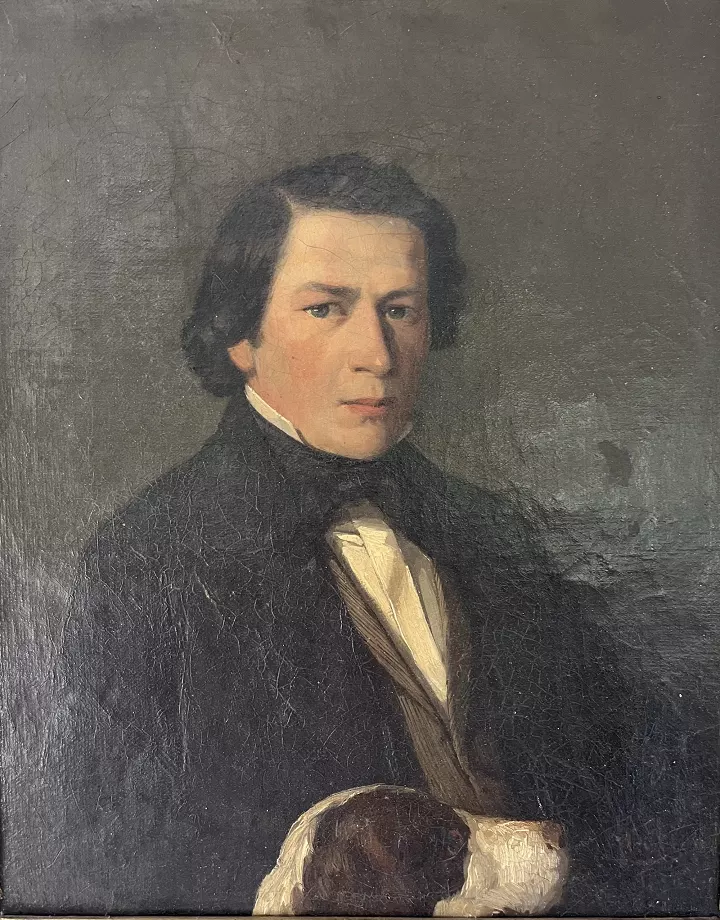
M. Daxelhofer et son chien domestique
Reference swissart-0086


Swiss Art Gallery
The artwork in detail
The model occupies a very tightly framed vertical half-length format, against a grey-green background with no identifiable decoration. The slightly offset bust forms an almost triangular dark mass, while the face turns towards the viewer. This contrast between the stability of the clothing and the attentiveness of the gaze gives the portrait a restrained presence. The black hair, parted by an unobtrusive parting, frames a face with firmly constructed volumes: a light forehead, an accentuated bridge of the nose, thin lips and cheeks animated by a warm pink tone.
The light enters from the left and models the features without theatrical effect. It first meets the forehead and cheekbone, then concentrates in the white of the shirt, whose angular folds structure the centre of the composition. Around this luminous area, the black of the coat, the brown of the waistcoat and the dark tie form a deliberately restricted range. The brushwork remains blended in the face, but becomes more visible in the clothing, the background and the cream-coloured impasto of the shirt.
At the lower edge, the dog appears, of which only a brown-and-white form is fully perceptible. This motif, cut off by the framing, is not merely an accessory. Its supple curve interrupts the rigorous lines of the costume and introduces, within a socially composed representation, a domestic intimacy. The dialogue between the man’s direct gaze and the animal’s silent presence thus shifts the official portrait towards a more personal register.
The old network of craquelure traverses the entire surface and is more apparent in the dark areas. The frame with broad gilded mouldings, now very worn and revealing its red bole, nevertheless extends the palette’s warm gravity.
Painted at the beginning of Bocion’s career, this canvas retains the imprint of his Parisian training under Louis-Aimé Grosclaude and Charles Gleyre, perceptible in the construction of the face and the economy of the composition. After returning to Lausanne, the painter still practised the genres of figure and narrative before devoting an increasing part of his work to Lake Geneva. This portrait thus recalls that his attention to human presence precedes and accompanies his future observation of the shores, fishermen and life on the lake.
Swiss Art Gallery selection
This artwork has found a collector
Discover other artworks currently available.