Johann Heinrich Füssli · 5 min read
Two sides of a revolt against heaven
Two drawings preserved on the sides of a single sheet give Satan’s defiance different gestures. Fuseli works on the tension of a body, a hand and a space of wash.
Published on October 3, 2026
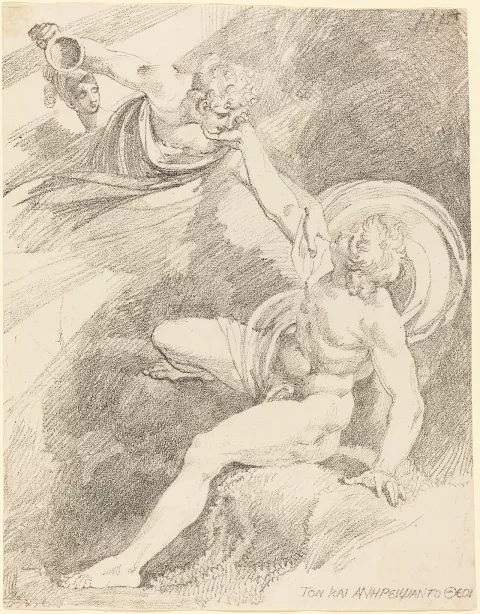
One leg braces the body while the other stretches out behind it. The torso rises and the arm reaches towards the top of the sheet. In Fuseli’s drawing entitled Satan Defying the Powers of Heaven, conflict first becomes a question of balance. The figure seems supported by unstable ground, but his gesture exceeds that support. Following the diagonal from foot to hand is enough to understand how a single figure can occupy an entire drama.
The National Gallery of Art holds two related versions, dated to the late 1790s, on the sides of a single sheet. Their inventory numbers end with the letters a and b. Graphite, black chalk and wash participate in the work. This presentation allows us to see the subject as an exploration rather than a definitively settled image. The two sides do not necessarily represent successive moments of the story: they offer two solutions to a problem of the figure.
On one side, a hand closes into a fist; on the other, the fingers open. The body’s orientation is also reversed in the images presented by the museum. These modifications seem limited when simply listed, but they change how the gesture is received. The fist concentrates force in a compact form. The open hand gives it a more extended direction. The defiance announced in the title can be constructed through these differences without becoming a new episode.
Looking at the work — On the side where the fingers are open, the pale body stands out before broad passages of grey. The surrounding shadows do not describe a landscape with the precision of a topographical view. They give space depth and resistance. The face turns towards the raised arm, while the bent knee brings the figure closer to us. This compression between gesture, head and support strengthens the impression of tension distributed throughout the body.
Wash allows broad values to be laid down and irregular edges to appear. Lines, in turn, can retrace a joint or clarify a direction. The two operations respond to one another. The figure is not defined solely by its outer line; it becomes visible through the surrounding surfaces and the contrasts running through it. The background participates in the subject. It is what the body measures itself against, even before the title indicates a heavenly power.
A crease crosses the sheet approximately halfway down. This trace belongs to the paper’s material history and should not be understood as part of the invented setting. It reminds us that we are looking at an object preserved, handled and passed from one collection to another. The drawing’s dramatic capacity does not erase its fragility. On the contrary, this coexistence is palpable: a monumental body can be carried by a few lines and a sheet we could hold in our hands.
The other side also contains construction lines, visible as a network in the background. They open the possibility of observing the work without assuming that every mark seeks to represent something. A trace can organise the surface before becoming an element of the image. The viewer need not decide which version is truer. Above all, comparison shows that an artist can return to the same subject and alter the relationship between a silhouette, its gesture and its surroundings.
The title gives the figure the name Satan and situates the action as opposition to the powers of heaven. This identification must be preserved, but it does not allow us to attribute a precise sentence to the figure. The drawing has its own way of making defiance intelligible. It does so through the thrust of the limbs, the upward gaze and the gap between a lit body and dark masses. Literature becomes a construction the eyes can follow.
The two sides benefit from being viewed in turn, without rushing the passage from one to the other. We can compare the hand, then the supporting leg, then the passages of wash. Repetition then ceases to seem like copying. It becomes the site of a decision. Fuseli measures a gesture’s intensity by trying several balances, leaving the traces of this exploration on the same support. The revolt remains motionless, but the work of drawing continues to move beneath our gaze.