Johann Heinrich Füssli · 5 min read
Ganymede enters lithography
In 1804, Fuseli brings Ganymede into an experiment in lithography. The mythological action takes the form of moving bodies and drapery, preserved in a print in Washington.
Published on October 3, 2026
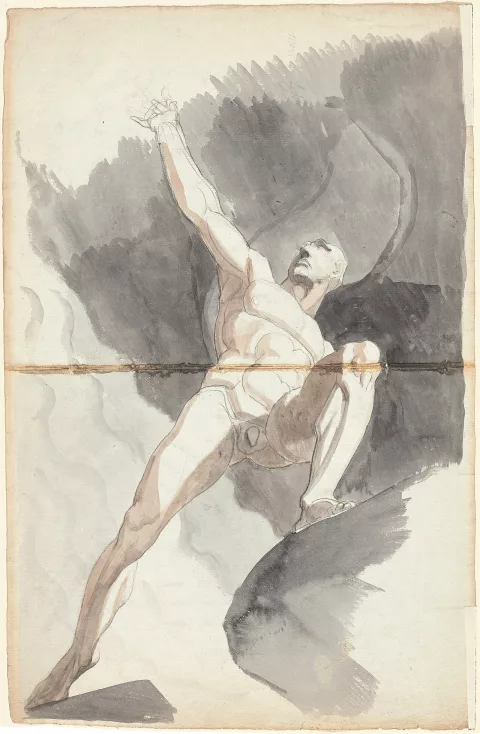
The young man raises his arm towards a figure coming from above. His body remains supported in the lower part of the image, while a great movement of fabric connects the two figures. Fuseli thus concentrates the action into a diagonal. The Abduction of Ganymede does not offer a distant view in which every element of the myth would find its place. It brings the bodies together and turns the subject into a meeting of forces, visible even before we have identified the names.
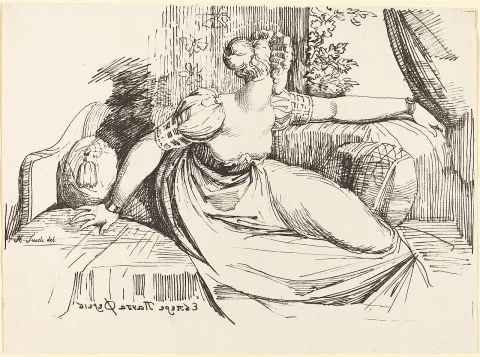
The impression held at the National Gallery of Art is a crayon lithograph on wove paper, dated 1804. The catalogue places it in the Specimens of Polyautography, as it does another Fuseli print showing a woman beside a window. This affiliation reminds us that a single process can accommodate very different subjects. The experiment concerns more than a mythological scene. It also concerns the means by which drawn gestures can become printed marks and reach other eyes.
Looking at the work — The lower figure presents a pale torso, legs directed two ways and a hand bracing the body. The raised arm meets that of the upper figure. Around them, the fabrics unfold in broader curves. The black remains composed of grains and passages of crayon rather than large, uniform areas. Density varies from zone to zone, giving the bodies a light that seems to come from their contrast with the neighbouring space.
Here lithography retains a quality close to drawing, but changes the image’s material condition. The sheet we see is a printed impression, not the unique trace of a point moved directly across this paper. This difference does not cancel the presence of the hand. It circulates it through another chain of work. Looking at the grain, shadows and reserved areas helps us understand why a reproductive technique can also become a terrain of invention.
The old title in the English entry uses a term denoting abduction. For a French reading, this action should be retained without adding a scene absent from the document. The image presents a grasp and a tension between two figures. It gives neither a complete sequence of the episode nor testimony about actual violence. Attention should remain on the mythological subject as the artist constructs it, with the precise gestures observable on the support.
The museum mentions a Greek inscription at the bottom of the sheet, associated with the twentieth book of the Iliad. Fuseli’s initials also appear in the stone. These markers bring text into the print itself. They can guide a knowledgeable viewer towards a familiar story, but the composition also works for someone who cannot read Greek. The group’s energy does not depend solely on an explanation. The bodies provide their own mode of understanding.
The drawing opposes points of support and movements that exceed them. A hand on the ground ensures provisional stability; an extended arm introduces an upward direction; the fabrics prolong this thrust without obeying the limbs’ weight exactly. The whole can thus seem caught at a tipping point. This impression is a visual construction. We do not have to imagine what the figure might have said just before or what would happen to him in the following second to feel it.
The sheet enters Washington’s collections through the Rosenwald gift in 1947. This moment in its provenance belongs to the history of the impression, several generations after its making. A print allows multiple impressions, but each sheet subsequently preserves its own journey. The museum publishes its support, dimensions and inscriptions to make this object identifiable. These details anchor our reading and prevent confusion between the general subject and all the images that revisit it.
We can finish by following only the curves: that of the leg, the fabric and the arm reaching the other figure. They form a circuit in which the eye accelerates, then returns to the point of support. Ganymede remains in this tension, between a visible ground and a direction that exceeds him. Fuseli gives the myth a compressed form and lithography a movement sustained enough for the sheet to preserve, long after its printing, the impression of an abduction still in progress.