Gustave Buchet · 3 min read
Gustave Buchet: a Futurist Entombment at the Concours Diday
In 1918, Gustave Buchet presented a Futurist interpretation of the Entombment at the Concours Diday. The work sparked controversy and was awarded joint fourth prize. In 1919, his first solo exhibition confirmed his position as a leading figure of Futurism.
Published on September 21, 2026
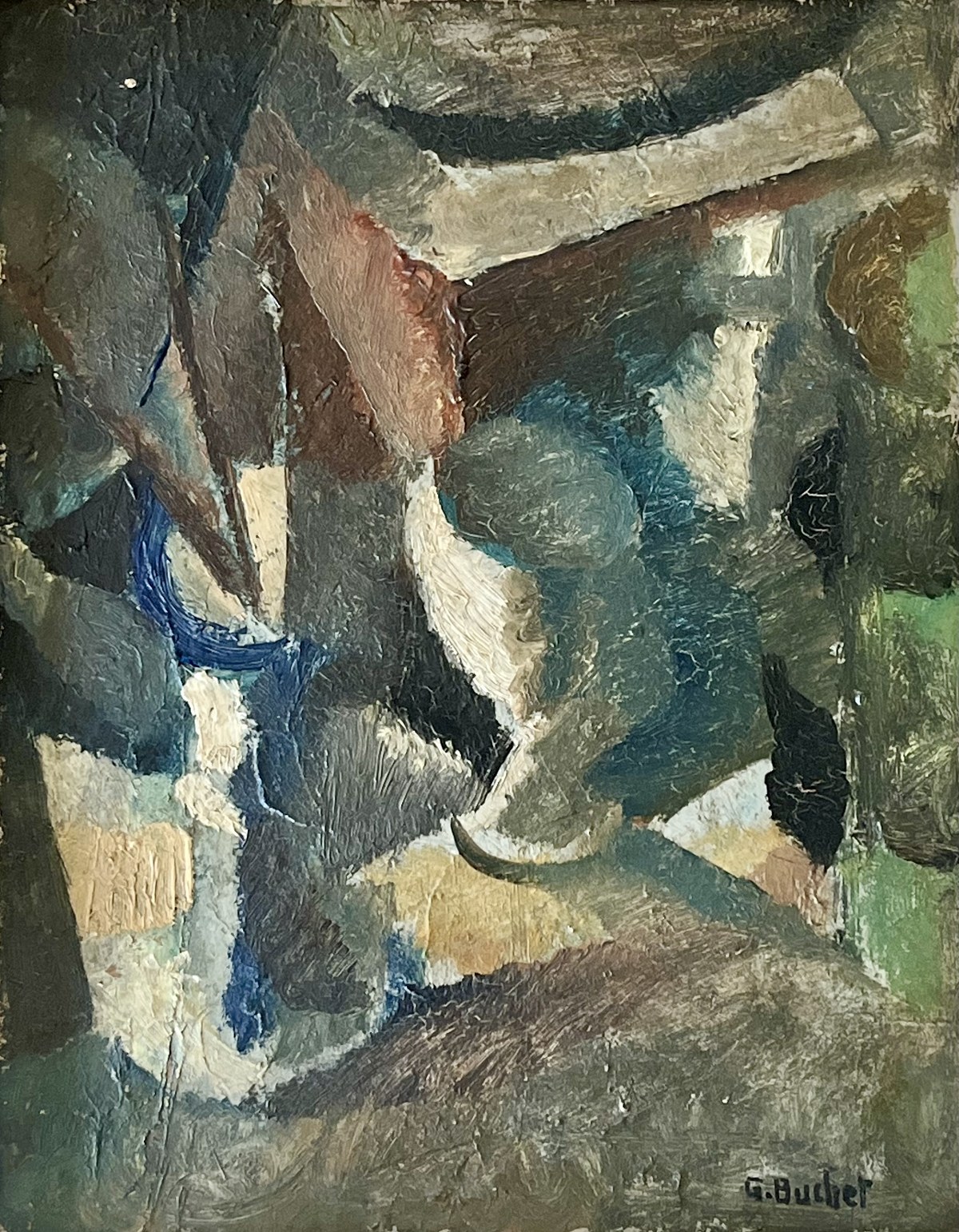
In 1918, Gustave Buchet presented his Entombment at the Concours Diday in Geneva. His Futurist interpretation sparked controversy—or, according to the Fondation Gustave Buchet, “something of a stir”—and was awarded joint fourth prize. The sources establish these two facts without specifying individual reactions from the public or the jury’s intentions.
Buchet had just returned from a second stay in Paris, undertaken in 1916–1917. Trained at the École des beaux-arts de Genève, he attended the Académie de la Grande Chaumière and the open classes at the Académie Colarossi in Paris. He became friends with Ossip Zadkine, who introduced him to Cubism and Futurism, and developed a passion for representing movement, rhythm and dynamism.
Back in Switzerland, he continued this research. From 1918 onwards, he adopted the principle of the “continuity of space”, which brings figures closer to their surroundings and causes them to interpenetrate. In Dancer in Motion, held by the Musée cantonal des Beaux-Arts de Lausanne, he constructs the composition through coloured planes, curves and counter-curves. The museum highlights the influence of Robert and Sonia Delaunay’s Orphism and the use of the spiral to make the dancer’s movement perceptible.
The Entombment also dates from 1918. This oil on canvas, measuring 146 by 116 centimetres, is held by the Musée d’art et d’histoire de Genève. The museum purchased it in 1965. The sources explicitly describe it as a Futurist work and connect it with Buchet’s research into rhythm and movement.
Commentary — The contrast at the heart of this episode lies in the very terms used by the sources: Buchet subjects an Entombment to a Futurist interpretation. The controversy and the joint fourth prize may be reported together, but they do not make it possible to reconstruct the jury’s intentions or to characterise this distinction as hesitant recognition.
In 1919, Buchet presented two solo exhibitions at the Salon Néri in Geneva and founded the Futurist movement A+D. The Musée cantonal des Beaux-Arts states that his first solo exhibition confirmed his position as a leading figure of Futurism. The sources, however, present neither these exhibitions nor the founding of A+D as direct consequences of the 1918 controversy.
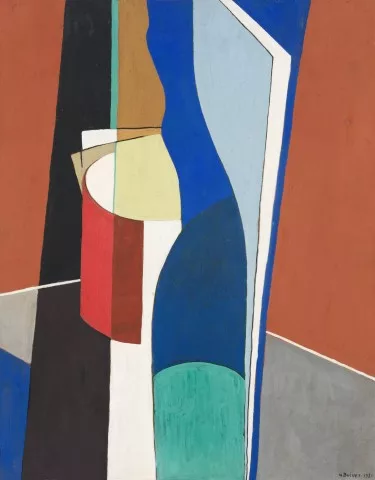
After a brief involvement with Dada-Genève, Buchet settled in Paris in March 1920. Invited by Alexander Archipenko, he took part in the travelling exhibition of the second Section d’Or. He then abandoned Futurism in favour of flat, geometric painting, close to Fernand Léger’s Post-Cubism and the Purism championed by Le Corbusier and Amédée Ozenfant.
Commentary — The Entombment thus documents a precise moment in Buchet’s career: that of his Futurist research in Geneva in 1918. The work caused a stir, won a prize at the Concours Diday and entered the collections of the Musée d’art et d’histoire de Genève in 1965. According to his foundation, lasting recognition of Buchet’s place within the historical avant-gardes did not come until the mid-1970s.
Sources and context
- Musée cantonal des Beaux-Arts de Lausanne — Guide de visite Gustave Buchet. Accusé de peindre ↗
- Musée cantonal des Beaux-Arts de Lausanne — Danseuse en mouvement ↗
- Musée cantonal des Beaux-Arts de Lausanne — Dossier de presse Gustave Buchet. Accusé de peindre ↗
- Fondation Gustave Buchet — Œuvre ↗
- Fondation Gustave Buchet — Biographie ↗
- Musée d’art et d’histoire de Genève — Rapport d’activité 2022 ↗