Swiss Art Gallery selection · Piece swissart-0113
◆
Composition abstraite
Reference swissart-0113


Swiss Art Gallery
The artwork in detail
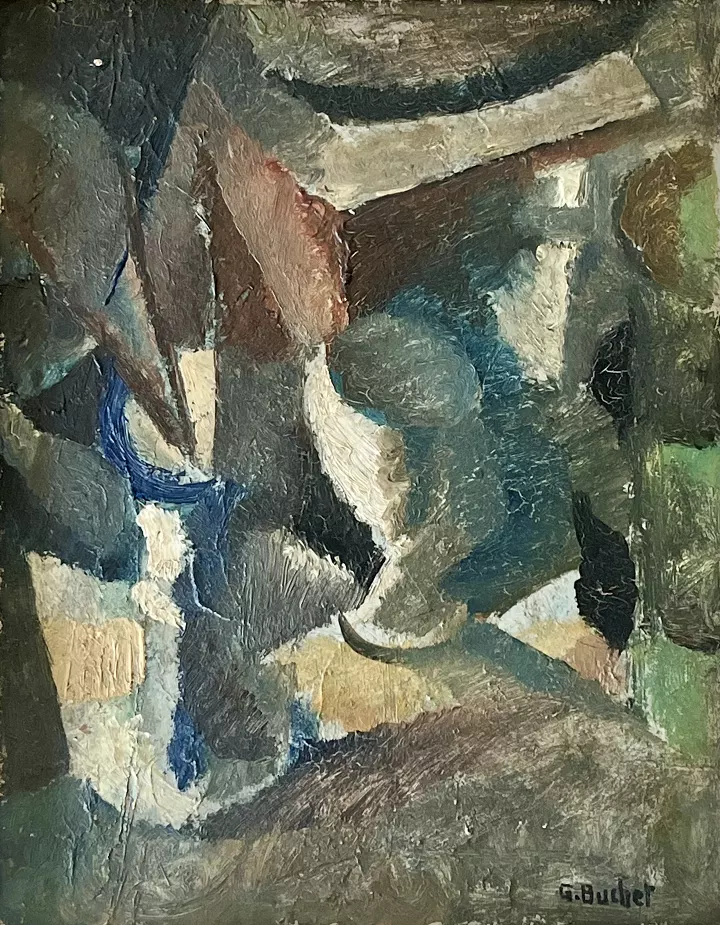
In this vertical format, the motif does not reveal itself immediately. It takes shape in fragments, through a network of planes that interlock, overlap and seem to slide against one another. A dark mass locks the left edge, while a long diagonal crosses the upper section and gives the whole a lateral thrust. At the centre, lighter forms open passages within this compact architecture; on the right, a blue-green field traversed by deep blacks restores a quieter balance.
A few clues momentarily sustain a figurative reading. A curve of cobalt blue may suggest the rim or handle of a vessel; cream-coloured planes hint at objects seen from several angles; a curved form near the lower centre seems to detach itself from a tray or table. These associations nevertheless remain unstable. As soon as they are perceived, things dissolve into the autonomous organisation of the painting. The eye thus moves continually from a possible still life to pure composition.
The palette is deliberately restrained. Coloured greys, earthy browns, muted greens and blacks form a grave foundation, enlivened by flashes of ivory, a brownish-pink note and several blue accents. The light does not come from any clearly defined natural source: it arises from the contrasts between the dark areas and the light fragments. These do not so much describe illumination as punctuate the surface, like breaths within a dense material.
The oil is worked in short, thick, directional strokes. The brush marks remain visible; certain areas have been reworked, scraped or modelled in relief, giving the cardboard an almost mural presence. This rough materiality tempers the rigour of the construction and introduces a perceptible vibration into each plane. The broad gilded frame and its light textile surround effectively isolate this concentration of forms, reinforcing its character as a pictorial object.
This tension between legibility and autonomy connects with the investigations pursued by Buchet in contact with the Section d’Or, post-Cubism and Purism. His painting subsequently moves towards more supple forms, in which earlier geometric experiments remain present without entirely subordinating colour. Without permitting a secure dating, this work appears precisely to combine the memory of Cubist dislocation with a more mature search for formal synthesis.
Swiss Art Gallery selection