Alice Bailly · 2 min read
Alice Bailly: when wool claims its place among the fine arts
In Geneva, during the First World War, Alice Bailly transforms wool and silk threads and metallic papers into paintings. With Les rythmiciennes, this technique, regarded as a craft, becomes a pictorial manifesto.
Published on September 25, 2026
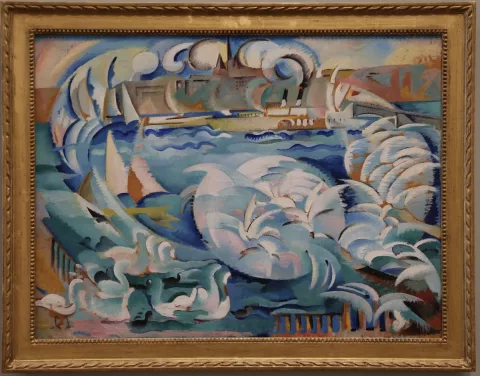
In 1916, in Geneva, Alice Bailly introduced an unexpected material into her painting: wool. The war had cut her off from Paris, where she had moved in avant-garde circles, while abstraction was still coolly received in French-speaking Switzerland. Yet she relinquished neither movement nor colour.
Her “wool paintings” were not conceived as decorative works. The multicoloured threads, arranged on a canvas, extended her explorations rooted in Fauvism, Cubism and Futurism. The first monograph devoted to the artist, published in 1918 by Albert Rheinwald, already championed this material as the equal of the media traditionally associated with the fine arts.
Created in 1918–1919, Les rythmiciennes offers a precise demonstration of this. Inspired by a performance by Lucienne Rouché and by the choreographies of Émile Jaques-Dalcroze, the work depicts dancers in full motion. Bailly reserves matt wool for the costumes and setting, uses lustrous silk for the arms and legs, then adds gold and silver papers to the leotard of the main figure. A few strokes of ink give structure to her face.
Between 1917 and 1923, Bailly produced around fifty wool paintings, to which she accorded the same status as her oil paintings. Long relegated to the realm of craft, these works are now recognised as major creations of Swiss modernism. The material that risked marginalising the painter thus became one of her most distinctive signatures.
Sources and context
- Musée cantonal des Beaux-Arts de Lausanne — Les rythmiciennes ↗
- Musée cantonal des Beaux-Arts de Lausanne — Alice Bailly, La fête étrange ↗
- Musée cantonal des Beaux-Arts de Lausanne — Rade de Genève ou Vol de mouettes ↗
- Kunsthaus Zürich — Alice Bailly, pionnière du modernisme ↗
- Musée d’Orsay — Notice Alice Bailly ↗