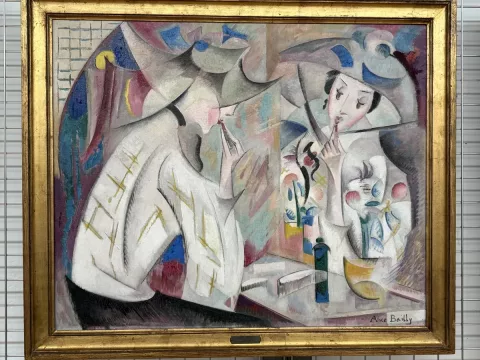
Alice Bailly · 5 min read
Alice Bailly: when war closes off Paris and sets the roadstead in motion
Stranded in Switzerland by the war of 1914, Alice Bailly loses access to her supporters in Paris. Yet with Rade de Genève ou Vol de mouettes, she transforms this enforced return into a pictorial manifesto.
Published on October 1, 2026
In mid-July 1914, Alice Bailly temporarily leaves Paris for Mézières, near Lausanne. She intends to prepare there for the next Salon d’Automne. In Paris, her commitment to the avant-garde is beginning to bear fruit: she associates with Guillaume Apollinaire, as well as Sonia and Robert Delaunay, and has established a place for herself in the Montparnasse art world. Her stay in the canton of Vaud was meant to be no more than a period of work. The outbreak of the First World War and the closure of the borders in early August abruptly change the situation.
As a Swiss citizen, Bailly cannot return to her studio and networks in Paris. She is forced to retreat to Geneva, where her position remains precarious. A year earlier, she had organised an exhibition of French Cubists in Lausanne and Geneva, before presenting her own works at the Musée Rath. The reception was hostile. Abstraction and Cubist experimentation find few defenders in French-speaking Switzerland at the time; the critic Paul Budry is among the rare supporters noted by the Musée cantonal des Beaux-Arts de Lausanne. Her return to Switzerland therefore offers nothing resembling secure professional refuge.
It is in this context that Bailly paints Rade de Genève ou Vol de mouettes in 1915. On the surface, the subject belongs to a firmly established tradition: the roadstead, the lake, the boats and, in the distance, the silhouette of the cathedral. Generations of painters have sought the balance of the Lake Geneva landscape in this panorama. Bailly retains the recognisable features of the place, observed from the right bank, but refuses to turn it into a peaceful view. She treats Geneva using the means developed through her contact with Fauvism, Cubism and Futurism.
The roadstead becomes a field of forces. The seagulls, clouds and smoke escaping from a boat’s funnel are swept into an elliptical rotation. The blues, pinks and whites do not merely describe the water or sky: they organise a rapid circulation across the canvas. Curving lines link the birds, vapours and lake in a single movement. Rather than fixing a panorama in place, Bailly constructs an image in which the eye cannot remain still.
This pictorial agitation acquires particular resonance in light of the circumstances. Deprived of Paris, the artist does not relinquish the modern language that had met with so much resistance in French-speaking Switzerland. She applies it to the most immediately Genevan of landscapes. Geographical constraint therefore does not produce a return to conventional painting. On the contrary, Rade de Genève ou Vol de mouettes asserts that a familiar motif can be entirely renewed through rhythm, colour and the fragmentation of forms. The painting is now held by the Musée cantonal des Beaux-Arts de Lausanne.
In the following years, however, the centre of gravity of her career shifts. Most of her Swiss admirers are then to be found on the other side of the River Sarine. In Winterthur, where collectors committed to modern art had helped establish a new museum in 1916, Bailly meets Werner Reinhart in 1918. This patron, closely connected to the city’s musical life, will support her until the end of her life. She also associates with Arthur and Hedy Hahnloser, who regularly welcome her to the Villa Flora between 1918 and 1920.
The contrast is clear. In Geneva, Bailly had been forced to find ways of continuing her work without her Parisian network; in Winterthur, she encounters collectors who naturally bring together modern painting and contemporary music. The concerts held in the garden of the Villa Flora notably inspire Le concert dans le jardin. The sketches are made in Winterthur, and the canvas is then executed in Paris after the artist’s return in 1920. Here again, curves carry the movement through the composition, this time around a piano quartet, while the multiplication of hands conveys the speed of the musical performance.
The closure of the borders had interrupted a Parisian career just as it was gaining visibility. Yet it led Bailly towards a new geography of support, extending between Geneva, Lausanne and Winterthur. Rade de Genève ou Vol de mouettes stands at this turning point: the place imposed by circumstance becomes the substance of a resolutely mobile painting. The war had taken her away from Paris; it did not immobilise her language.
Observing the work — In Rade de Genève ou Vol de mouettes, the cathedral and harbour still provide points of reference, but they no longer govern the composition. Attention is captured by the ring of smoke, birds and clouds that sweeps across the canvas. Bailly does not merely represent objects in motion: she organises the surface itself as movement. This shift from motif to rhythm explains the work’s singularity within the long history of views of Geneva.