Swiss Art Gallery selection · Piece swissart-0108
◆
La Neptune à Versoix
Reference swissart-0108


Swiss Art Gallery
The artwork in detail
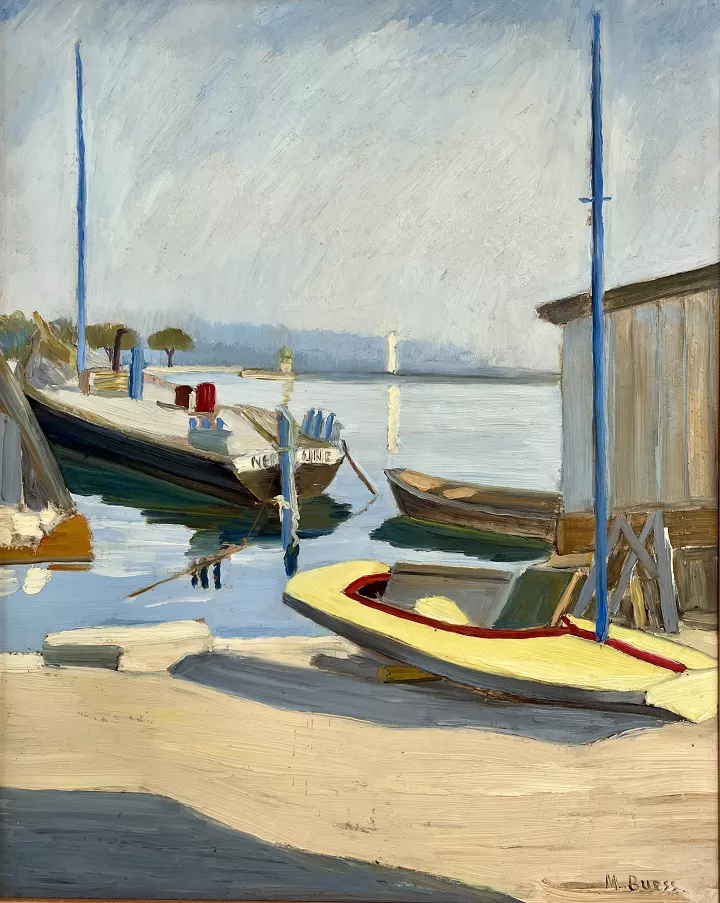
From a working quay, the gaze opens onto the harbor through a tangle of hulls, masts, and moorings. In the foreground, a yellow boat pulled ashore cuts obliquely across the scene; its red stripe and blue mast give this bright area an immediate tension. To the right, the vertical facade of a hangar constricts the space, while to the left, the dark mass of the Neptune advances diagonally towards the center. Between these volumes, a channel of light leads to the lake and the distant shore.
The construction relies on a very clear play of horizontals and verticals. The blue masts traverse almost the entire height of the panel, echoing the white line of the Jet d’eau placed in the distance. These verticals are met by the calm bands of the lake, the shore, and the sky. The boats, oriented in various directions, introduce more mobile rhythms: their brown, green, or yellow silhouettes stand out against the pale water, accompanied by dark reflections that anchor them in the basin.
The pictorial matter remains constantly perceptible. The sky is composed of broad passages of blue-gray, white, and cream, brushed obliquely, while the water unfolds in more horizontal strokes. The impastos catch the light on the hulls, the rigging, and the quay. A deliberately restricted palette — milky blues, grays, off-whites, deep greens, and earth tones — is enlivened by a few accents of red and by the bright yellow of the boat in the foreground. No figures appear, but the taut moorings, the closely positioned boats, and the objects arranged on the large boat maintain a diffuse human presence.
The Neptune and the Jet d’eau clearly fix the motif in the harbor of Geneva. Built in 1904 to transport, among other things, the stones and gravel needed for the city's construction sites, the large boat remained in service until 1968. However, it is not isolated here as a monument: it still belongs to the everyday life of the port, among the canoes, the rigging, and the working buildings.
Due to a lack of sufficiently reliable biographical data, the author's journey cannot yet be precisely reconstructed. This work nevertheless reveals, within the limits of this single painting, a painter attentive to the port motifs of Geneva, capable of ordering a complex space through a few clear axes and making the thick stroke the true agent of light and the presence of things.
Swiss Art Gallery selection