Paul Klee · 5 min read
A face constructed from geometric shapes
Senecio transforms a face into a meeting of circles, triangles and colours. In this 1922 painting held in Basel, apparent simplicity calls for a surprisingly precise gaze.
Published on October 3, 2026
A large face occupies almost the entire painting. We recognise eyes, a mouth and the top of a head, but these ordinary reference points appear within a construction of coloured surfaces. With Senecio, Paul Klee does not give us the satisfaction of a portrait whose model we could immediately identify. Instead, he lets us experience this threshold: at what moment does an arrangement of shapes begin to look at us? The question is easy to formulate, but the painting keeps it open far longer than its first appearance suggests.
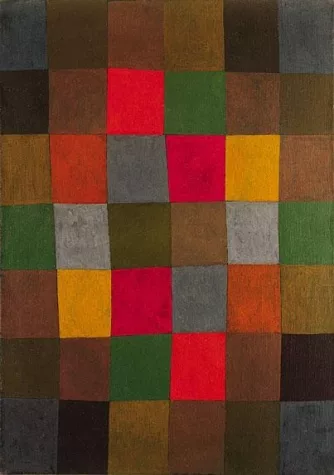
The work dates from 1922 and belongs to the Kunstmuseum Basel. The museum uses it, particularly in its educational activities, to explain what an abstract portrait can be. Its example brings together elementary geometric shapes, easy to name: circle, triangle, square. Yet an easy vocabulary does not guarantee an easy construction. It matters whether a boundary is oblique, whether a warm surface touches a paler colour or whether one eye sits slightly differently from the other. Each choice changes the face’s presence.
The outline of the head proposes a unity, while the interior divides it. This relationship allows two ways of looking. From a distance, we perceive a frontal figure; close up, we can follow joins and separations that do not correspond exactly to anatomy. Klee therefore does not erase the portrait entirely. He keeps it legible enough for us to recognise a being, then shifts the means of that recognition. Colours participate in identity as directly as the organs we think we distinguish.
The eyes are particularly useful for understanding this shift. Two marks in the upper part of the face are enough to establish contact, even when the modelling of the body has disappeared. We are very quick to recognise a gaze; the painting works with this disposition in the visitor. It becomes unnecessary to know what the person might think or whether they might be happy. No sooner have we decided on an expression than the arrangement of planes can modify it. The figure seems by turns attentive, distant or surprised, depending on the length of our observation.
This mobility must remain an experience of reading, not a diagnosis. A portrait with simplified forms proves nothing about the health, temperament or history of a model whom our story does not identify here. The appearance may awaken the idea of a mask or a theatrical presence, but these associations do not amount to catalogue information. Distinguishing them helps us enjoy their richness. The visitor can propose an association, then return to the surfaces actually present to see what gave rise to it and what still resists it.
The range of colours is also part of this presence. Warm tones construct a closeness that the schematic character of the forms might seem to contradict. A very legible geometry is not necessarily cold. It can produce warmth, tension or fragility, depending on the relationships it establishes. The gaze moves from a large area to a small mark and discovers that a detail can inflect the whole. The painting thus invites us to compare intensities rather than seek a convincing imitation of light on skin.
The educational use of Senecio does not reduce it to an exercise for beginners. It reveals a lasting quality: we can enter the painting with little knowledge and continue to find real difficulties in it. Naming a triangle is a first step; understanding why its position changes the face is another. An adult and a child can share this experience without looking at exactly the same thing. Klee offers accessible elements, then organises them in a way that makes our familiarity with portraiture less automatic and more conscious.
As we leave the image, the circle of the head remains in memory with remarkable clarity. Yet trying to reconstruct it mentally brings out the differences initially overlooked: an angle, a coloured division, the position of a small line. Simplicity was a doorway, not an absence of work. Senecio retains the power of a face precisely because Klee gives it other means of living. A few shapes are enough to make us feel a presence; their exact balance keeps that presence from becoming ordinary.