Alberto Giacometti · 5 min read
The walker who found his place in a courtyard
The large sculptures conceived for the Chase Manhattan Bank were not installed there. Walking Man continues its history at the Fondation Maeght, where Giacometti himself adjusted relationships between the bronzes and their surroundings.
Published on October 3, 2026
One foot is in front of the other, the body stretches and the arms follow a very simple direction. Alberto Giacometti’s Walking Man possesses an almost immediate legibility. Yet the gesture gives us neither destination nor story. The sculpture maintains a passage rather than showing its arrival. Before this thin body, visitors can feel fragility and strength in the same instant. The movement is clear enough to be recognised, open enough for our own movement around the work to renew its appearance continually.
The 1960 version belongs to a monumental exploration connected with a project for the Chase Manhattan Bank plaza in New York. The Fondation Maeght documents this origin and the fact that the project did not materialise on the intended site. An architectural commission therefore constitutes a real part of the history, even when its destination changes. The work was not born solely to become an isolated image. It was also meant to take its place in a public space, alongside other sculptures and buildings whose scale would have transformed the encounter with the body.
The step is the first means of this presence. The feet inscribe a direction on the base, while the torso retains a verticality. The figure is caught between these two movements. Visitors can follow the supposed route and observe that the sculpture cannot be reduced to a silhouette seen in profile. From the front or obliquely, other relationships become palpable: the torso’s thickness, the limbs’ position, the feet’s weight. The movement remains recognisable, but its obviousness consists of relationships that change as we ourselves change place.
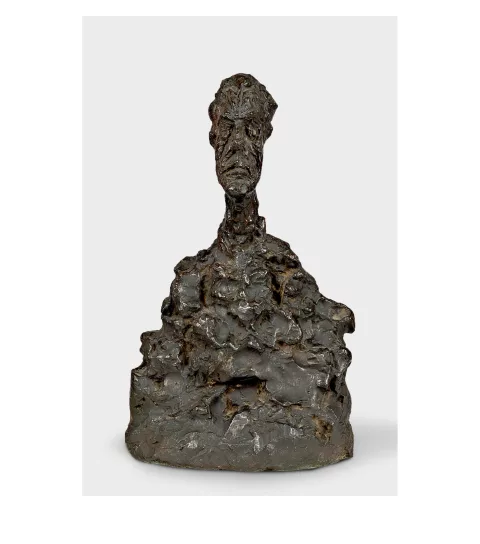
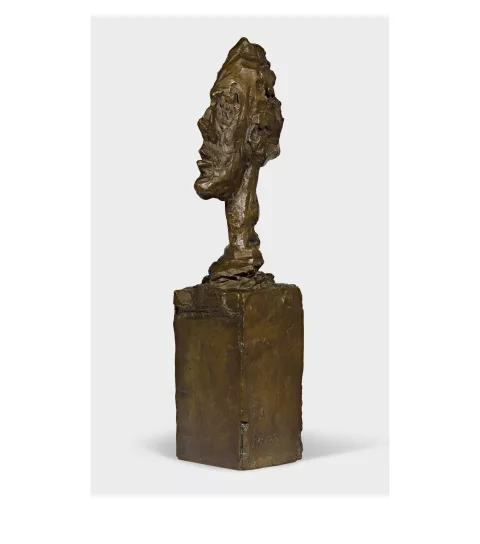
The surface retains an activity contrasting with the general simplicity. Irregularities catch the light and give the body a materiality difficult to summarise as a thin line. From afar, the work seems almost a sign; close up, it reveals a density of work. This alternation is part of its power. Visitors encounter not simply an idea of walking, but an object whose sculpted skin continues to act. The gesture is common, while the surface gives it a particular presence distinct from that of a smooth, ideal body.
In Saint-Paul-de-Vence, the Fondation Maeght offers the large figures another surrounding context. Adrien Maeght’s testimony describes Giacometti intervening in their installation and modifying their arrangement. The object’s place thus itself becomes an artist’s decision. A sculpture can retain its identity while changing its relationship with a neighbour, a tree or a building. This work is not simply tidying after the making. It participates in how visitors receive the distances, directions and group the works form in the courtyard.
The same testimony specifies that Giacometti painted some bronzes for their presence in the light and colours of the south. Bronze therefore does not impose a single surface effect. Its encounter with an environment can lead to a further intervention belonging to the work’s material history. This precision allows us to look at sculpture beyond a famous image. The thin figure does not travel in neutral space: it receives an air, colours and surroundings the artist actually examined before leaving them to other gazes.
The courtyard ensemble reactivates walking. A standing figure, a head or another walker can constitute a reference point in our own journey. Visitors seek relationships and discover that their wandering is not external to the experience. The sculptures do not begin to move; our movement makes their organisation appear. This encounter gives the unrealised New York project a second concrete destiny. Forms conceived for a plaza find a place where their directions continue to answer one another, in architecture and light different from those first envisaged.
By the end of the visit, Walking Man seems to have walked through its history too: from a commission that did not reach completion towards a courtyard where its author adjusted its place. This journey must not be confused with that of the character, who remains without a named destination. It nevertheless gives the sculpture a new depth. Giacometti created a presence recognisable at a glance and demanding enough to require a precise environment. In the Maeght courtyard, this body always in passage continues to give a human measure to our own movement.