Alberto Giacometti · 5 min read
Diego, always to be recognised anew
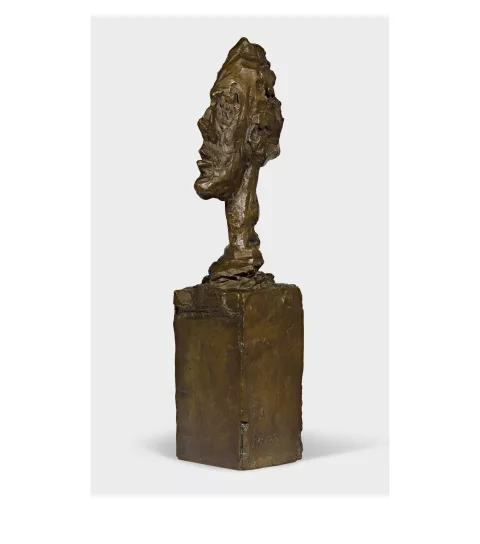
A Bust of Diego made around 1954 bears the first name of Giacometti’s brother. Yet his familiar presence does not end the exploration: volume obliges visitors to rediscover the face with every change of viewpoint.
Published on October 3, 2026
The title gives a first name even before we approach the face: Diego. A Bust of Diego by Alberto Giacometti therefore offers an encounter with someone identified, not an entirely anonymous head. Yet this familiarity does not make the appearance simple. Surface, proportions and depth invite us to change place to recognise again what we thought we had seen. The sculptor keeps the face at the centre of his work, but refuses to let a single view exhaust the presence of a model belonging to his closest circle.
The Fondation Giacometti database dates the creation of this Bust of Diego to around 1954; the listed bronze belongs to a private collection and was cast in 1980. Its database distinguishes this bust from other effigies of Diego, with specific dates, materials and formats. This precision is essential, because the first name recurs often. It does not designate a unique work repeated without changes. Diego was the artist’s brother and one of his regular models; he also played a role in his material work. Biographical proximity offers the sculpture a context, while the object retains an organisation we must look at for itself.
Seen from the front, a head can seem very concentrated. The gaze seeks eyes, nose and mouth, then discovers that the volume does not present them according to the conventions of a smooth portrait. Differences in relief attract light and give the surface its own activity. It becomes difficult to separate the model’s identity completely from how the material makes us receive it. The face is recognisable, but recognition calls for attention: recovering a presence amid the marks of work without treating them as mere defects to forget.
A step to the side changes the encounter. What seemed shallow can extend, a line becomes a volume and certain reference points move closer together or further apart. Visitors then understand that a bust does not simply offer an image to look at. It occupies a space shared with them and asks them to move. Every view is real, but none summarises the entire object. Diego’s face remains the same subject, while its form presents itself differently according to the place from which we approach it and the light accompanying it.
This experience makes portraiture more demanding than a simple check of resemblance. We could ask whether the nose or mouth corresponds to a photograph of the model, but that would not suffice to describe what the sculpture does. It constructs a presence with material, depth and scale. The brother’s familiarity takes nothing away from this problem. On the contrary, it helps explain why a close model can recur in the work: knowing a person does not automatically provide the solution to representing them, and a known face remains a visual encounter to be undertaken again.
Bronze also preserves the history of a process. Its surface bears forms originating in sculptural work and transmitted through casting. We need not pretend to reconstruct every studio gesture to understand this difference from an object carved directly from a block. The final material can retain marks of an earlier state, and those marks act within present light. The work therefore brings together several times: that of the model, that of making and that of our movement. The bust seems fixed, but its reception continues to change within these relationships.
Other effigies of Diego can illuminate this one without replacing it. Comparing a head, a bust or a painting reveals what each medium allows portraiture. The same person can receive several organisations and scales. The institutional file helps us preserve their differences instead of speaking of a general Diego without any precise materiality. The model’s repetition then becomes the history of an exploration. It is not the sign of a solution applied indefinitely, but the possibility of encountering again a difficulty previous work did not close definitively.
At the end of looking, the first name remains close and the face seems less easily possessed. We have learned to recover it by changing view, look at the surface and distinguish the object from a single reproduction. Giacometti gives his brother a presence within a modest format, but whose relationships with space remain active. The Bust of Diego thus tells of familiarity without ease: someone is known enough to return before the artist for a long time, and singular enough for each new form still to demand complete attention.