When a face also becomes a word
In Death and Fire, Klee combines painting, signs and letters. A late work from 1940 holds the question of ending within a face that can be looked at, but can also be read.
Read the story →A face can be built from a few shapes; a fish can sit at the centre of a network of signs. Paul Klee gives viewers images to read as well as to see. These stories examine identified works, their techniques and sources. The route explores how abstraction can remain connected to recognisable objects and the experience of drawing.
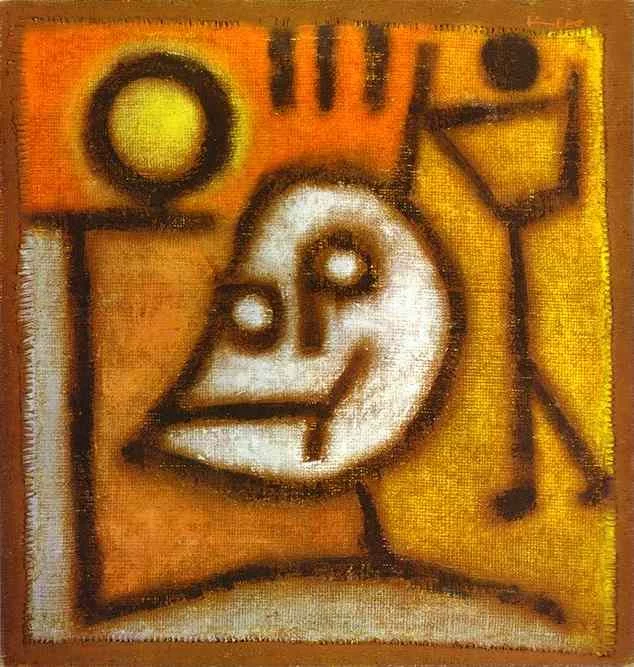 Illustration from a story
Paul Klee · Mort et Feu · Wikimedia Commons · Public domain
In Death and Fire, Klee combines painting, signs and letters. A late work from 1940 holds the question of ending within a face that can be looked at, but can also be read.
Read the story →Senecio transforms a face into a meeting of circles, triangles and colours. In this 1922 painting held in Basel, apparent simplicity calls for a surprisingly precise gaze.
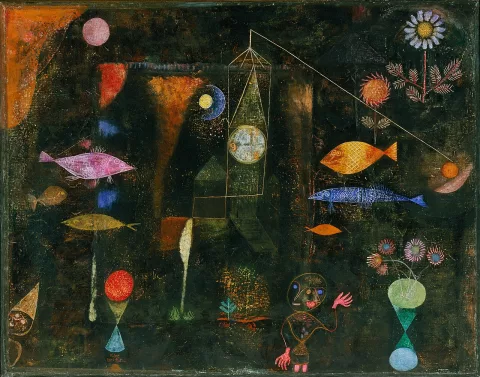
Read the story →Around the Fish, painted in 1926, retains the appearance of a still life and opens it to an array of signs. Its journey from Berlin to New York gives this enigmatic scene a second history.
Read the story →New Harmony, painted in 1936, distributes colour within a geometric construction. Klee lets the relationships between surfaces become the true subject of the painting held at the Guggenheim.
Read the story →