Sophie Taeuber-Arp · 3 min read
Sophie Taeuber-Arp: Three Performances to Enter History
In Zurich in 1918, Sophie Taeuber-Arp transformed an Italian fairy play into geometric theatre. The Spanish flu and the management’s scepticism limited the play to three performances, but heads and marionettes were soon presented in an exhibition and featured in a Dadaist publication.
Published on September 17, 2026
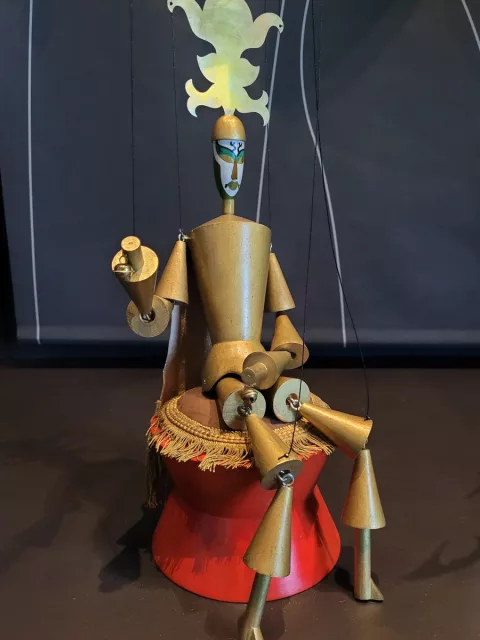
Zurich, 1918. On Bellevueplatz, a marionette theatre is built for the Werkbund exhibition. Alfred Altherr, director of the museum and the School of Applied Arts, commissions Sophie Taeuber to design the marionettes and scenery for a play by Carlo Gozzi, The Stag King. The artist departs from the realist tradition: she constructs wooden bodies from cubes, spheres and other geometric volumes. Seventeen marionettes are created for the performance.
The text, too, shifts eras. René Morax and Werner Wolff update the eighteenth-century Italian fairy play and turn it into a parody of psychoanalysis. The magician becomes Freudanalytikus, accompanied by a small parrot, while Dr. Komplex alludes to Carl Gustav Jung. Modern satire thus takes the form of creatures suspended from strings.
The attachments do not follow traditional construction methods. Fastened near the ends of the limbs rather than at the joints, the strings give the figures jerky movements. The geometric bodies make no attempt to conceal their construction. On most of the faces, the preliminary pencil lines remain visible beneath the paint. Fabrics, beads, artificial flowers and feathers complete some of the figures. King Deramo, Angela and the stag share golden eyes, a correspondence that emphasises their relationship through colour and form.
The play premieres in Zurich in September 1918. The organisers, however, consider the marionettes too modern. The management’s scepticism and the spread of the Spanish flu lead to the theatre’s closure: The Stag King is performed only three times. The experiment seems destined to remain ephemeral, but the artists and writers associated with the Dada movement soon acclaim the marionettes.
In 1919, Taeuber presents heads and marionettes at the Kunsthaus Zürich in the exhibition Das Neue Leben. Works of this kind are subsequently featured in Der Zeltweg, the last Dada journal published in Zurich. The sources do not make it possible to assert that all seventeen marionettes were exhibited or reproduced. A photograph by Ernst Linck nevertheless shows Sophie Taeuber and Jean Arp among several figures from The Stag King. After the performance’s rapid disappearance, these traces help inscribe the project in the history of the avant-garde.
Observational commentary — This episode reveals an essential continuity in Taeuber-Arp’s work. Textiles, scenery, dance and sculpture are not arranged according to a hierarchy: they work together. Abstraction is no longer merely a composition to be viewed; it has joints, wears fabrics and moves before an audience. The interruption of the performances thus produces an unexpected reversal: a spectacle that disappeared almost as soon as it emerged leaves behind figures, photographs and publications that perpetuate its memory.
Sources and context
- Kunsthaus Zürich, Sophie Taeuber et Jean Arp avec des marionnettes pour Le Roi Cerf ↗
- Museum of Modern Art, Deramo, The King, marionette for King Stag ↗
- Museum of Modern Art, The making of the marionettes ↗
- SIK-ISEA, Sophie Taeuber-Arp, catalogue raisonné ↗
- Museum of Modern Art, Sophie Taeuber-Arp ↗
- Centre Pompidou, notice de Sophie Taeuber-Arp ↗
- Centre Pompidou, Les enquêtes : Sophie Taeuber-Arp, épisode 4, transcription ↗
- Kunsthaus Zürich, Sophie Taeuber, Rythmes libres ↗
- Centre Pompidou, Sophie Taeuber-Arp, pionnière de l’art abstrait ↗