Sophie Taeuber-Arp · 4 min read
Sophie Taeuber-Arp: the three performances of King Stag
In September 1918, Sophie Taeuber-Arp transformed an Italian fairy play into geometric theatre. Her seventeen marionettes delighted circles close to Dada, but the management’s scepticism and the Spanish flu limited the play to three performances.
Published on September 27, 2026
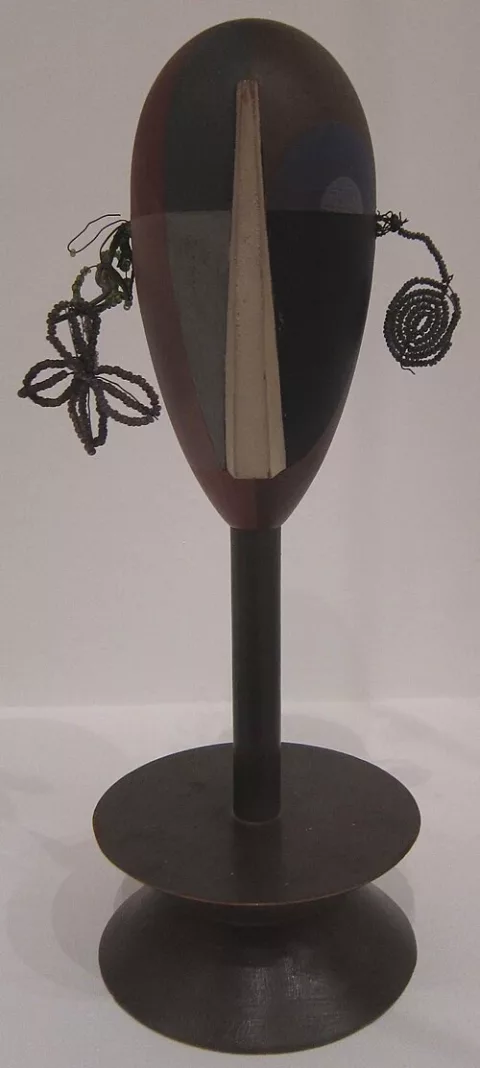
In September 1918, an articulated wooden king took to the stage in Zurich. His name was Deramo, and he could transform himself into a stag. Around him moved characters composed of geometric volumes, sometimes embellished with fabric, metal, feathers or beads. Nothing in these angular bodies sought to conceal how they were made. The premiere of King Stag revealed seventeen marionettes created by Sophie Taeuber, who had been born in Switzerland twenty-nine years earlier. The artist did not merely dress up an old tale: she brought abstraction onto the theatre stage.
The commission came from Alfred Altherr, director of the Zurich School and Museum of Applied Arts. Taeuber had taught textile design, embroidery and weaving at this institution since 1916. For the Swiss Werkbund exhibition, Altherr had a marionette theatre built on Bellevueplatz and commissioned the artist, among others, to design the figures and scenery for an adaptation of König Hirsch, an eighteenth-century play by Carlo Gozzi inspired by commedia dell’arte.
René Morax and Werner Wolff updated the fairy play as a parody of psychoanalysis. The magician in the play became Freudanalytikus, accompanied by a small parrot that served as his alter ego, while Dr Komplex alluded to Carl Gustav Jung. The fairy tale was thus transformed into contemporary satire in the city where the Dada movement had developed during the war. Taeuber knew this milieu: close to Jean Arp since they met in 1915, she took part in Dadaist activities, notably through dance, while continuing to teach at an official institution.
Her marionettes broke with the naturalistic traditions of the genre. Rather than imitating living bodies and concealing their mechanisms, they displayed their turned volumes, fastenings and joints. Strings connected to small eyelets were attached towards the ends of the limbs rather than at the joints, producing jerky movements. Geometry also expressed the relationships between the characters: Deramo, Angela and the stag into which the king transformed notably shared golden eyes. Forms and colours thus made the connections within the plot visible without resorting to realism.
This formal freedom did not preclude meticulous execution. The facial features were first drawn in pencil, then painted with precision; some preparatory lines remain visible. Depending on the figure, the turned wooden pieces were supplemented with fabric, sheets of brass, metal elements, sewn-on beads, artificial flowers and feathers. These assemblages brought together several of Taeuber’s practices: drawing, painting, textile work, sculpture and the design of objects in motion.
The scenery and characters were particularly appreciated by artists, writers and connoisseurs close to Dada. This enthusiasm did not, however, amount to a generally favourable reception: the organisers considered the marionettes too modern, while the management remained sceptical. The spread of the Spanish flu also led to the theatre’s closure. King Stag was ultimately performed only three times, and the sources consulted do not make it possible to determine whether these performances took place on three separate evenings.
In 1919, Taeuber presented heads and marionettes in the exhibition Das Neue Leben at the Kunsthaus Zürich. They were subsequently reproduced in Der Zeltweg, Zurich’s last Dadaist journal, and circulated in avant-garde publications. The stage had barely had time to accommodate them; photography and print prolonged their presence. The explorations undertaken for King Stag have also been linked to the abstract sculptures in turned wood now known as Dada Heads.
Commentary — The fate of King Stag lies in this reversal: a production limited to three performances became an enduring work through the objects that were intended to serve its staging. The strings, eyelets and jerky movements were not imperfections to be concealed, but the visible elements of a new language. By giving geometric form to metamorphosis, satire and movement, Sophie Taeuber-Arp conceived far more than mere props. The flu closed the theatre; her marionettes continued their journey through the history of modern art.
Sources and context
- Kunsthaus Zürich, « Sophie Taeuber et Jean Arp avec des marionnettes pour König Hirsch » ↗
- Museum of Modern Art, « Sophie Taeuber-Arp. Deramo, The King (marionette for King Stag). 1918 » ↗
- Museum of Modern Art, « Sophie Taeuber-Arp. The making of the marionettes » ↗
- Museum of Modern Art, « Sophie Taeuber-Arp » ↗
- SIK-ISEA, « Sophie Taeuber-Arp. Catalogue raisonné » ↗
- Centre Pompidou, « Sophie Taeuber-Arp, l’audace d’être libre » ↗
- Centre Pompidou, « Sophie Taeuber-Arp » ↗
- Museum of Modern Art, catalogue « Sophie Taeuber-Arp » ↗
- SIK-ISEA, « Sophie Taeuber-Arp. Catalogue raisonné » ↗