Giovanni Segantini · 5 min read
The tree that ceases to be a simple landscape
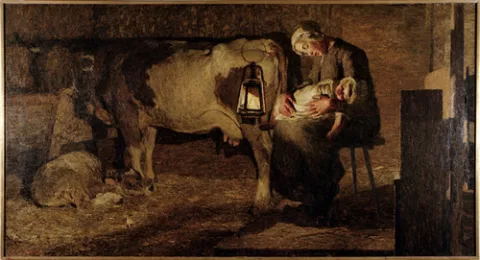
In The Evil Mothers of 1894, Segantini brings human figures into an unsettling winter landscape. The Belvedere has related this work to the history of trees in art, revealing the strength of the motif carrying the scene.
Published on October 3, 2026
A tree stands in the cold, but its branches do not merely constitute a landscape form. Giovanni Segantini’s The Evil Mothers brings together vegetation, human figures and a winter expanse in a situation that cannot be read as an ordinary event. Visitors recognise familiar elements, then their relationship unsettles them. The tree can support, restrain or threaten, depending on how the gaze receives it. The landscape becomes a symbolic scene without losing the very concrete means making its cold and distances palpable.
The Belvedere in Vienna holds this 1894 painting. The museum presented it in the exhibition GROW, devoted to the tree in art, in 2022–2023. This association gives the painting a fruitful entrance: beginning with what might seem its setting. The vegetation does not simply accompany the figures. It participates in the situation and its uneasy character. A single motif can therefore pass from landscape observation to constructing a symbolic scope. Segantini does not need to remove the tree from nature to make it one of the image’s major actors.
The branches possess directions very different from those of a body. They divide, return and occupy the air with angles that seem to resist human suppleness. The figures’ encounter with this structure makes the scene particularly striking. Visitors can follow a limb, then observe a branch continuing or thwarting its direction. This proximity conveys a dependence. We do not see characters simply installed before a background; we see material relationships giving the symbol a presence concrete enough to exceed the effect of a title alone.
Winter contributes to this presence. The large cold areas and bare elements reduce the signs of welcome a verdant landscape might have offered. The figures appear in an environment where the withdrawal of vegetation and the light expanse give space a particular hardness. This sensation comes from the composition. It does not prove that the artist represented a place observed exactly under these conditions. Painting has the power to bring natural means together within a constructed scene, capable of making an idea palpable through relationships of bodies, materials and distances.
The title pronounces a moral judgement. It belongs to the work and its history, but repeating it without examination as a truth about women would lose some of the necessary distance. Visitors can look at how a culture gave form to a theme of motherhood and fault while refusing to take this construction as a timeless rule. Documentary precision helps here: the painting is an object of 1894, with its own invention and references. The represented bodies do not become evidence of actual conduct directly accessible to us.
The reading proposed by the Belvedere emphasises the tree as a projection of punitive eternity. This interpretation illuminates the scene’s character, but we can also observe how the image resists an overly rapid translation. A branch possesses a curve, an expanse a rhythm and a figure a presence. Naming them solely through a meaning would forget their visible relationships. The painting touches us because it makes a situation experienceable. The symbol remains linked to a landscape retaining its expanse, a body retaining its weight and a gaze obliged to travel through their relationships.
The framework of the GROW exhibition allows comparison of this function of the tree with other uses: a sign of knowledge, a protective presence or an object of ecological attention. The variety of associations shows that the motif does not possess a single meaning throughout art history. Segantini gives it a particular organisation here, which we can recognise without imposing it on every other image of vegetation. An exhibition thus becomes a means of learning to distinguish. The same natural element can carry very different experiences depending on the figures, titles and spaces with which it is brought together.
Returning to the tree, the scene seems more precise and less simply mysterious. We do not know everything, but can follow the directions producing unease and observe each relationship’s role. The Evil Mothers gives the landscape a charge that does not turn it into a mere setting for a story. Cold, branches and figures make the experience together. The recent history of its presentation at the Belvedere helps us recover this construction: looking at a painted tree, then understanding that its place and extensions can change everything a scene makes us feel.