François Diday · 5 min read
A glacier reserved for Lausanne
In 1841, Diday shows a Bernese Oberland glacier in Paris. The canton of Vaud reserves this large canvas for its museum. A Swiss landscape thus makes a public journey from the Salon's stage to Lausanne's viewers.
Published on October 3, 2026
The glacier arrives in Lausanne by way of Paris. In 1841, François Diday presents a large view of the Bernese Oberland at the Salon. The canton of Vaud reserves it for its museum, and the acquisition is recorded in 1842. This journey gives The Rosenlaui Glacier a history different from that of a simple hiking memory. Mountains observed by a painter become a composition exhibited in a capital, then a work selected for public preservation. What viewers encounter today has already changed place and function several times.
The canvas measures two metres high by two metres fifty-nine wide. Its scale allows the landscape to occupy a large part of our field of vision. The title under which Diday shows it at the Salon mentions a view of the Rosenland glacier in the canton of Bern. The museum today identifies it as The Rosenlaui Glacier. This change of wording adds no geographical puzzle: it chiefly reminds us that a work circulates with titles and entries presenting it to different publics before joining a lasting collection.
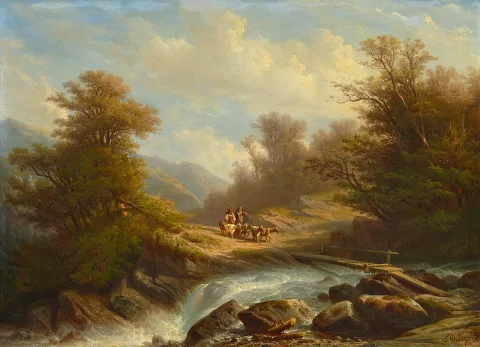
Looking at the work — In the MCBA reproduction, the central landform rises like a dark point amid the clouds. A snowy area appears on the left between cliffs and trees. Fir trees punctuate the planes, while a pale torrent opens at the bottom of the composition. Nearby rocks and trunks receive marked contrasts. Our gaze progresses from foam and foreground masses towards the peaks. The snow is luminous, but remains caught within an ensemble where areas of shade retain considerable weight.
Diday learnt his craft in Geneva, then in Antoine-Jean Gros's Paris studio. The Fondation Custodia also recalls his practice of oil studies in Italy and Swiss landscapes. The large painting should therefore not be confused with a canvas carried in this form all the way to the glacier. The MCBA describes studio work nourished by studies made directly from the subject. Observation supplies forms; composition gives them a relationship. The immensity that impresses us may have been prepared through much smaller painted objects, easier to revisit.
This passage between scales can be felt in the image. A nearby tree provides a measure for the mountain, then another, further away, extends the distance. The torrent gives one direction; the clouds open others. At each stage, a partly illuminated form reveals what shade tends to absorb. We can read this construction as a journey without supposing an actual path the painter or viewer might have followed. The canvas organises an approach to the mountains within the very limits of its surface.
At the Salon, this type of landscape responds to interest in the characteristics of foreign national schools. The MCBA entry places Diday's success in this context and recalls that Louis-Philippe had purchased another view of the Bernese Oberland the previous year. The canton of Vaud's choice thus belongs to a moment when the artist's landscapes attract attention beyond Switzerland. A mountain painting can then represent a territory while addressing viewers who know it chiefly through images and reputation.
Public acquisition subsequently changes this relationship. The canvas is preserved to be encountered again, not merely appreciated for the duration of a Salon. Viewers can return, look more at forest than ice or follow a direction different from their first encounter. The painting's effect does not end when it obtains a destination. Its institutional history gives it a new duration, during which a Romantic composition can also become a document of earlier ways of representing force and distance.
Leaving The Rosenlaui Glacier, we readily remember mountains and flowing water. Yet their history reveals a second, much quieter circulation: that of the canvas itself. From studies to large format, from the Salon to a cantonal reservation, then to the Lausanne collection, the landscape was constructed and transmitted. Painting places us before powerful nature, but reaches us through a series of human choices. The glacier reserved for Lausanne thus preserves two movements: that of painted waters and that of a work people decided to keep.