François Bocion · 5 min read
When the lake takes first place
In 1885, Bocion keeps the boats, nets and fishermen but gives them less space. A small elongated canvas tells of this shift: on Lake Geneva's French shore, light becomes the true thread guiding the eye.
Published on October 3, 2026
Featured on October 12, 2026
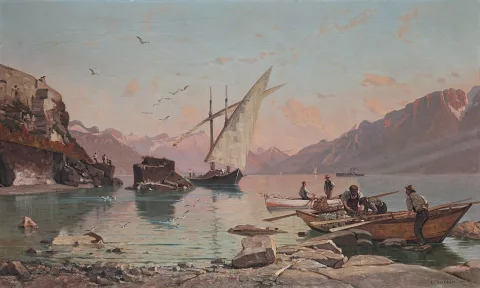
There is indeed a fisherman in Lake and Fishermen. He is even close enough for us to follow his silhouette along the shore. Yet François Bocion's painting seems to begin elsewhere: in the broad expanse of pale water, the open sky and the distant mountains crossed by clouds. The title keeps people beside the lake; the image conveys a change in their relationship. In 1885, familiar activities on the shore become landmarks in a landscape expanding around them.
The MCBA places this work at a time when Bocion gradually gives greater importance to the landscape itself. The museum suggests identifying a beach at Tourronde, near Évian, on Lake Geneva's French shore. The mountains and archival documents support this hypothesis without turning it into absolute certainty. The artist regularly worked on this side of the lake. The national border therefore does not fully describe his painting territory: his motifs are spread between shores sharing the water and exchanging their horizons.
Looking at the work — In the MCBA reproduction, the shore forms a curve running from the bottom right towards the centre. Two dark boats occupy the water on the left. A standing figure appears near the curve, while nets and trees close off the right edge. Elsewhere, everything opens out. The sky takes up about half the image; the lake's blue extends towards a chain of pale mountains. The composition leads into the distance without erasing the few nearby objects.
This openness also owes something to the format: thirty-four and a half centimetres high by sixty wide. Bocion does not need a large painting to suggest an expanse. He organises distances within a space viewers can easily take in. The boats act as dark points and the nets as a lateral boundary. Between them, the water offers a less occupied area. We can let our gaze linger there, then rise towards the mountains. The small elongated format gives the journey a duration that its measurements did not suggest.
The museum entry draws attention to the paint itself: in the water, horizontal brushstrokes sometimes leave the preparatory drawing, and even the canvas, visible. The shore receives a thicker treatment. We should not confuse this freedom with careless work. It allows the painter to distinguish surfaces. Nearby ground resists, more distant water spreads out, a mountain becomes light. The painting thus does not use the same density for everything it shows, and this difference creates part of its calm.
Bocion's career helps us understand this attention without reducing the scene to a manifesto. Trained in Paris and then established in Lausanne, he produced many views of Lake Geneva throughout a long career as teacher and painter. The Musée Jenisch recalls the role of outdoor painting in his work. The Historical Dictionary of Switzerland also emphasises small brushstrokes and the lightening of his palette. These references invite us to follow a method of looking: return to the motif, observe what changes and let colour convey a particular light.
We might want to narrate the fisherman's action. The image does not offer enough evidence to assign him a precise intention. It does, however, show his size relative to the water, his position and his contrast with the boats. That is already a visual story. The figures establish a scale, but they no longer command the whole painting. Our gaze moves away from them easily and can also return. This circulation holds together two experiences of Lake Geneva: a place where people work and an expanse where light changes distances.
Entering the collection in 1949, the canvas preserves this slight shift without any spectacular effect. Nothing announces an abrupt break. Fishing, vessels and nets remain present; they simply leave more air around them. At the journey's end, the standing figure seems less alone because he belongs to the whole the eye has just explored. Bocion has not emptied the lake of its everyday life. He has given it enough space for water and sky, too, to become events.