Ferdinand Hodler · 5 min read
A great painting prepared down to the fingers
View into Infinity grows out of a monumental commission and numerous studies. A hand painted on paper lets us approach the precise work supporting the figures’ grand deployment.
Published on October 3, 2026
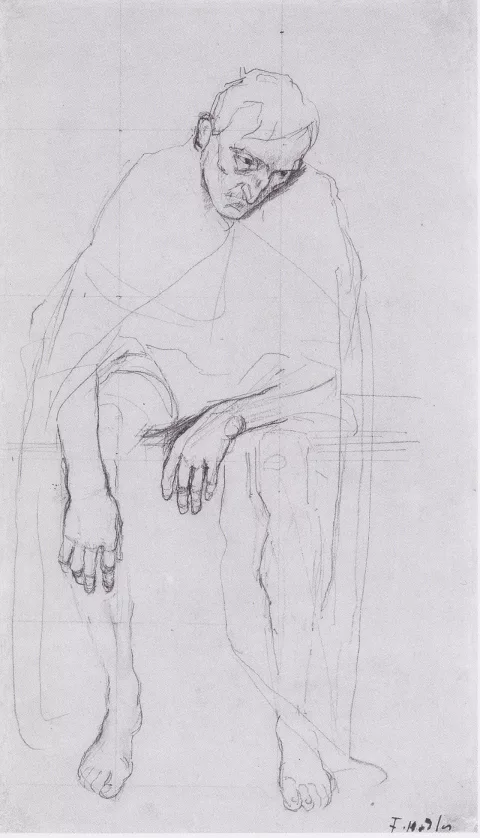
On a sheet, a few fingers spread out, and colour gives the flesh orange or purplish passages. Before a hand study by Ferdinand Hodler, infinity seems very far away. Yet it is present in the title of the project to which this fragment belongs: View into Infinity. There is something surprising about the encounter. A monumental painting, seemingly offering a great collective movement at once, also rests on the investigation of a joint, an interval between two fingers and a position sufficiently exact to support the whole.
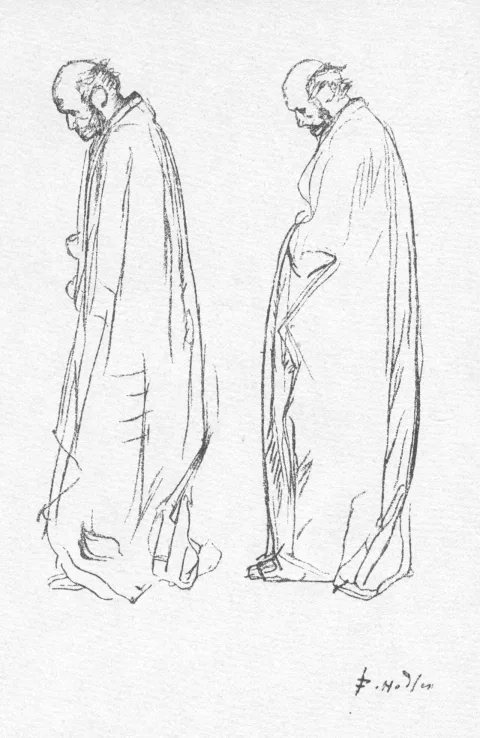
The Musée Jenisch holds several studies related to this work, including a hand study and explorations of figure or composition. The large project forms part of a commission intended for the Kunsthaus Zurich. The museum in Winterthur, which owns a version of View into Infinity, recalls this context and relates it to the principle of parallelism developed by Hodler. The story therefore does not begin with a finished image suddenly landing in a museum. It passes through a building, an intended function and a group of preparatory works that move the composition between several scales.
The hand study offers a particularly intimate entrance into this work. The drawing defines the joints, and reworkings in paint bring the surfaces to life. A hand already possesses several directions; it can extend the arm, interrupt its movement or open an interval in space. In a composition where figures answer one another, this local decision acts beyond its small format. The eye can follow a gesture to the fingers, then move towards the neighbouring body. Anatomical precision thus becomes a question of rhythm, not simply an exercise in resemblance.
The studies preserved in the museum must not be taken as successive photographs of the entire making process. They are distinct objects, with their own materials, formats and functions. Some isolate a detail; others propose a more general arrangement. Bringing them together helps us understand the number of problems to solve, without claiming that every decision is now documented. This caution makes the file more interesting: we can recognise methodical work while leaving unresolved those stages whose precise order cannot be reconstructed from the available documents.
Before the large composition, the repetition of figures produces a unity that is not merely the duplication of a model. The visitor can follow gestures, variations in posture and relationships between outlines. The idea of parallelism then becomes a visible experience. Related elements answer one another without becoming interchangeable. The separately studied hand returns to its place in this continuity, but retains its local power: a difference in position can open or close a passage in the visual chain the whole invites us to follow.
The title proposes a spiritual or symbolic scope, but is not enough to turn the studies into evidence of an individual belief. We can feel an opening, an attention directed beyond the scene or a shared harmony. These readings belong to the experience of painting and its history of reception. The hand study usefully reminds us that this breadth is constructed through concrete means. The infinity of the title does not excuse the artist from solving the body’s difficulties: it gives him a problem the forms must carry, even on a very large scale.
The different versions also show that a composition can continue to work after its initial state. A format, a destination or a set of proportions demands adaptations. It would be misleading to present all images entitled View into Infinity as a single object that travelled without changing. The museums distinguish studies and versions, and these distinctions become an aid to the visitor. They allow us to compare what persists: an organisation of gestures, a relationship between figures and a shared ambition to give the group a unified presence.
At the end of the journey, the fingers painted on the small sheet acquire a new grandeur. They are no longer a secondary detail of a famous masterpiece; they constitute a place where part of its movement is decided. Returning from the monumental composition to the study, then setting off in the other direction, lets us feel Hodler’s craft without inventing a studio scene for him. The story of View into Infinity also resides in this change of scale: a vast idea seeks its form, and a hand becomes one of the precise places where that search takes shape.