Ferdinand Hodler · 5 min read
Souls brought together without consolation
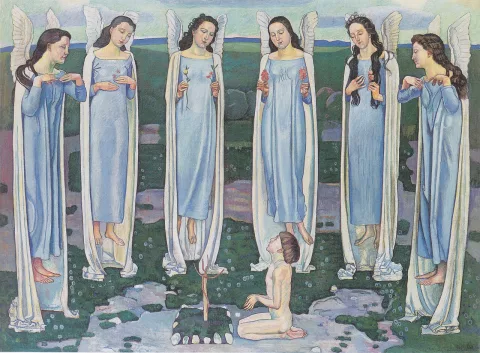
The Disappointed Souls presents a group of old men whose attitudes answer one another. This 1892 painting, acquired in Bern in 1901, makes the proximity of bodies an experience without an easy solution.
Published on October 3, 2026
Men sit side by side, each with his own weight, clothing and attitude. The Disappointed Souls might seem to bring together the characters of a story from which the painting preserved a single moment. Yet Ferdinand Hodler gives us very few means of reconstructing that episode. The figures share a space, but their proximity does not become a visible conversation. The visitor finds both a group and isolated presences at once. It is this coexistence, rather than the search for an absent event, that gives the scene its strength.
The painting is dated 1892 in the Kunstmuseum Bern’s inventories. It entered the museum in 1901 with Night, Day and Eurhythmy. A shared acquisition establishes a public ensemble; it does not turn these works into undifferentiated variants. Here, the seated bodies and frontality propose a different mode of presence from walking. The title names souls and disappointment. The painting itself must make this scope palpable through concrete means: the arrangement of figures, the inclination of heads, outlines and intervals.
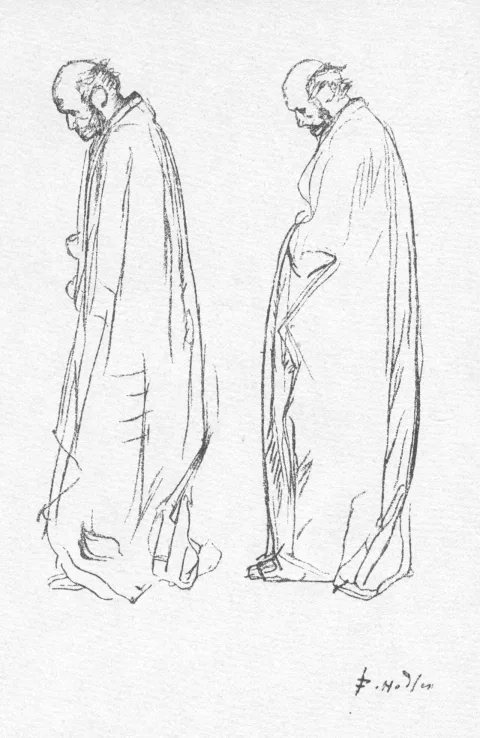
The repetition of silhouettes offers an initial order. The gaze can move from left to right, find a related posture and observe a variation. None of these figures simply becomes the copy of its neighbour. The group possesses coherence, but it is not a mechanical addition. Differences preserve the painting’s human character. We can feel fatigue or withdrawal as we follow a body, then recover a more general impression when we take sufficient distance to see the entire row and its organisation.
The spaces between the men matter in this experience. Physical proximity does not guarantee the emotional relationship we might be tempted to imagine. The painting can convey a shared condition without showing the gesture that would relieve one of them. The visitor must then inhabit a waiting without an answer. This arrangement is not a narrative defect; it constitutes a painting decision. Hodler removes the actions that would have directed the scene towards a resolution and lets the attitudes carry what a developed story might have resolved too easily.
The comparison with The Weary of Life, held in Munich, helps measure this exploration. The Neue Pinakothek’s entry emphasises the affinities of frontality and parallelism between the two works. It is important to keep their identities distinct, even if they belong to the same reflection. One title is not the other, and one group does not have exactly the same attitudes as its neighbour. Comparing does not mean merging. Differences instead become a way to approach Hodler’s decisions and the variety of forms a great question can receive.
Before The Disappointed Souls, the temptation to give each face a story is strong. It must remain aware of its limits. We do not have five attested biographies to tell here, nor the words of a dialogue the scene would allow us to reconstruct. Emotion arises from what is visible and the accompanying title. We can describe it without claiming to know the characters’ past. This restraint leaves more room for the work: it preserves its shared scope instead of reducing it to individual causes imagined after the event.
Symbolist painting finds a particularly demanding means in this simplicity. A great idea could be supported by accessories or a mythological scene; here Hodler prefers bodies and their relationships. The visitor does not need to recognise a legendary figure to enter the image. They must observe an inclination, an interval, an immobility. The more ordinary these means seem, the more decisive their arrangement becomes. They sustain the gravity of the whole and prevent the painting from being merely an inventory of figures.
Leaving the scene, the row may remain in memory as a single presence. Returning to the men allows us to observe all the differences that unity contains. The Disappointed Souls offers no consolation added at the last moment, but an attention: taking the time to look at bodies whose withdrawal might make them easy to avoid. The work’s public history brought it into a museum where visitors continue this encounter. The group’s immobility remains, while every gaze gives it duration, proximity and weight anew.