Ernest Biéler · 4 min read
Ernest Biéler: the painting acquired before his Paris exhibitions
Acquired for the Musée cantonal des Beaux-Arts de Lausanne in 1886, a painting more than three metres wide remains temporarily with Ernest Biéler so that it can be shown at the 1887 Salon de Paris and then at the 1889 Exposition Universelle.
Published on October 3, 2026
In 1886, the Musée cantonal des Beaux-Arts de Lausanne acquired In Front of the Church of Saint-Germain in Savièse, an oil on canvas measuring 204 × 302 centimetres. The painting did not, however, immediately enter the Museum: Ernest Biéler was allowed to keep it in order to present it in Paris, first at the 1887 Salon and then at the 1889 Exposition Universelle.
The story of the work begins in Savièse. Based in Paris in the early 1880s, Biéler was then making occasional stays in Switzerland. He discovered the Valais village during the summer of 1884. Captivated by its customs, costumes, light and clear air, he returned in the autumn to make several sketches for this ambitious composition.
The following summer, Biéler had a large stretcher transported to the site. He then completed the painting in his Paris studio. Eugène Ruffy, a State Councillor from Vaud, noticed the work and acquired it for the Museum in 1886. The sources do not give the precise date of this transaction and therefore do not make it possible to establish whether the artist was then twenty-two or twenty-three years old.
Institutional context — The MCBA entry relates the painting to the interest that many painters around the turn of the century took in rural life and religious practices, perceived as signs of a world that was disappearing. It considers that Biéler gives the scene a universalising scope: rather than depicting a precisely identified rite, he represents women gathered in front of a church, some following Mass from outside, others reading their missals or tending to a child.
After its acquisition, the painting remained with Biéler for some time as it followed a documented exhibition itinerary. It was shown at the Salon de Paris in 1887 and then at the 1889 Exposition Universelle. The Collection Pictet describes it as the artist’s first masterpiece and states that it attracted considerable attention at the latter event. The sources consulted specify neither the date of its physical return to the Museum nor its whereabouts after 1889.
Commentary — The scale of the canvas gives this village scene an imposing presence. Without equating its dimensions with those traditionally reserved for history painting, it can be observed that the tight framing monumentalises the figures. The MCBA also highlights the effects of light, the bluish shadows and the broad brushstrokes that reflect lessons learned from the Impressionists.
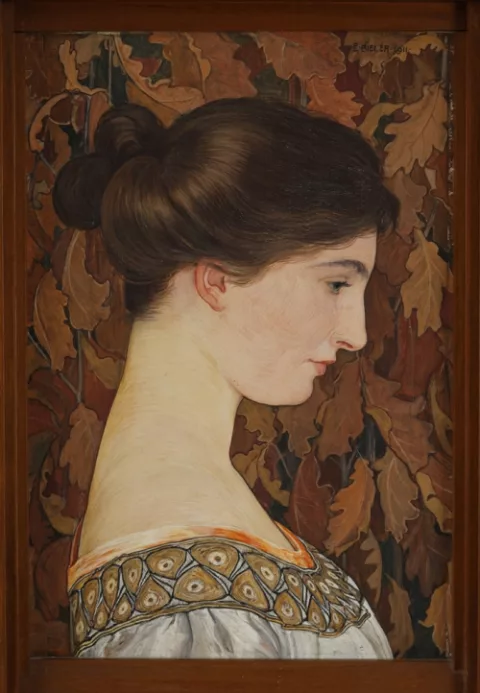
This work predates Biéler’s later stylistic transformations. Based in Savièse from 1900, he drew closer to Art Nouveau circles from 1906 onwards and developed a style he called “graphisme”: outlines delimit flat surfaces, colours are applied in flat areas, and the artist notably adopted tempera, watercolour and gouache for their matt finish.
Observational commentary — The painting’s documented itinerary connects three places: Savièse, where the subject was studied; Paris, where the work was completed and then exhibited; and Lausanne, whose museum acquired it in 1886. Its singularity lies in this attested chronology: although already acquired for a public collection, the canvas remained temporarily with its creator so that it could be shown to the Parisian public.
Sources and context
- Musée cantonal des Beaux-Arts de Lausanne — Devant l’église de Saint-Germain à Savièse ↗
- Musée cantonal des Beaux-Arts de Lausanne — Retour du baptême ↗
- Musée cantonal des Beaux-Arts de Lausanne — Les Tresseuses de paille ↗
- Collection Pictet — Ernest Biéler ↗
- Musée d’Orsay — Répertoire des artistes et personnalités : Ernest Biéler ↗
- Musée d’Orsay — Ernest Biéler, Portrait de Julia Scheller-Erni ↗