Alexandre Calame · 5 min read
Dutch light on Lake Brienz
Calame's Lake Brienz owes something to a journey far from the Alps. After studying the Dutch masters, the painter returns to the Swiss landscape with different tools for guiding light between trees and water.
Published on October 3, 2026
Featured on October 14, 2026
To paint a Swiss lake, Alexandre Calame also looks towards Holland. This detour is one of the paths leading to Lake Brienz of 1843, held at the MCBA. Before the canvas, we first encounter gentle light and a group of trees, then an opening between the mountains. The 1838 journey to the masters of the seventeenth century did not change the place represented. It nourished a way of composing it: water can become depth, foliage a passage and mountains a horizon rather than an obstacle.
The museum recalls that Calame then studies works by Meindert Hobbema and Jacob van Ruisdael. He had already encountered Dutch painting in Geneva collectors' homes. Northern paintings interested him particularly for their precision and attention to local landscapes. The detour therefore does not begin only with a departure abroad; it also starts in nearby collections. A painting travels even before its viewer takes to the road, and can reveal a different way of questioning one's own territory.
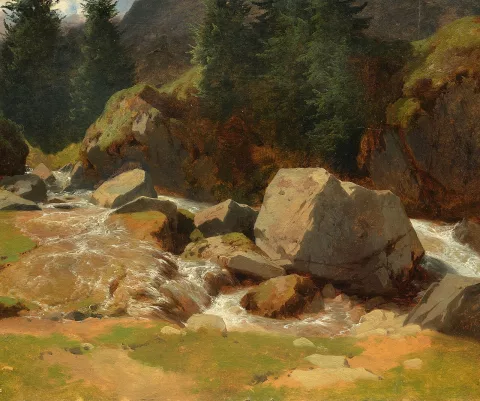
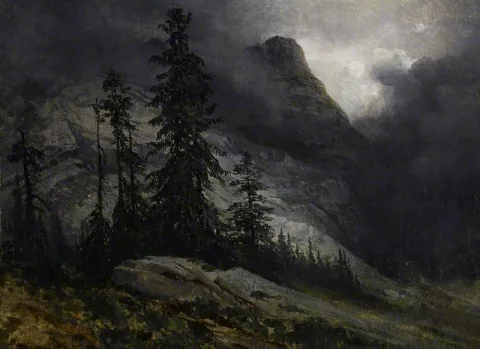
Looking at the work — In the MCBA reproduction, a cluster of dark trees occupies the left and extends to the lake's edge. On the right, light settles on the shore and water. The mountains part into the distance towards a bright area near the centre. Clouds hold back some of the brilliance without entirely closing the sky. Our gaze thus passes from a dense foreground towards a luminous opening. The trees seem close, the water further away, and the landforms gradually become less distinct.
The subject is among the many lakes Calame paints after his explorations of the Bernese Oberland and central Switzerland. This canvas, ninety-six by one hundred and forty-six centimetres, is nothing like a small travel note. Its format allows a landscape to unfold while keeping a precise starting point on the shore. The peaks do not dominate the whole on their own. They accompany the space the water opens before them, and their presence is measured by the distance that allows our eyes to reach them.
We can then understand what studying the masters could offer without searching the image for literal imitation. The museum points in particular to work on the transparency of water and foliage. These are concrete problems of painting. How can one show a mass of trees without making it a wall? How can water be given both surface and depth? In the canvas, light passes through or along forms rather than isolating them all in the same way. The different elements respond to one another, and brightness becomes the link between their distances.
The Fondation Custodia, in its catalogue devoted to painting directly from nature, stresses the role of nature studies in Calame's work. This reference illuminates the labour behind such a unified view. Observing foliage or a rock provides knowledge of forms; composing the picture decides where that knowledge will be visible. The landscape can thus appear calm without being simple. The nearby shore retains details, while the distance requires less precision. The painter adjusts each area's intensity so the eye can advance without meeting the same resistance everywhere.
In 1843, Calame already enjoys an established reputation. The tranquil lake is therefore not the solution of an artist who has renounced ambition. It is another way of exercising it. A painting can impress by letting forms breathe and giving the opening enough weight to balance the dark shore. This reading does not require knowledge of all the artist's landscapes. It can be checked before this one: after following the foliage, we almost physically feel the relief of the bright space towards which the water leads.
The Dutch detour thus ends in a Swiss location, but does not disappear entirely. It remains in a way of organising the encounter between near and far. The painting invites us to recognise Brienz while observing how that recognition is prepared. As we leave, we may remember a lake, trees and light advancing between them. Calame's journey produced more than a foreign memory: it gave him new ways of making familiar a landscape he encountered again at home.