Image credits
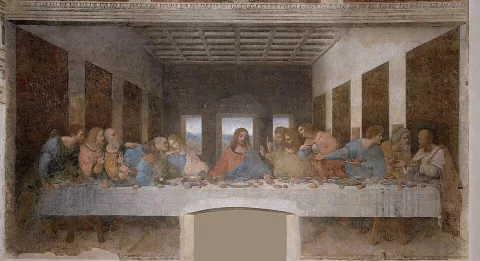
Léonard de Vinci — La Cène, vers 1495–1498 · Réfectoire de Santa Maria delle Grazie, Milan. Reproduction : Wikimedia Commons, domaine public.SourceDomaine public (Wikimedia Commons)
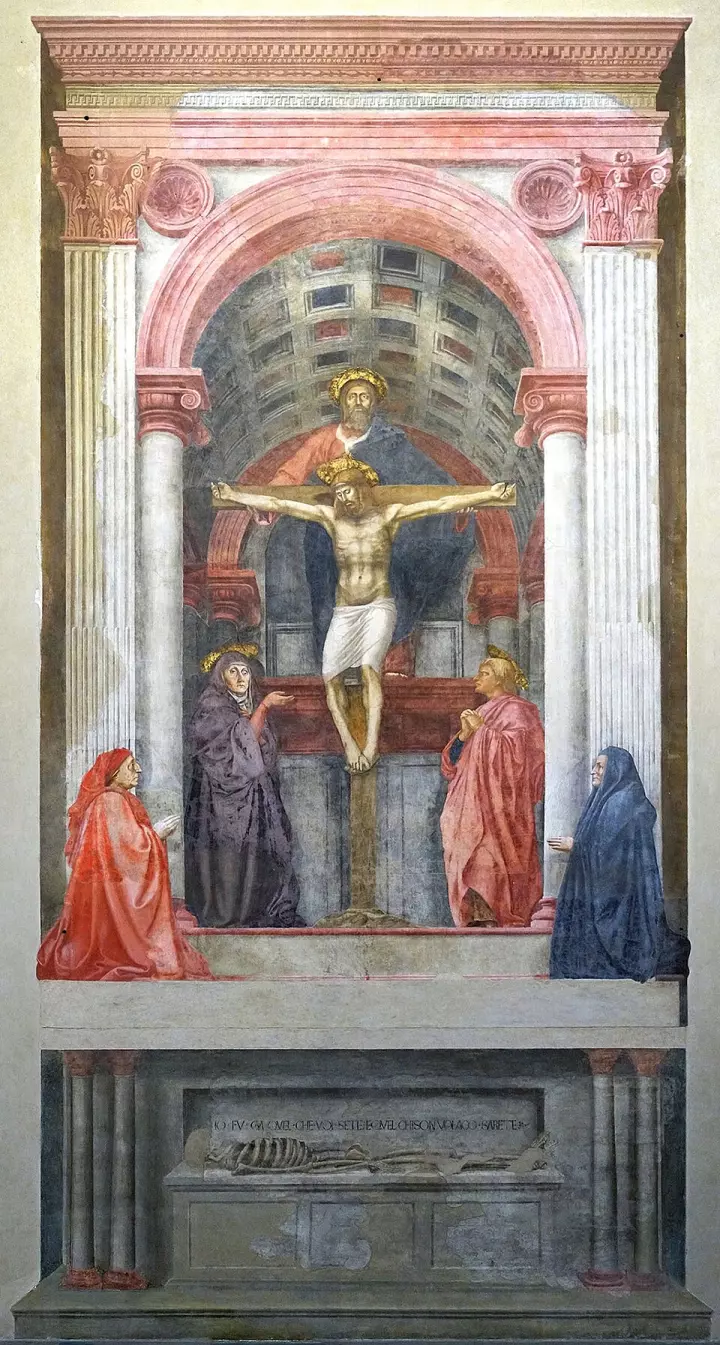
In Florence’s Santa Maria Novella, Masaccio’s Holy Trinity, painted around 1425–1426, creates the illusion of architecture receding beyond the wall. The Early Renaissance fresco offers a direct explanation of how linear perspective makes a painted surface appear to contain a coherent, measurable space.
 Museum artwork
Masaccio — La Trinité, vers 1425–1428 · Basilique Santa Maria Novella, Florence. Reproduction : Wikimedia Commons, domaine public.
The church documents the fresco’s location, its concealment in the sixteenth century and the history of its rediscovery. Its material history matters alongside its theoretical importance: what visitors see today is also shaped by conservation decisions and changes in placement.
Perspective is not merely a decorative effect. It organises the figures, the donors and the viewer’s position. A useful way to explore Masaccio is to examine the picture’s geometry before returning to its religious programme. The artist’s profile offers further context for the Italian Renaissance.