Paul Klee · 5 min read
The black you must scrape away to discover a world
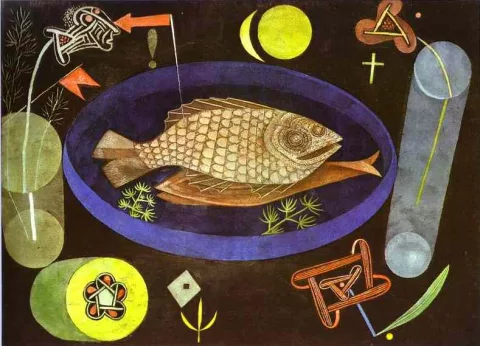
Fish Magic brings together fish, flowers and celestial signs in a dark space. Beneath this 1925 scene, Klee arranges a real material discovery: colours appear by breaking through the black layer.
Published on October 3, 2026
In Fish Magic, the fish do not occupy an aquarium whose walls we can see. They appear among flowers, luminous signs and presences difficult to identify, within a darkness that no more resembles an ordinary sky. Paul Klee gives the visitor several families of reference points, then makes them coexist without explaining the rules of the place. Wonder begins there: we recognise fragments of a world, but their proximity does not allow us to recover the familiar situation that would contain them all.
The Philadelphia Museum of Art holds this 1925 work and describes a making process based on superimposition. A black layer covers colours that Klee brings back into view by scraping and drawing. The drawing is therefore also constructed by removal. This operation reverses a usual expectation before a painting: to make a form visible, the artist does not necessarily have to supply a new colour. He can work on what already conceals the colour, open a passage and let a light prepared underneath rise to the surface.
This history of layers gives a very concrete meaning to our discovery of the image. The small coloured areas do not seem simply deposited on an available background; they emerge from a material depth. Outlines may offer clear visibility, while other passages retain an uncertain appearance. Black is then neither a void nor an absence of work. It becomes an active surface, one that makes us await appearances and measures their intensity. The more understated the scene seems, the more the visitor is encouraged to look for what it reveals.
The fish encourage this attention. Their presence is enough to provide an aquatic orientation, but the other motifs immediately shift it. A flower is not a marine animal; a celestial sign does not naturally occupy the same depth as a fish. We can read their meeting as a freedom of imagination, provided we recognise that this reading comes from our gaze. The painting does not document a universe actually observed. It organises a coexistence through which each motif retains something recognisable and receives a new life from its surroundings.
At the centre, the museum points out a square of muslin glued to the canvas. Here is another element that is not solely a matter of representation. An additional material is physically present in the work. Before a reproduction, the visitor may be tempted to treat it as one shape among others; before the object, its texture and edge call for particular attention. This difference reminds us why a photograph is so useful for preparing a reading, but does not reveal every property of a painting in which the materials themselves create events.
The association of this square with a kind of curtain remains suggestive. The museum’s entry mentions a diagonal line that seems ready to draw it aside. We can then follow the painting as a stage on which something might be revealed a second time. This suggestion does not authorise us to tell an imaginary performance with its actors and ending. Instead, it helps us see how lines produce an expectation. Even amid small, scattered forms, Klee can give a merely possible gesture the power of a change to come.
The time spent reading thus becomes very different from that of quick identification. Finding a fish does not complete the encounter; it leads us to seek the other appearances, measure the distances and return to the darkness. The title, Fish Magic, accompanies this shift without supplying a definitive explanation. Magic here does not require belief in a miracle. We know there are painted layers, a collage and interventions on the surface. Knowledge of the process does not dispel the strangeness; it shows how that strangeness is patiently made.
When the gaze moves away, the motifs gather into an almost silent whole. Approaching again, we rediscover the colours uncovered beneath the black, the square of fabric and the paths crossing the composition. This alternation is part of the painting’s pleasure. A singular image can be viewed as a world, then as an object worked on at very close quarters. Fish Magic holds these two dimensions together: what we think we glimpse in the depths of a space arises from real gestures performed on the surface of a canvas.