Jules Breton · 4 min read
The grape harvest leaves the château for Omaha
Commissioned in the nineteenth century for Count Duchâtel, Breton’s painting passes through collections, fails to sell, then joins a public initiative in Omaha.
Published on October 3, 2026
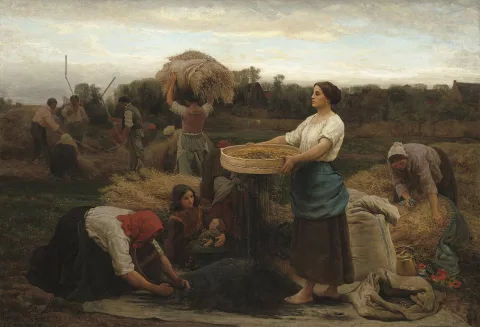
A grape-harvest scene can have a history far more mobile than the place where it is situated. The Vintage at Château Lagrange, painted by Jules Breton in 1864, is now preserved at the Joslyn Art Museum in Omaha. The museum documents a commission from Count Charles Marie Tanneguy Duchâtel. The title attaches the work to an estate; provenance follows its movements. These two geographies are not the same. The painting remains connected with Château Lagrange while the object passes from French owners to American collections, then to a museum.
The commission gives the rural subject a particular framework. A harvest appears in a work requested by a named owner. We do not know all the discussions between commissioner and painter here, and assigning them precise intentions would be imprudent. The information nevertheless suffices to recall that paintings also have conditions of production. An agricultural scene does not always arise solely from an artist’s decision before a field. It can respond to a project and a relationship between people.
The painting is presented at the Paris Salon in 1864. Two years later, it appears in a Bordeaux exhibition under a title designating the grape harvest in the Médoc. The circulation of titles emphasises two ways of identifying the same work: through a particular estate or a wider winegrowing region. These designations orient the gaze without changing the canvas’s material substance. They can make the subject familiar to different audiences. The museum retains this variation, which belongs to the history of presentation and that of the words used to describe the painting.
After the commissioner’s death, the work passes to his heirs. It is sold at Drouot in 1888, then joins Thomas E. Waggaman’s collection in Washington. The path does not unfold as a sequence of easy transactions. The Joslyn entry cites a letter from Knoedler to Breton dated 13 March 1896, indicating that the painting was offered at public auction without finding a buyer. It is then entrusted to the dealer, again without an immediate sale. A recognised work can remain an object the market hesitates to receive.
This stage deserves to be retained in the account. A painter’s fame does not remove the circumstances of a sale, buyers’ preferences or the limits of an occasion. We have no single reason explaining this failure, and seeking one at any cost would obscure what the document actually supplies. The painting continues its journey despite a commercial interruption. Its history contains waits as well as departures. The painting does not cease to exist when a transaction fails to occur; it remains available for another destination.
In 1916, Omaha’s Friends of Art buy it from Knoedler. In 1932, they donate it to the Joslyn Art Museum. This final stage transforms the work’s relationship to its audience. A painting arising from a particular commission joins a collection visitors can discover. Its horizontal format, approximately 93 by 170 centimetres, gives it a substantial presence, but its history is no longer solely that of an owner. A collective initiative contributes to its preservation and availability. The object enters civic memory far from the estate designated by its title.
The Vintage at Château Lagrange thus recounts two different harvests. The first is the subject announced by the painting. The second, figuratively, is the patient gathering of works in which enthusiasts, dealers and institutions participate. This metaphor must remain a reading, not an additional historical fact. The painting passes through exhibition successes, sales and hesitations. In Omaha, it receives a new address without losing its old geography. The museum entry allows us to follow this path and recognise that a public collection can begin with a private history far away.