Jules Breton · 5 min read
Le Soir spends seventy-six years in a town hall
Painted in 1860 and acquired the following year, Le Soir has a surprising institutional life. Its long loan to Cuisery reminds us that a painting in a national collection can be encountered far from the museum with which we associate its name today.
Published on October 3, 2026
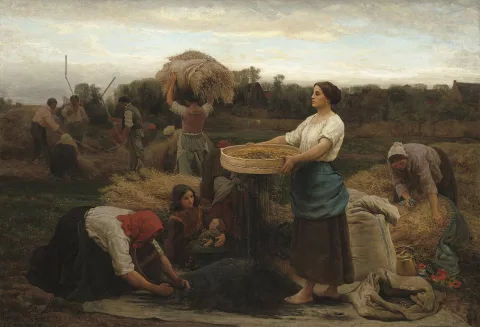
A painting can belong to a national collection and spend a large part of its life elsewhere. Jules Breton’s Le Soir provides a precise example. Painted in 1860 and purchased in 1861, it is placed on loan at Cuisery town hall from 1936 to 2012. Seventy-six years separate those two dates. The title first invites us to think about the end of a day; the Musée d’Orsay’s entry reveals a quite different duration, that of a painting encountering successive places and passing through several generations.
The oil on canvas measures ninety centimetres high by one hundred and eleven centimetres and six millimetres wide. It bears Breton’s signature and date. These details give us a precise object to follow. The history does not concern all the evening paintings made by the artist, but this painting, identified by the number RF 547. The accuracy of the inventory protects the account against overly hasty connections. A common title can bring together different works; here, the measurements, technique and provenance allow us to keep hold of the right thread.
The first destination after purchase is the Musée du Luxembourg. The canvas then passes through the gallery of the Corps législatif, returns to the Luxembourg, and is subsequently displayed at the Louvre and the Château de Fontainebleau. This succession shows that preservation does not always mean leaving something in the same place. We should not assign each move a reason the entry does not give. The dates are nevertheless enough to establish an interesting fact: the painting belongs to a history of circulation in which institutions decide the conditions of its presence.
Its passage through a political place such as the Corps législatif requires particular attention. A painting does not only encounter the audience of a museum room. It can accompany other uses of a building, other visits and other habits of looking. We do not know what each person thought before Le Soir. The change of place nevertheless allows us to imagine different conditions without inventing a specific reception. The object retains its material substance, but how we approach it also depends on where it is presented.
From 1936, Cuisery town hall becomes the location of a loan that continues until 2012. The word loan is important: it does not automatically signify a sale or a loss of ownership. It describes an arrangement for preservation and presentation. The painting from a national collection thus takes its place in a municipality for several decades. The account can dwell on this duration without fabricating a tale of abandonment or discovery. A long provincial presence already constitutes a history, even when no spectacular event is needed to tell it.
This stage invites reflection on what we call encountering art. We readily associate a familiar work with the major museum that publishes its entry. Its material life may have been far more dispersed. A resident, visitor or person working in the building may have had an opportunity to see the painting without travelling to Paris. These are possibilities arising from its presentation, not documented individual encounters. They remind us that the circulation of collections can create other forms of proximity to works of art.
Its return to Orsay in 2012 does not erase those years. The historical record preserves them and gives them a place in our knowledge of the painting. An entry can therefore change our gaze: what seemed simply a painting available in a collection becomes an object whose destinations have varied. Its creation date is no longer its only measure of time. We must add purchase decisions, movements between institutions and the duration of a loan. Each concerns the same object within another relationship.
Le Soir then acquires an unexpected significance. Its scene remains attached to the moment Breton painted in 1860, while its history leads us through a century and a half of places. The visitor can look at the canvas and then retain the memory of a town hall where it spent seventy-six years. This knowledge replaces neither its colours nor its subject. It adds a journey to the encounter. A painting from a national collection has not only passed through famous rooms: it has also had time to take its place in the life of a municipality.