Frédéric Rouge · 4 min read
A poacher in the public collection
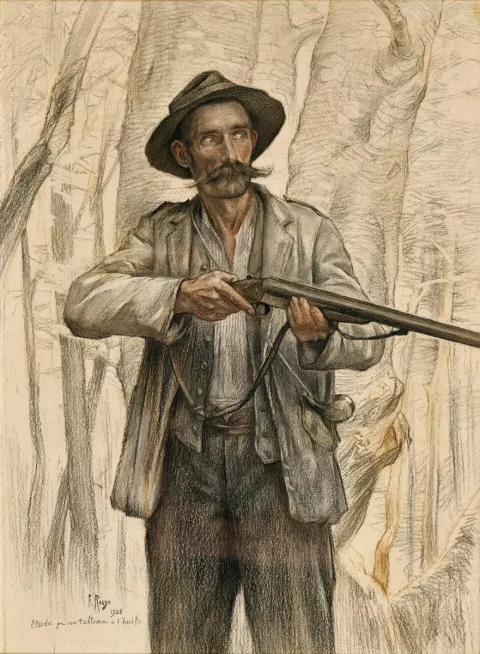
The Poacher, painted in 1908 and preserved at the Musée Jenisch, allows us to follow Rouge’s rural figure to an exhibition questioning its idealisation.
Published on October 3, 2026
Frédéric Rouge’s The Poacher bears a title that slightly disturbs the peaceful image of the countryside. A poacher is not simply a walker or hunter: the word introduces an activity on the margins of the rules. The canvas, painted in 1908, is preserved at the Musée Jenisch in Vevey. Espace Graffenried gives its dimensions, 102.5 by 77 centimetres, and its inventory number, 1908-002. These precise details return a rural character to an identifiable material object followed within a public collection.
In 2021, this work appears in the presentation of Bucolic Silhouettes. Frédéric Rouge and the School of Savièse. The exhibition associates an artist from Vaud based between Aigle and Ollon with painters connected to neighbouring Valais. It compares their representations of the rural world. The association does not suppose they all worked together or shared a written programme. It constructs a space for comparison: the same decades, geographical proximity, interest in human figures and differences in how they give them form.
This new situation changes our reading of the title. In a history of hunting, the poacher might be considered according to practices, customs and prohibitions. In a painting exhibition, he also becomes a silhouette chosen to represent a world. Why this figure rather than another? What can it carry that is distinctive, romantic or familiar? These questions do not call for a model’s identity to be invented. They invite examination of the pictorial choice itself, the transformation of a particular activity into a subject capable of holding the gaze.
Espace Graffenried precisely emphasises the element of idealisation in these representations. Its text proposes distinguishing Rouge’s scenes from the more Symbolist tendencies of artists gathered under the name School of Savièse. It also questions the place left for industry in images of Valais. This perspective belongs to the reading of the 2021 exhibition; it must not be presented as a confidence from Rouge. It nevertheless allows us to look at rural painting without automatically taking it for a faithful photograph of the entire society surrounding it.
A painting selects. Even when based on meticulous observations, it cuts out a subject, organises its relationships and leaves other realities outside the frame. The Poacher thus invites us to hold two ideas together: the presence of an individual to whom the painter pays attention, and that individual’s role in a broader image of the countryside. The title designates him by his activity without giving a name. This passage from person to type can give the character great strength, but also simplify what an entire existence would be.
The painting’s public path adds another layer to this history. A scene associated with the rural world enters a museum, then returns to Aigle within a reflection on neighbouring territories. Painting is preserved while questions change. We can admire its execution, compare it with Rouge’s other figures or question the countryside it shows. These readings do not necessarily cancel each other. They constitute the stages of a work remaining available because an institution preserves it and others choose to present it again.
The canvas does not supply a judicial file or the complete account of a day’s hunting. Its power lies elsewhere. It gives a lasting place to a figure whose title already contains a social ambiguity. More than a century after 1908, an exhibition can make this ambiguity a starting point rather than dissolve it into general nostalgia. The poacher remains recognisable as a subject; around him, our way of thinking about rural life becomes more precise. The painting’s history continues when the public gaze accepts putting a question to what seemed familiar.