Frédéric Rouge · 4 min read
From the model in Ollon to the light of Vionnaz
The cartoons and stained-glass windows of 1926 reveal another destination for Rouge’s drawing: a figure prepared on paper becomes a presence traversed by light.
Published on October 3, 2026
In Frédéric Rouge’s catalogue, the stained-glass windows of Vionnaz church appear with their preparatory cartoons. Two ensembles are dated 1926. This way of listing them invites us to follow the work between two states: the drawn project and the work intended for an opening in the building. The French word carton here does not designate simple packaging. It names a support for design, an object allowing the form to be prepared before its passage towards another material and another situation of looking.
The website devoted to the painter also preserves a human detail: a Miss Bonzon from Ollon is said to have posed for Saint Thérèse in the Vionnaz windows. The biographical account places her among the many models drawn from the village and its surroundings. This memory must be attributed to that text rather than given an invented sitting or conversation. It nevertheless gives the project a concrete dimension. A religious figure does not arrive only from an abstract model; it can develop from a face belonging to the painter’s neighbourhood.
This passage alters the portrait’s destination. In a canvas named after a person, features often serve to preserve their identity. For a saint’s figure, they enter a representation whose name and role exceed the model. The face can be observed attentively while receiving a different significance. This shift belongs to the work of composition. It does not authorise us to identify every detail of the window with the sitter’s life, but reminds us that a sacred image can retain the trace of an ordinary relationship.
The cartoons also help us understand what drawing must anticipate. A window imposes a form and a place; the project must organise itself within them. Unlike a painting easily moved from one wall to another, stained glass dialogues with an architectural opening. Its lines are seen from a collective space. Distance, height and light alter conditions of perception. Even without the execution contract, we can follow this essential transformation: drawing prepares an image that will be received through a building.
The separate presence of cartoons and windows in the catalogue prevents design and execution from being confused. We do not know the details of the technical operations or the identity of every participant here. Rouge’s name documents his role in the project; it is not enough to assign him every gesture of glass manufacture without evidence. This distinction makes the work more interesting. An artistic project can circulate between skills and supports while retaining a visual organisation born in the painter’s studio.
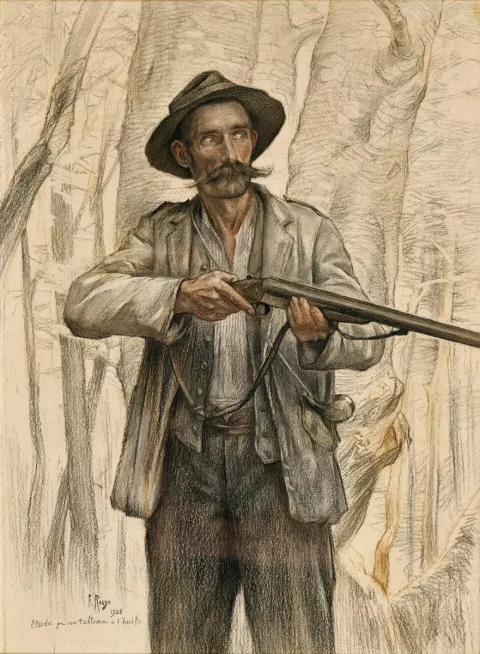
Vionnaz is not the only ensemble of this kind listed. The catalogue also presents the cartoons and windows of Aigle’s Protestant church, dated 1901, as well as secular subjects including coats of arms and a chamois hunter. The practice therefore belongs to a broader career. Rouge does not reserve his drawing for a single use or audience. Figures, local activities and signs of identity can take their place on different surfaces. The variety of commissions requires the relationship between an image and its location to be reconsidered each time.
Before a stained-glass window, we receive light the cartoon could not materially contain. The project prepared lines and colours; the installed work associates them with the day’s variations. At Vionnaz, the history therefore begins before the glass and continues after its installation. It connects a model from Ollon, a painter’s work and a shared space of contemplation. The catalogue preserves these stages without reducing them to a single photograph. It invites us to view drawing as a promise of light, and stained glass as an image whose environment constantly participates in its life.