François Bocion · 4 min read
François Bocion: the first painting inventoried before the museum opened
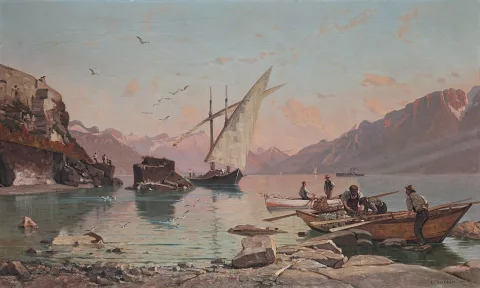
In Vevey, a public subscription was launched in 1893 for François Bocion’s Le Port d’Ouchy. However, the Musée Jenisch’s pages differ on the date of acquisition: the work’s catalogue entry gives 1896, while the history page states 1893. Both present the painting as the first inventory number in the collection, predating the museum’s inauguration in March 1897.
Published on September 23, 2026
At the lower left, the painting bears the inscription “2.4.85.” and, at the lower right, the signature “F. BOCION”. Dated 1885, Le Port d’Ouchy is an oil on canvas whose support measures 28.5 by 42.7 centimetres. Its number, INV 1896-0001, makes it the first work entered in the inventory of the Musée Jenisch collection.
François Bocion was born in Lausanne in 1828. After a childhood spent between Lausanne, Montreux and Vevey, he trained in Paris from 1845 to 1848 in the studios of Louis-Aimé Grosclaude and Charles Gleyre. Returning to Lausanne in 1848, he became a drawing teacher at the École industrielle cantonale, where he taught until his death in 1890. From the 1860s onwards, landscape, primarily the Swiss and French shores of Lake Geneva, assumed a predominant place in his work.
Bocion regularly worked outdoors and observed the activities on the lake: fishing, hunting and the transport of goods. He also depicted recreational boating, then reserved for a rare few, as well as the increasing use of steamships, associated with the region’s development as a tourist destination. From the 1880s onwards, the human presence in his compositions became less frequent, and the lake became their principal subject.
The provenance of Le Port d’Ouchy is linked to the Neuchâtel painter Léon Berthoud, whom Bocion met during his training in Paris. The two artists remained in contact in Lausanne and Neuchâtel, particularly at events organised by the Société des Amis des Arts, and exchanged their creations. According to the Musée Jenisch’s catalogue entry, the painting probably became the property of Léon Berthoud in this context, but this transfer is not presented there as certain.
After Léon Berthoud’s death in 1892, Le Port d’Ouchy was in the hands of his family and belonged to his sister Marie Berthoud. A public subscription was launched in Vevey in 1893 to contribute to its acquisition for the future museum. The catalogue entry states that the work, which remained in the Berthoud family until its sale in 1893, was sold for 500 francs.
The institutional sources do not provide an entirely consistent chronology. The painting’s catalogue entry states that the Musée Jenisch acquired it in 1896 following the subscription launched in 1893, and it also records 1896 as the date of accession. The page devoted to the museum’s history, for its part, states that this first work was acquired through public subscription in 1893. These two formulations should therefore be explicitly retained rather than choosing between them.
The Musée Jenisch, founded as a result of a donation by Fanny Jenisch to the town of Vevey, was inaugurated in March 1897. Initially encyclopaedic in scope, it became exclusively devoted to the fine arts in the late 1980s. Whichever acquisition date is given on its two pages, Le Port d’Ouchy bears the collection’s first inventory number and predates the institution’s opening to the public.
Commentary — The small format of Le Port d’Ouchy contrasts with its institutional importance. This importance lies not in physical monumentality, but in its inaugural place in the inventory. The sources agree on the public subscription of 1893, the painting’s foundational role and the museum’s opening in 1897, while differing on the exact date of acquisition. This chronological reservation does not erase the essential image: a view of Lake Geneva became the administrative starting point of the collection even before the museum was inaugurated.