Émile Chambon · 5 min read
Mathilde finds a place in the painting
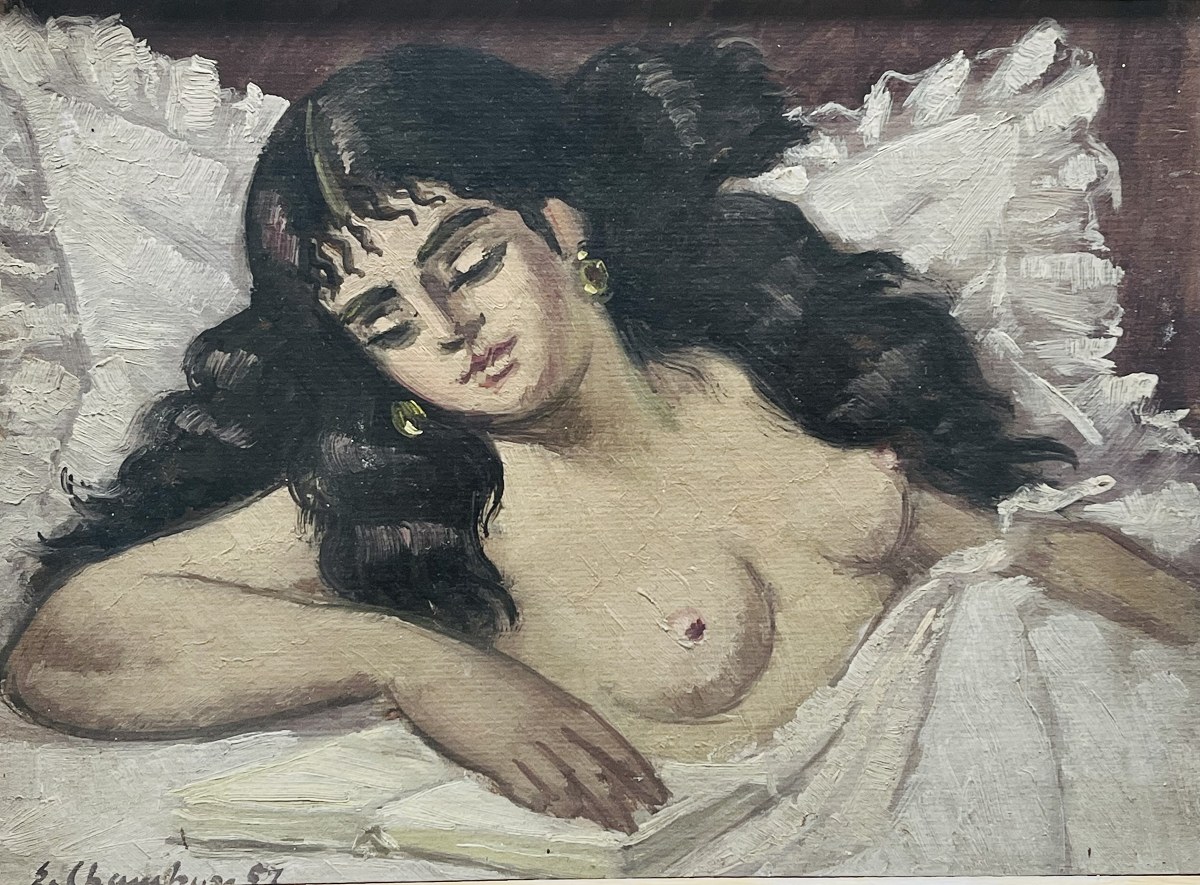
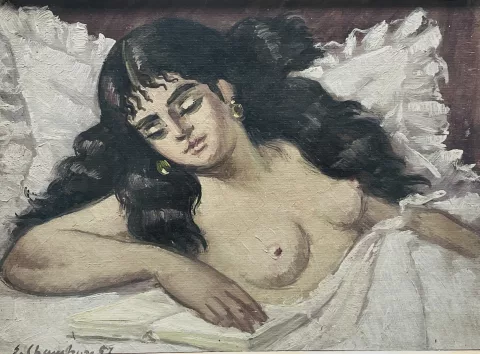
Mathilde in the Yellow Waistcoat, painted in 1946, bears the name of Chambon’s sister. The portrait allows a documented family presence to be recognised without assigning her words or a role the sources do not specify.
Published on October 3, 2026
The name Mathilde changes the encounter with a portrait. It does not give us an entire biography, but prevents the figure from remaining wholly anonymous. Émile Chambon paints Mathilde in the Yellow Waistcoat in 1946, according to his Fondation’s catalogue. The painter’s biography names his sister Julia Mathilde and recalls that she assists him over the course of his life. These details open a relationship between a family presence and a work. They allow the account to begin without inventing a studio conversation or the model’s exact state of mind.
A portrait of someone close has a simple particularity: the person exists for the painter before becoming a pictorial subject. This relationship can give the work different conditions from those of meeting a stranger. We do not know the details of the sittings or all the decisions made during execution here. The family connection nevertheless suffices to shift our attention. The painting does not merely depict a face to which we might have assigned a name afterwards. It belongs to an environment of relationships the documentation allows us to recognise at a precise scale.
The yellow waistcoat enters the title with the person. This association distinguishes a name and a visible element of her appearance. We can ask how a garment helps retain a portrait in memory without assuming it summarises the model’s identity. The title helps us recognise the work; it does not explain Mathilde’s entire life. Painting can thus preserve a particular presence through concrete choices. It remains for visitors to look at what those choices do within the image rather than be satisfied with biographical information.
The mention of Mathilde’s support also deserves restrained attention. It indicates continuity in the painter’s life, but the source does not describe all the tasks or their circumstances. It would be improper to distribute precise gestures across every year or assign her a single function. We can nevertheless recognise that Chambon’s career does not develop in complete isolation. Someone close participates enduringly in his environment. The portrait’s account can accommodate this presence without turning it into a series of anecdotes for which we possess no traces.
Painting and biography propose two forms of knowledge. One retains an appearance on a surface; the other gives relationships and facts in time. They can complement each other, but do not replace each other. A painting alone does not prove every aspect of a family connection. A biographical entry does not describe everything the portrait makes perceptible. Keeping both allows a more fitting encounter. We know the name and relationship, then give the painterly work the duration needed to appear in its particularity.
The year 1946 locates the object without authorising us to make it summarise the sister’s whole path. A dated portrait belongs to a moment of representation. The family relationship can continue before and after that moment. This difference of duration is useful: the person is not reduced to her presence in the painting. Visitors can receive the image while remembering that the model has a life not entirely contained within the frame. The name Mathilde retains this possibility of an existence beyond what painting shows.
The Fondation’s archives also document Mathilde beside her brother at the Musée Rath opening in 1966. This later reference brings a trace distinct from the portrait. It should not be used to recount every event separating the two dates. It simply confirms that a family presence also belongs to the painter’s public life. The painting and photograph offer two different occasions to encounter her: one within a work, the other in a documented event. The account can bring them together while preserving what distinguishes their functions and moments.
Mathilde thus finds a place in Chambon’s history through several routes without our needing to lend her a memorable remark. Her name appears in a portrait; the biography indicates support; the archives preserve a presence at the opening. These traces do not tell everything, but they are not negligible. Before Mathilde in the Yellow Waistcoat, visitors can recognise a person connected with the painter’s life, then return to the surface. The portrait gains documentary depth, while the gaze remains free to encounter its pictorial reality.