Joos van Winghe (1544–1603), a Flemish painter born in Brussels, completed his training in Italy. His travels took him to Rome and Parma, and he participated in decorating the Palazzo Farnese at Caprarola. After returning to the Netherlands, he worked as court painter to the governor Alessandro Farnese.
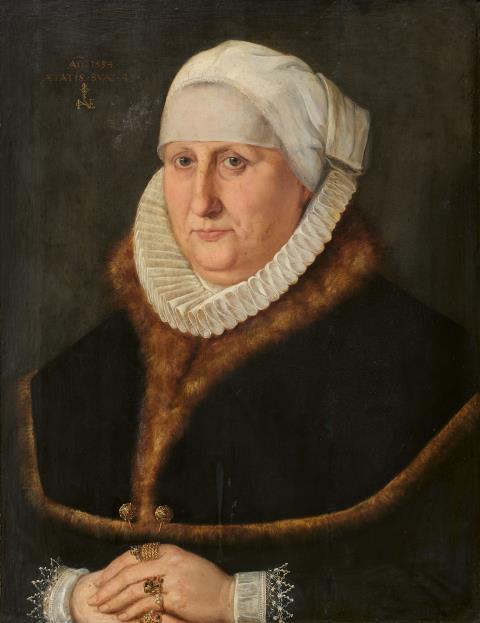
Around 1584 he settled in Frankfurt, remaining there until his death. Printmaking became an important part of his activity, although he continued to paint. A portrait of a Frankfurt patrician woman, bearing his monogram and dated 1594, documents that practice. His history painting Apelles and Campaspe, made for Emperor Rudolf II and now in Vienna’s Kunsthistorisches Museum, also recalls his connections with major patrons across Europe.
This profile brings together identity references for Joos van Winghe and paintings, drawings and works on paper documented in auction catalogues.
Documented auction references
2auction references
1auction house
2documented results with prices
Lempertz
References include catalogue entries and available results; they do not all represent completed sales. Attributed works and special lots are excluded from the priced results.
SwissArtGallery documentary note based on the cited sources. Titles, media and qualifications are provided in the profile language; the original catalogue wording remains available in each record. Profile updated :
Jamini Roy (1887–1972) was an Indian painter who developed an original form of modernism from the traditions of Bengal. Trained at the Government Art School in Calcutta within a Euro…
Sidney Nolan (1917–1992), born in Melbourne, was a major figure in twentieth-century Australian art. Beginning in commercial drawing, he became associated with John and Sunday Reed a…
Francis Bacon (1909–1992) was born in Dublin and spent time in Berlin and Paris before settling in London. Discovering Picasso’s work encouraged his decision to paint. Self-taught, h…