Hieronymus Bosch worked chiefly in ’s-Hertogenbosch, the town from which he took his name and where he died in 1516. His panel paintings combine religious narratives with fantastic symbols and sometimes disturbing observations of human behaviour. The Garden of Earthly Delights in the Prado is a triptych painted in oil on oak, dated by the museum to 1490–1500. Its central panel presents a deceptive paradise dominated by sensual pleasures.
In the Louvre’s Ship of Fools, drinkers and gluttons sail without a destination. This painting originally formed part of a triptych wing, subsequently separated and cut down. Christ Mocked in the National Gallery instead concentrates the action around five closely grouped figures. Christ’s calm outward gaze contrasts with the threatening gestures of the four men surrounding him.
This profile brings together identity references for Hieronymus Bosch and paintings, drawings and works on paper documented in auction catalogues.
Documented auction references
3auction references
2auction houses
Genève Enchères · Piguet
References include catalogue entries and available results; they do not all represent completed sales.
References excluded from statistics: attributions and special lots
These references are shown separately because of their attribution or lot composition. Each record states the reason.
Photograph : Piguet · Enlarge image ↗
Piguet
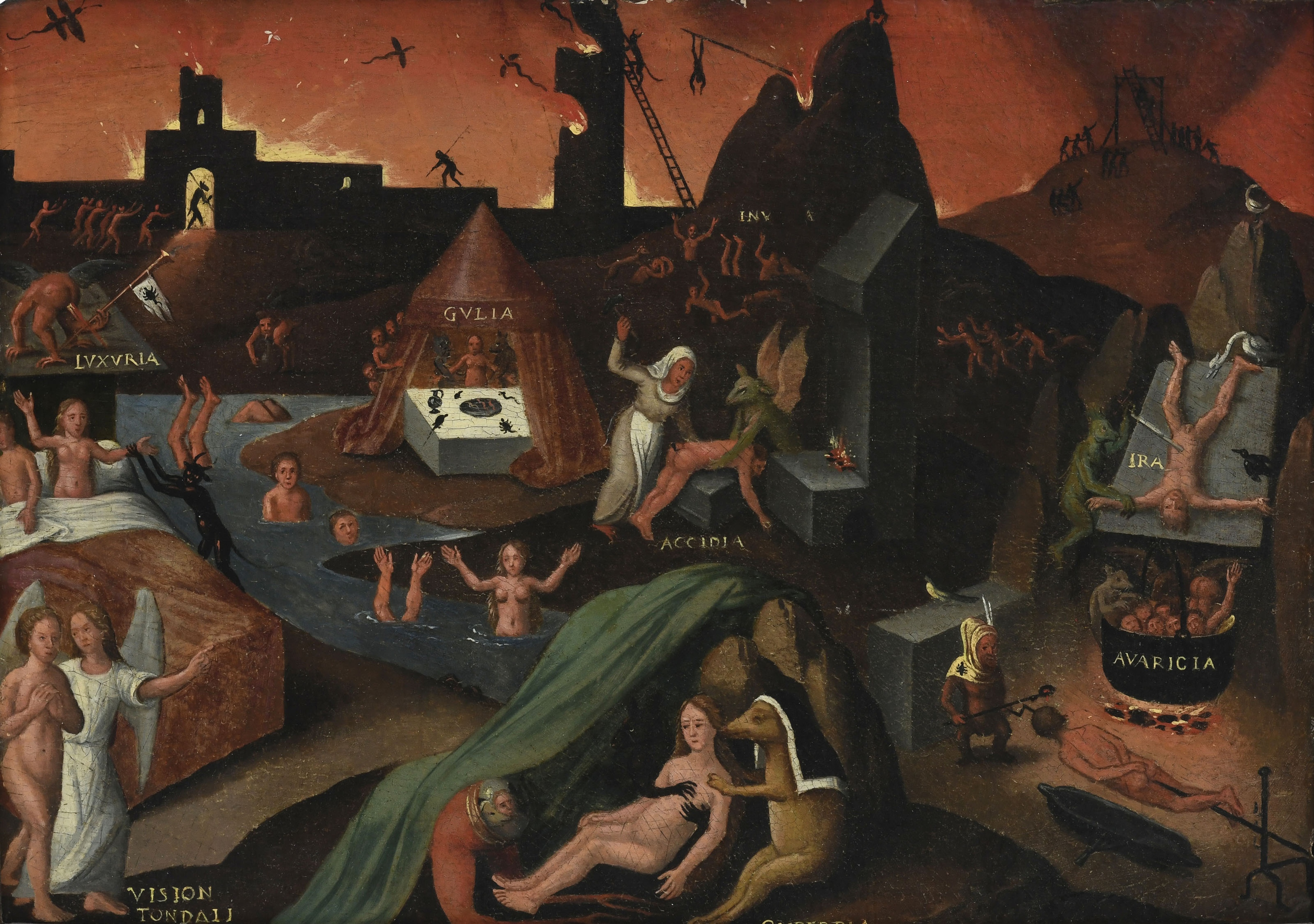
Les sept péchés capitaux
Oil on panel
Original catalogue wording
Les sept péchés capitaux huile sur panneau Attribution ou qualification signalée dans le catalogue
Original title: Ecce Homo — version d’après un modèle attribué à Jérôme Bosch ou à un suiveur
Medium — source: Huile sur panneau, école flamande de la fin du XVIe–début du XVIIe siècle, 34, 5 × 28 cm.
Full catalogue description and documentary notes
Catalogue description — original language Ecole flamande (fin XVIe - début XVIIe s.) , Ecce Homo , huile sur panneau, 34,5x28 cm Une des nombreuses versions connues d'après le Couronnement d'épines attribué à Jérôme Bosch (ca 1450-1516) ou à un de ses suiveurs, conservé à l'Escorial.
Documentary attribution note — original language Artiste possible du modèle, lui-même attribué à Bosch ou à un suiveur. Les deux niveaux d’incertitude sont conservés ; l’Escorial abrite le modèle cité et non le panneau vendu.
Auction date : 2016-03-09
Attribution — source: d’après un modèle attribué à Bosch ou à un suiveur
SwissArtGallery documentary note based on the cited sources. Titles, media and qualifications are provided in the profile language; the original catalogue wording remains available in each record. Profile updated :
George Ricard-Cordingley (1873–1939), also known as Georges Ricard-Cordingley, was born in Lyon to a French father and an English mother. He trained in Lyon and at the Académie Julia…
Arcangelo Salvarani (1882–1953) was born in Quartirolo di Carpi and died in Modena. He worked mainly in watercolour, alongside mural decoration and teaching at the Fermo Corni instit…
Jac Martin-Ferrières (1893–1972), born Jacques-Auguste Martin, was the son of painter Henri Martin. Abandoning scientific studies, he developed an initially pointillist practice befo…