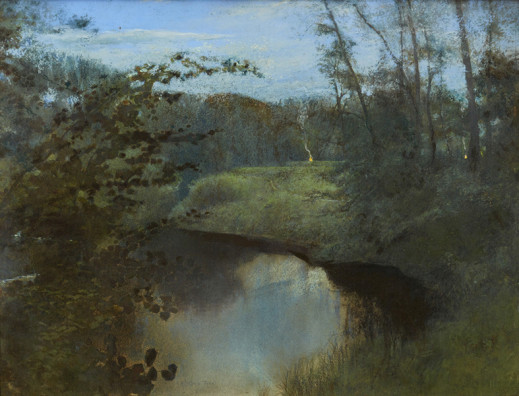
Giulio Aristide Sartorio (1860–1932), born in Rome into a family of sculptors, combined easel painting with monumental decoration. He exhibited Malaria at Rome’s International Exhibition in 1883 and subsequently worked within artistic circles associated with Gabriele D’Annunzio. His diptych Diana di Efeso e gli schiavi and La Gorgone e gli eroi was shown at the Venice Biennale in 1899 and acquired there for the Galleria Nazionale d’Arte Moderna.
Between 1908 and 1912 he executed the wax-tempera frieze for the parliamentary chamber at Montecitorio, devoted to the history of the Italian people. The human figure also carries his later religious investigations. In Il Precursore, painted in 1927–1928 and held by the Vatican Museums, John the Baptist appears veiled, extending his arm towards Christ.
This profile brings together identity references for Giulio Aristide Sartorio and paintings, drawings and works on paper documented in auction catalogues.
Documented auction references
1auction reference
1auction house
1documented result with a price
Artcurial Beurret Bailly Widmer
References include catalogue entries and available results; they do not all represent completed sales. Attributed works and special lots are excluded from the priced results.
SwissArtGallery documentary note based on the cited sources. Titles, media and qualifications are provided in the profile language; the original catalogue wording remains available in each record. Profile updated :
George Ricard-Cordingley (1873–1939), also known as Georges Ricard-Cordingley, was born in Lyon to a French father and an English mother. He trained in Lyon and at the Académie Julia…
Arcangelo Salvarani (1882–1953) was born in Quartirolo di Carpi and died in Modena. He worked mainly in watercolour, alongside mural decoration and teaching at the Fermo Corni instit…
Jac Martin-Ferrières (1893–1972), born Jacques-Auguste Martin, was the son of painter Henri Martin. Abandoning scientific studies, he developed an initially pointillist practice befo…