Jules Breton · 5 min read
A gleaner on a monumental scale
With The Gleaner of 1877, Jules Breton gives a peasant figure an imposing format. The painting’s dimensions invite us to consider what scale changes in our encounter with a familiar subject.
Published on October 3, 2026
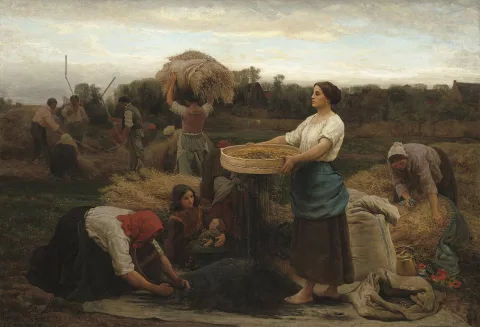
The word gleaner may bring to mind a distant silhouette in a field. With The Gleaner of 1877, Jules Breton gives her an altogether different scale. The canvas measures approximately two metres thirty in height. Before knowing anything about the person depicted, the visitor therefore encounters a presence occupying substantial space. The subject has not changed occupation to obtain these dimensions. Painting grants her the conditions of an imposing appearance, and this decision transforms the way we approach the image.
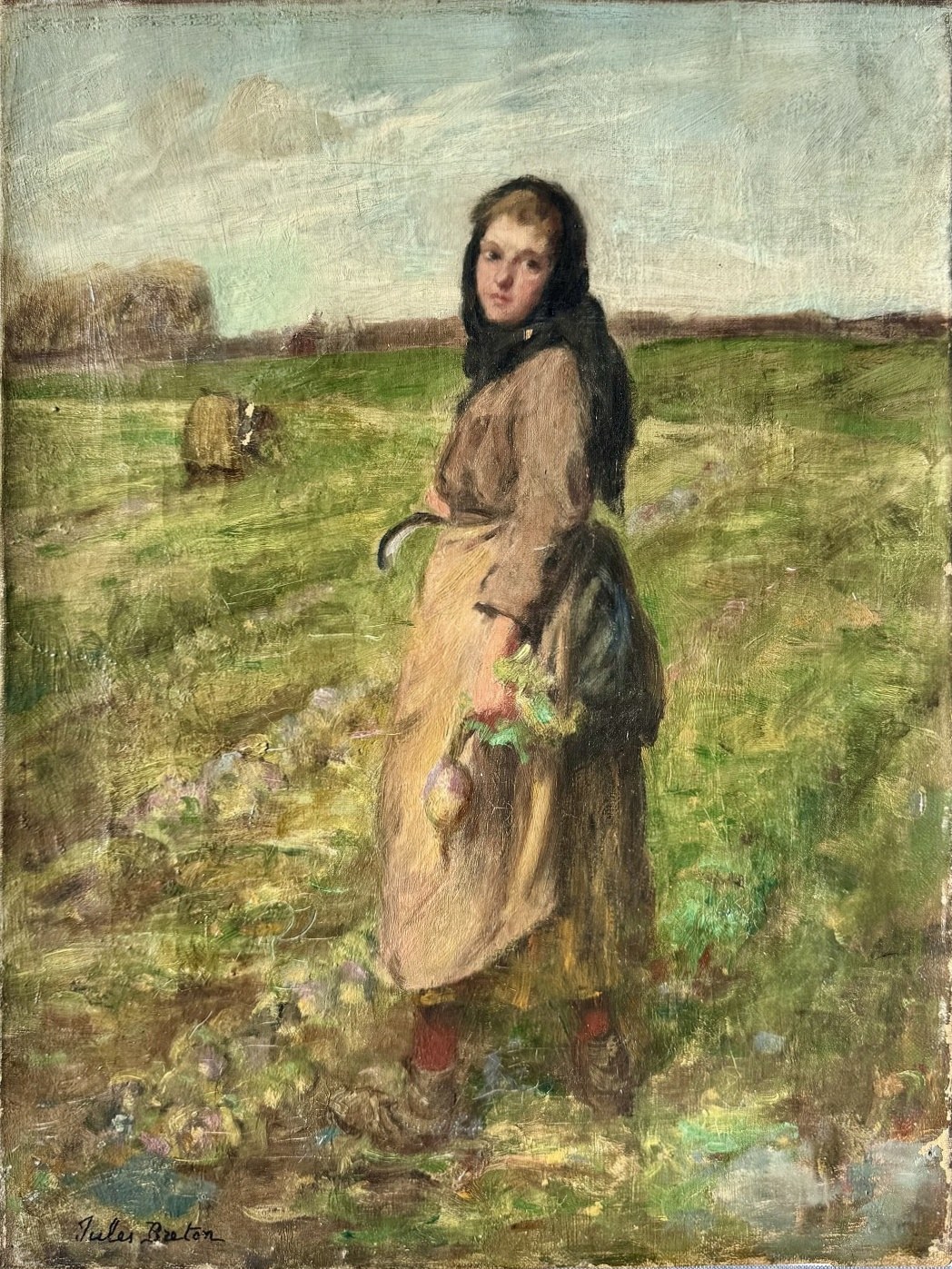
The Musée d’Orsay’s entry describes a standing woman, facing forward and carrying wheat, against a landscape of fields. These details remain restrained. They do not name the model or recount her day. They nevertheless suffice to establish a relationship between a person, an activity and a place. A figure carries something that comes from working the land. The gesture and the material being carried can draw our attention without any need to invent hardship, joy or a specific event behind her face.
In a small reproduction, this decision about scale is easily lost. A two-metre canvas can appear on a screen as a thumbnail. The eye recognises the subject but forgets the bodily distance that exists before the object. This is why dimensions deserve to form part of the account. They are not an extra reserved for specialists. They help us imagine how a visitor enters the encounter: looking up, stepping back, then coming closer to examine a detail. This movement changes what we notice.
The frontal presence opens a reading different from that of a group at work. We do not necessarily follow the successive stages of a task. We encounter a figure holding her place in the painting. The wheat links this presence to an activity, but the activity’s duration is not recounted in full. The painting can thus remind us that a person exists beyond the gesture that defines them socially. This proposition belongs to our reading; it does not claim to establish a precise intention of Breton’s that the entry does not state.
The canvas is signed and located at Courrières in 1877. This reference ties the image to a place familiar to the artist, but does not turn every detail into an exhaustive document about the village. We should hold the two levels together. The subject has an anchor; the composition is a work chosen and constructed. By preserving this distinction, we can look at a sign of labour without reducing the whole to an agricultural illustration. The field provides a context, while the painting organises the conditions of a particular encounter.
The work is acquired in 1877 and first joins the Musée du Luxembourg. Its history subsequently mentions the Louvre, then a loan to Arras in 1926. These destinations document the painting’s recognition and preservation. They also require an often forgotten clarification: the museum publishing an entry is not necessarily where the object is located. Orsay is the responsible institution, while the entry gives Arras as the place of preservation. A visitor seeking the canvas benefits from not confusing these two pieces of information.
Choosing a large format for a gleaner invites thought about what we consider worthy of a major image. We are accustomed to the imposing dimensions of famous figures and public events. An ordinary activity can also become the centre of such an object. This observation is not enough to turn the canvas into a political declaration whose every nuance we would know. It simply highlights a fact of representation: a peasant woman receives a place the visitor must physically take into account when standing before the painting.
The Gleaner thus leaves two scales in the memory. The first belongs to work: the wheat being carried, the field and a person’s body. The second belongs to the work of art: a tall canvas, acquired and preserved, that passes through collections. They meet without becoming identical. We can leave the image retaining the memory of a familiar subject turned into a presence that is hard to forget. This change rests partly on a very concrete decision: to paint a peasant figure in dimensions giving her the full space of an encounter.