Jules Breton · 5 min read
Knitting keeps a different rhythm
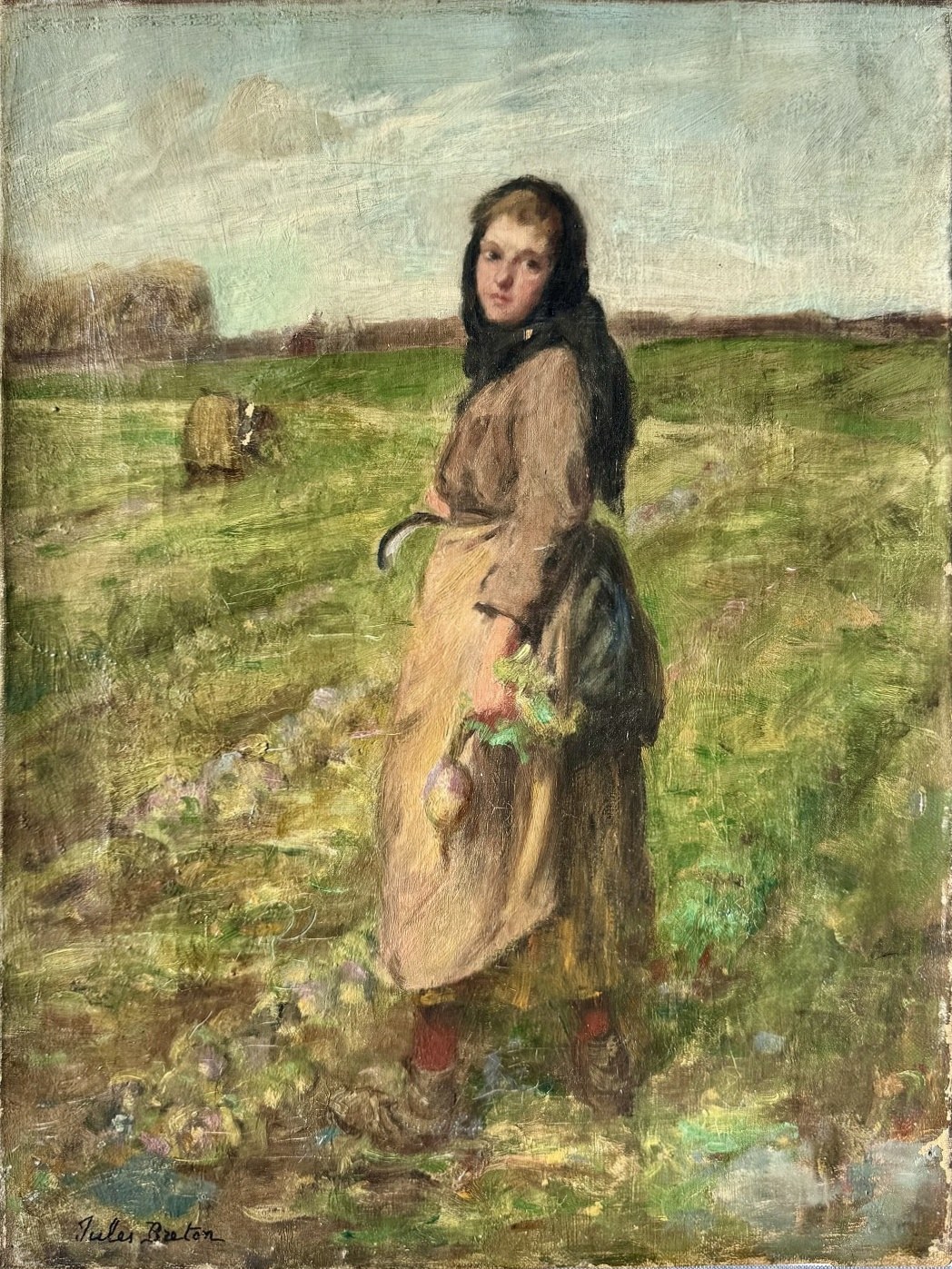
A young peasant woman knits in a canvas by Jules Breton dated around 1870. The Metropolitan’s small painting gives a modest task a duration of attention beyond its apparent simplicity.
Published on October 3, 2026
Not all working hands follow the rhythm of a harvest. In A Peasant Girl Knitting, Jules Breton chooses a young peasant woman occupied with knitting. The Metropolitan Museum’s entry dates this oil on canvas to around 1870. The title gives us a specific activity, but reveals neither the person’s name nor whom the work might be intended for. This simplicity is the starting point of an encounter: observing an ordinary action without immediately inventing a story larger than the information available.
The painting measures fifty-seven and a half centimetres high by forty-seven wide. This vertical and relatively modest format gives the figure a space the visitor can easily approach. It does not require the distance imposed by a large composition of several people. The difference in scale presents another possibility for a rural subject. One person and one activity can sustain an entire painting. The world of the fields does not necessarily need a multitude of workers to find a presence in art.
Knitting presents a particular problem for the eye: a succession of small movements gradually constructs something, while the painting shows only a retained position. We know what the activity is because the title names it. We do not see the preceding or following gestures. We must therefore allow the painting its own way of concentrating time. A fixed image can recall a continuous practice without supplying every stage. This difference between what we recognise and what we see forms part of the pleasure of observation.
The entry places Breton between the academic idealisation and social realism of his time. These categories provide context; they must not replace the encounter with the subject. We can ask what the presentation accords to the figure’s dignity, then what remains concrete in the activity. One question is how to avoid reducing the peasant woman to a decorative function. Knitting is not merely an opportunity to arrange hands. It denotes a skill, attention and production that exist beyond the painted surface.
It would nevertheless be excessive to derive from this canvas every condition of women’s work around 1870. A particular painting is not a comprehensive inquiry into working hours, earnings or the division of tasks. It offers a presence chosen by an artist. This limitation does not make it useless. It simply leads us to look at the appropriate scale. Starting with a young knitter, we can question what we notice about a repetitive activity and what our memory of a more spectacular subject would tend to leave aside.
The familiarity of the action also creates a relationship with our own experience. Many visitors have already seen someone knitting, even if they cannot do it themselves. This recognition offers an accessible way into the painting. It must then be extended through attention to the support, the format and the way the person occupies her place. Recognising an occupation is not the same as having looked at a work of art. Breton makes the subject available; the visitor can give it the time needed to move beyond the simple word that names it.
The canvas joins the Metropolitan through Catharine Lorillard Wolfe’s bequest in 1887. The collector’s name and the date of the bequest constitute another history, distinct from that of the young woman depicted. They indicate how this small painting becomes a public work. The ordinary task acquires a place where other people can return to encounter it. We should not imagine that the model foresaw this destiny. It is the painting, with its material existence and its collection, that makes this continuity possible after the time of its creation.
The most lasting memory therefore does not need to be an imagined adventure. A figure, a title and an action are enough to open up attention. Knitting reminds us that some kinds of work advance through very small operations, hardly spectacular when examined one by one. Painting offers them a different kind of visibility: we can remain before a position and think of its repetition. By choosing this subject, Breton gives the visitor an opportunity to assess the value of a slow rhythm, without asking the young peasant woman to become the heroine of an invented tale.