Jules Breton · 5 min read
The signal that brings a day of gleaning to a close
In Le Rappel des glaneuses, Jules Breton chooses departure rather than work. The painting turns a collective signal into a succession of individual presences, before leaving the fields itself for an imperial and then a public collection.
Published on October 3, 2026
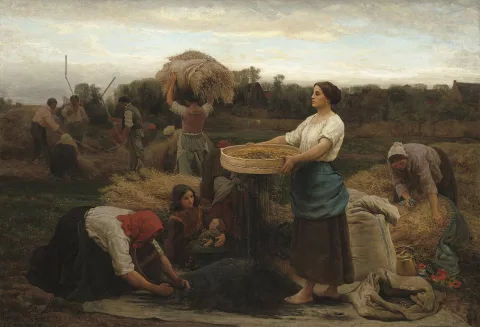
A working day does not end at the same moment for everyone. In Le Rappel des glaneuses, Jules Breton makes this the subject of a painting. Some women have already gathered, others are still arriving, while a field guard calls them to leave. We see neither the beginning of the harvest nor its full duration. We encounter the moment when scattered activities must recover a shared movement. This choice alone gives the picture a small tension: how can people be brought to leave together when their work has taken them apart?
Breton paints this oil on canvas in 1859. The Musée d’Orsay identifies the setting as Courrières, his home village in Artois. The crescent moon and the light of the setting sun specify the moment depicted. These elements are not a weather report. They establish the conditions in which the action becomes legible. One signal is given by a man and another by the sky. The painting thus brings together a social rule and a change in light, without confusing them.
The word rappel directs our attention towards a voice that painting cannot produce. Yet we can understand its existence through the guard’s gesture. This is one of the simplest powers of an image: a body shows something that escapes its material. There is no need to add an invented sentence to hear the call in our minds. The title and the posture provide enough clues. Viewers can then observe the differences between the figures, as so many visible responses to an event that remains silent.
The width of the canvas, one hundred and seventy-six centimetres for a height of about ninety, accompanies this dispersal. The group does not present itself like a family portrait enclosed around a centre. It invites us to move across the image, seek passages between people and allow time for those who lag behind. The eye can repeat this experience: return to one figure after following another. This comment concerns our way of reading the format; it does not claim to reconstruct an obligatory route devised by the artist.
The worn clothing and bare feet prevent us from entirely forgetting the material conditions of gleaning. Yet the museum stresses the idealisation of the scene. This coexistence deserves more than a quick verdict. A painting can include signs of poverty while also offering noble postures and appealing light. Viewers benefit from holding on to both perceptions. Recognising the beauty of the whole is not enough to know the life of every model; noticing this distance does not mean that we must look only at the clothes either.
The painting enjoys considerable success at the Salon of 1859. Empress Eugénie notices it, and it is acquired for the collection of Napoleon III before being donated to the Musée du Luxembourg in 1862. The world of the fields thus finds a destination far removed from its scene: an imperial collection, then a museum devoted to living artists. This move raises a question of reception. What workers do to make a living can become, for others, an image to preserve. Between these two uses, the work creates its own encounter.
Its history does not stop in Paris. The catalogue documents a long-term loan to Arras, between 1926 and 1985, followed by its allocation to the Musée d’Orsay. The places of conservation change, while departure remains suspended. This contrast is especially palpable before a subject of transition. The call never ceases in the picture, while the picture continues its journey through institutions. We need not turn all its moves into adventures: their dates are enough to distinguish the time of the figures from that of the object.
The call eventually concerns viewers themselves. After looking at the light and the figures, we must leave the painting. We can retain the memory of a harmonious composition, but also of a moment when the group is not yet fully assembled. Breton gives the end of work a form that continues to demand attention. This is not the complete story of a community. It is an invitation to see how a day ends in different gestures, before the silence of the museum brings them together again.