Jules Breton · 5 min read
The future wife enters the fields
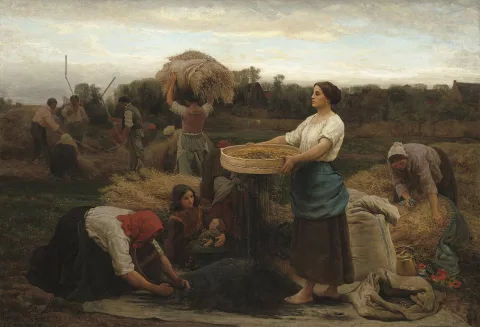
Les Glaneuses of 1854 contains a precise biographical link: Élodie de Vigne, Jules Breton’s future wife, models for one figure. This information brings the painting closer to his life without turning its characters into private memories.
Published on October 3, 2026
A painted peasant woman can have the face of someone the artist knows. In Les Glaneuses of 1854, the National Gallery of Ireland identifies Élodie de Vigne as the model for the standing woman in the foreground. She is the daughter of Jules Breton’s teacher, Félix de Vigne, and will marry the painter four years later. The information gives the picture an unexpected closeness. It also calls for a distinction: modelling for a gleaner is not enough to establish that someone personally carried out this activity in the field depicted.
The subject brings together women and children collecting what remains of the harvest. The museum places the scene near Courrières, in Artois, and a field guard oversees its progress. The activity is therefore not merely a pretext for painting clothing or a landscape. It organises relationships between the figures, their loaded arms and the parts of the field that have already been harvested. Breton has chosen a situation in which we can look both at people and at what they gather, within the same space.
Élodie’s presence changes how we encounter the woman in the foreground. Instead of immediately seeking a romantic story, we can observe what a painting does with a face available to it. A model provides features and a presence; the picture assigns them a place among other figures. This is transformation rather than simple recording. The difference allows us to accept the biographical information without asking it to replace the image. The painter’s future wife remains, within the painting, one of the participants in a collective scene.
The format, ninety-three centimetres high by one hundred and thirty-eight wide, gives the group enough room to develop several actions. Such a surface offers viewers two distances for reading. From afar, we can seek the coherence of the gathering; closer up, distinctions between the bodies become more important. The time spent before the work allows us to move from one to the other. This experience is not a reconstruction of the day of gleaning. It belongs to the organisation that the painting makes available to the eye.
The canvas is shown at the Paris Salon of 1855 and enters Isaac Pereire’s collection. Its rural subject joins a circuit of visibility and collecting that extends far beyond Courrières. The village is not transported to the Salon in its entirety: what arrives is an image that has been selected, constructed and signed. The success of this presentation adds another dimension to the story. The painting’s history can be followed without attributing to its figures an awareness of its future public career, of which they are not the narrators.
Nor does the family connection exhaust the different relationships contained in the work. Through Élodie emerges the transmission between a teacher and his pupil; through the subject, a painter’s attention to his region; through the Salon, an encounter with viewers and collectors. These relationships do not follow exactly the same timetable. Holding them together gives the painting depth, provided that each retains its own evidence. A marriage date and an identified model do not automatically tell us all the circumstances in which the work was made.
Sir Alfred Chester Beatty gives the canvas to the National Gallery of Ireland in 1950. It can then be encountered in Dublin, far from the field in Artois and long after the models. The gift introduces another form of sharing: a work preserved in a private collection enters a museum. The location changes without erasing its title or the activity depicted. For visitors who do not yet know Élodie, the picture remains a scene of gleaning; learning her name then allows a human relationship to be added to that first view.
The small biographical detail therefore has above all the merit of opening a question. Where does the portrait end, and where does the role assigned by the painting begin? Breton has not placed a written answer on the canvas. He has brought together a collective subject and the presence of an identifiable model. We can look at the gleaners, then return to this woman whose personal history is partly known to us. This return keeps the work open: the painter’s life brings it a closeness, while the group continues to ask us to look beyond a single face.