Jules Breton · 5 min read
Two titles cross at the end of the work
Jules Breton’s catalogue documents an old confusion between Across the Fields and The End of the Working Day. Following the titles reveals a creative process made of revisions, decisions and written traces.
Published on October 3, 2026
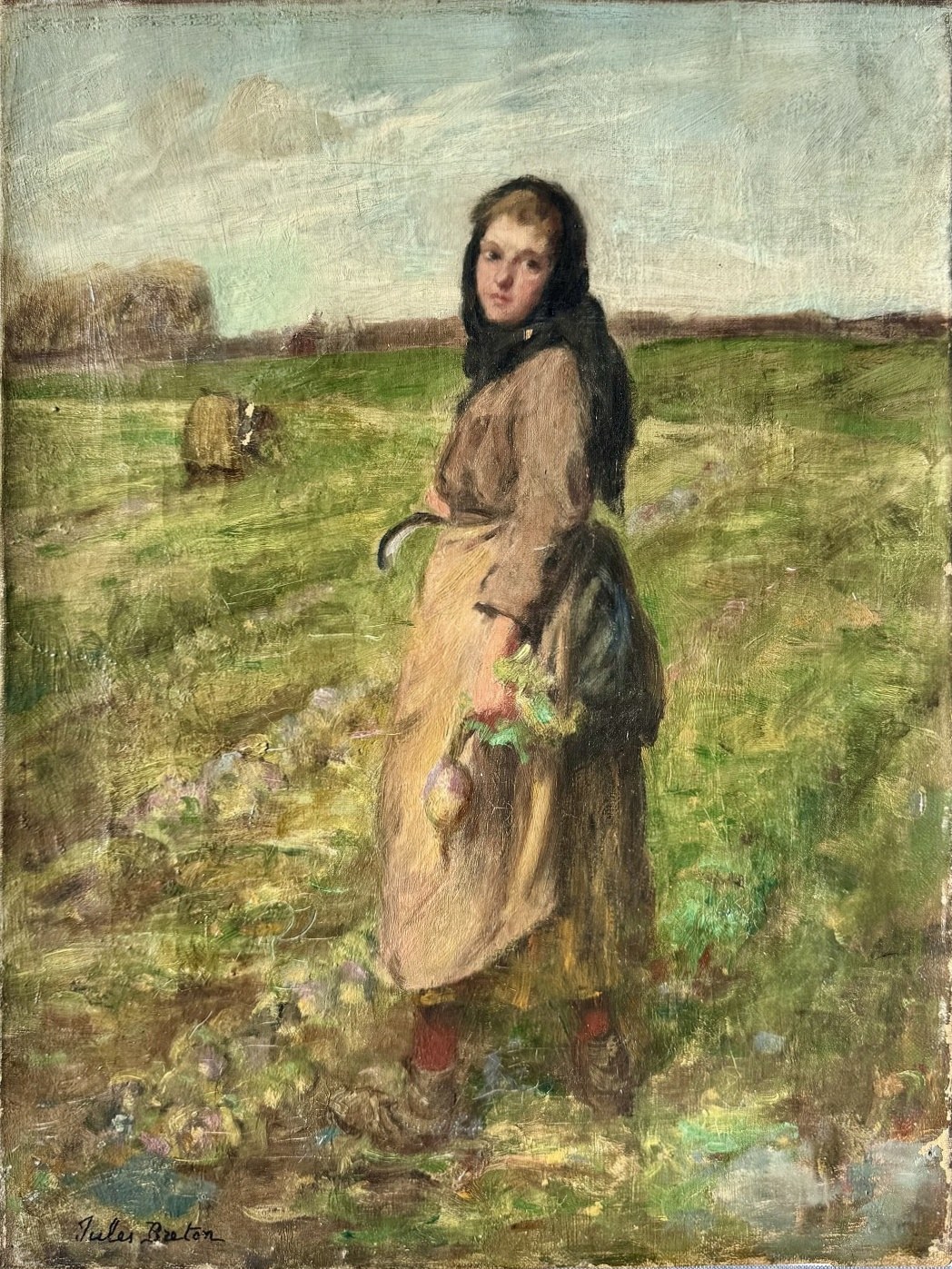
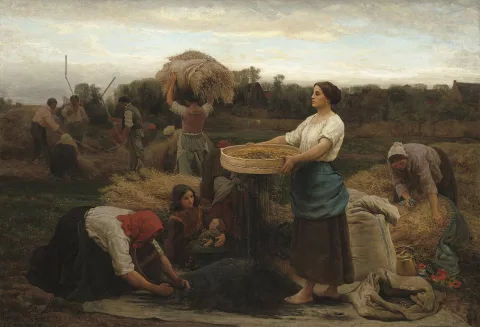
Two paintings can resemble each other enough for their titles to begin travelling from one to the other. The catalogue of the Jules Breton family archives identifies precisely this problem surrounding Across the Fields and The End of the Working Day, two works presented in 1887. The subject is more than an error to correct. It shows how a name accompanies creation, then how critics and exhibitions can blur this relationship. To follow the right painting, we sometimes need to leave the image for a moment and examine the written traces.
Across the Fields did not immediately receive its definitive name. The catalogue traces several designations during its development and connects it with a second canvas begun subsequently. When the two works are due to be presented, their titles are fixed. The diary of Élodie, Breton’s wife, provides important evidence for this reconstruction. It places the decisions within a chronology. We do not need to stage an imaginary conversation between husband and wife: the document’s existence already helps explain why a catalogue may prefer one title to another.
A provisional title can guide the work without having to remain on the final label. The artist sometimes discovers a more accurate relationship between words and what he has constructed. This possibility concerns how we read the work. When we encounter an established title, we tend to regard it as if it had preceded every brushstroke. Breton’s dossier recalls another route: the image and its name advance together, then their relationship becomes clearer. Words form part of the making, not just the public presentation.
The confusion becomes more delicate when it persists in the reception. Critical descriptions may correspond to the wrong title; a later exhibition may repeat a mistaken identification. A sentence’s age is therefore not enough to ensure it correctly designates the object. This observation does not accuse every witness of carelessness. It shows an ordinary difficulty in documenting art: a text must be connected to a work through dates, provenance and sometimes material details. The right account begins with this unobtrusive operation.
The catalogue dates Across the Fields to 1887 and identifies it with the Brooklyn Museum. This destination helps establish the object independently of the circulation of words. The painting retains a material existence: a canvas, a signature, dimensions and a collecting history. Its name may be debated, but these reference points keep us from losing the thread. It would be tempting to multiply details of the market; here, the issue lies elsewhere. We seek how different sources can restore to a painting the title the artist and those close to him eventually used.
The presence of Élodie’s diary also gives a place to work often less visible than the painter’s gesture. A preserved note can become decisive long after it was written. We do not know every circumstance of its composition, and it would be excessive to turn it into a fictionalised domestic scene. Its documentary usefulness is remarkable enough. Information connected with the Bretons’ everyday life now helps reread an exhibition and distinguish two paintings that commentaries brought together too hastily.
For the visitor, this history can alter a habit: read the title after looking, then look again. The words direct attention towards a passage across fields or towards an ending. These are not quite the same expectations. Once the dossier is known, we can attend more closely to the gap between a title and our first impression. The title does not necessarily summarise the whole painting. It offers an entry arising from a process and a decision, which our gaze can subsequently extend.
The two names finally recover their places without the history of their crossing disappearing. The catalogue preserves the difficulty and explains its method. This transparency is valuable: it makes the correction understandable rather than imposing it as mere authority. Across the Fields can then be viewed as a painting, but also as an object whose name had to be followed carefully. The work ends in the image; the reading of documents continues to protect the precision of what we recount.