Jules Breton · 5 min read
At the Fountain, a painting travels between exhibitions
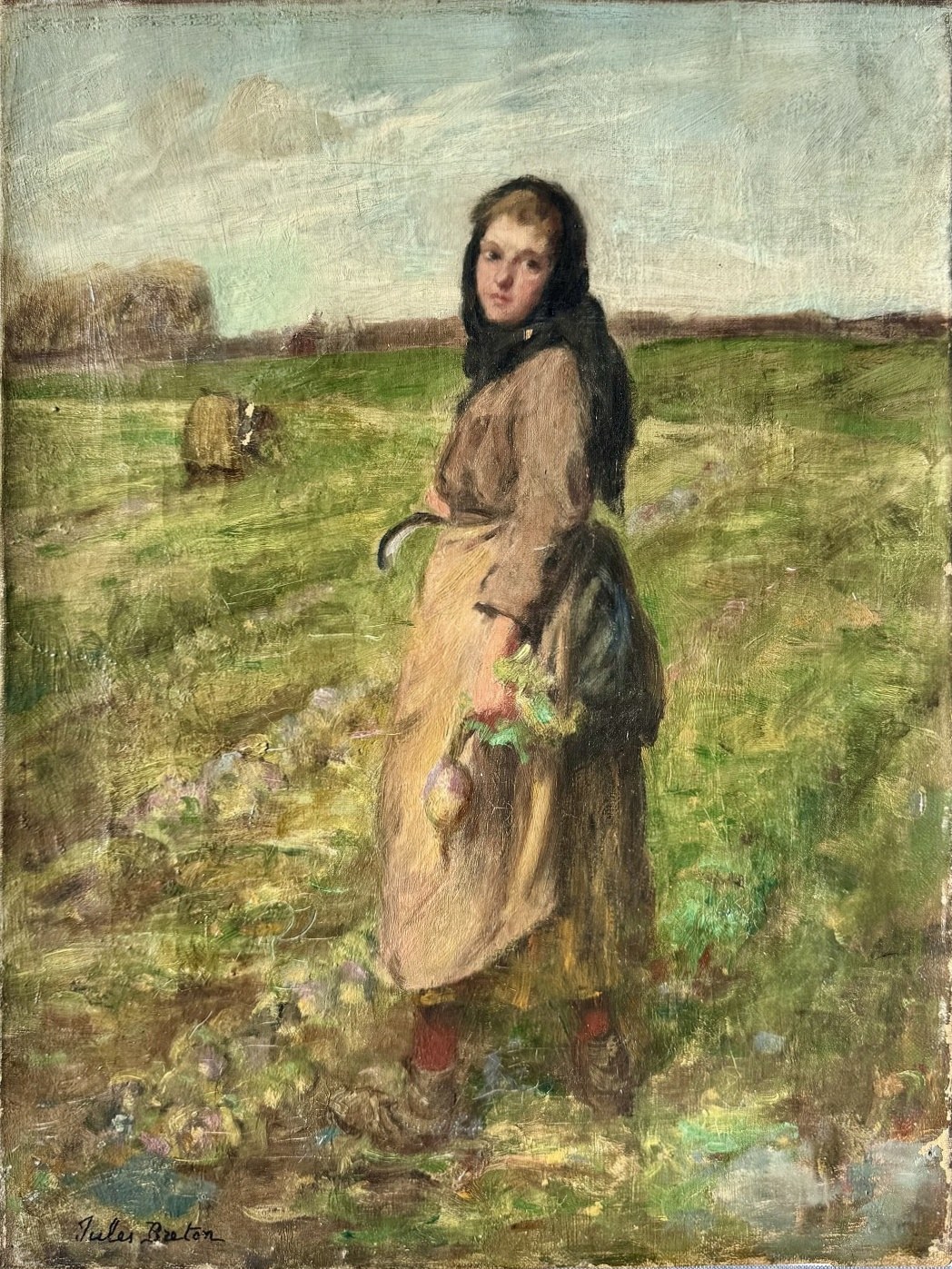
At the Fountain, painted in 1892, belongs to the museum in Quimper. Its entry gathers stages showing how a work with a Breton subject can enter very different exhibition narratives.
Published on October 3, 2026
At the Fountain seems to promise a simple place: a water source and what happens beside it. Jules Breton’s painting, dated 1892 in the catalogue of Quimper’s Musée des Beaux-Arts, nevertheless has another history of places. Before and after entering the collection, it appears in exhibitions that give it different neighbours. Following this route allows us to look at a work differently: its subject remains the same, while the questions it is invited to answer can change.
The entry identifies an oil on canvas acquired following a commission in 1895. The title, date and this manner of acquisition designate a precise object. There are other paintings of fountains by Breton; this one must retain its own reference points. Such attention avoids bringing paintings together too quickly under a single word. A fountain is a sufficiently familiar motif to seem interchangeable, but a work retains its format, destination and movements. The visitor can begin with the common subject, then discover the particular history attached to it.
The catalogue mentions a presentation in Chicago in 1893, followed by Antwerp in 1894. These stages precede the acquisition recorded by the museum. They show that the image had an audience beyond its present place of preservation very early on. We must not turn these movements into personal adventures of the painter when the documents do not recount them. We are following the stages of the painting’s presentation. A work can travel to be exhibited, while the depicted subject remains attached to a scene whose surface does not change.
Exhibitions devoted to Brittany subsequently offer another framework for reading. A painting then enters an ensemble in which the places depicted and their cultural identities become important. The title of the Quimper catalogue connects it with paintings inspired by Brittany. This classification does not replace the visual encounter, but gives it context. It can lead visitors to ask what an artist retains of a place, how he presents it to an audience and what a collection wishes to preserve of that representation over time.
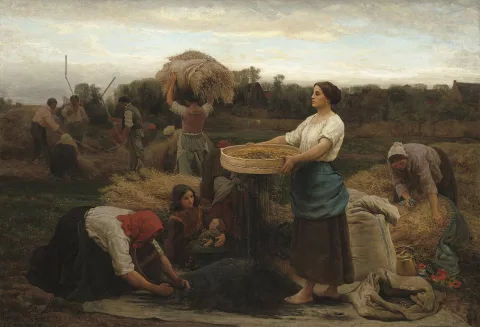
Other presentations associate the work with naturalism or the dignity of humble people. The same canvas can therefore serve to examine a region, a painting practice or the place of ordinary figures. This plurality is not necessarily a contradiction. An exhibition chooses a viewpoint and creates relationships between objects. Visitors benefit from recognising this work rather than believing a painting belongs forever to a single narrative. Works remain stable in their material substance, but their neighbours open new questions and different connections.
The fountain itself provides an accessible way into this reflection. A water source can be viewed as a landscape feature, a place of activity or a meeting point within a village. We must not assign all these uses to this painting without observing them. We can nevertheless let the title prepare our attention: seeking the link between the named place and the presence surrounding it. Knowledge of the exhibitions should not draw us away from this task. On the contrary, it can make us more attentive to what each framework brings forward.
A long exhibition list also gives a measure of a painting’s public life. It contains dates and cities, but behind these reference points lie successive opportunities to see it. Individual reactions are not documented here. We can simply acknowledge that the work was available in several contexts and to several groups of visitors. This circulation keeps it from existing only within a local description. At each stage it can become known to people who bring different memories of places, work or painting.
Returning to the Quimper entry finally brings these perspectives together. A modest title leads to a work that is dated, acquired, classified and exhibited. At the Fountain needs no spectacular event to offer an account. Its history develops in the passage between a scene and the frameworks that make it visible. Visitors can retain the simplicity of the motif while knowing the canvas has encountered distant audiences. A painted fountain stays in place; the painting containing it continues to enter new conversations.