François Bocion · 5 min read
The painter who steps into his own boat
In 1877, François Bocion joins a family outing on Lake Geneva. This small panel brings together landscape, boating and self-portraiture, inviting viewers to find their place almost at water level.
Published on October 3, 2026
Featured on October 8, 2026
François Bocion appears somewhere we do not quite expect him: in the middle of his landscape. In Bocion and His Family Fishing, painted in 1877, the man dressed in white stands on a small boat. Beside him, a second boat carries other figures. Lake Geneva remains immense, but its painter is no longer merely an observer standing outside it. He now belongs to the world he depicts, alongside his family and with a slight solemnity that raises a smile.
The panel held at the Musée cantonal des Beaux-Arts in Lausanne measures only thirty-two by forty-eight and a half centimetres. Its small scale matters. It makes us move closer and gives the encounter an intimacy that an enormous panorama would not have. Yet the painting contains several subjects at once: a lake view, a family group, a leisure activity and a portrait of the artist. None needs to occupy the scene alone. The boats hold these different ways of telling a story together.
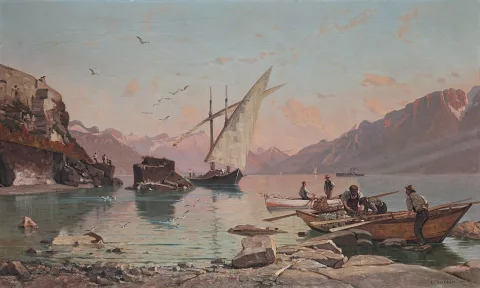
Looking at the work — In the MCBA reproduction, the two hulls form a horizontal band near the bottom of the image. The mast and pale sail rise on the left, while the sky occupies a considerable area. The white suit first catches the eye; then the darker clothes, hats and gestures spread our attention among the passengers. Beneath the boats, a few reflections stretch out their colours. No strip of shore closes off the foreground: we look from the water, at the level of this company.
The museum identifies the standing figure as Bocion and cautiously suggests that the woman beneath a parasol might be his wife, Anna-Barbara Furrer. That reservation is valuable. A family painting does not automatically provide the personal details behind every face. It does, however, show how each person occupies the space: standing, seated, sheltered or close to the edge. The presence of loved ones makes the lake a shared place. Its expanse is not simply something to contemplate; it also becomes a place where bodies gather.
This outing belongs to a period when pleasure boating was still uncommon on Lake Geneva, according to the MCBA entry. Transport and fishing continued to play a major role there. The title refers to fishing, but the image also makes room for the enjoyment of sailing. The distinction is therefore less straightforward than a division between work and relaxation. Bocion depicts a familiarity with the lake that comes through the vessel itself, its stability and the tangible closeness of the water.
The painter has known this landscape for a long time. After training in Paris, he returned to Lausanne in 1848 and taught drawing there for decades. The Musée Jenisch recalls how closely his Lausanne career was bound to Lake Geneva's changing atmosphere. This devotion illuminates the panel without confining it to biography: the distant mountains and sky are not merely a convenient backdrop. They are elements revisited again and again, to which a family gathering here gives a different rhythm, closer and more personal.
We might remember only the white silhouette, so conspicuous is it. That would miss the composition's quiet movement. The oar extending to the left, the boat stretching to the right and the receding mountains invite us to move around the self-portrait. Bocion has a definite presence, but he does not monopolise the painting. The eye leaves his suit to follow a hull, encounters a reflection, then rises towards the clouds. The small portrait thus joins the broad expanse without needing to dissolve into it.
The painting entered the museum in 1939. What remains today is neither the complete account of a day nor a photograph of every family relationship. It is a way of making them visible together, in the same air and on the same water. By the end of our viewing, the initial surprise means something different: the painter has not merely added himself to his favourite landscape. He has opened a space in front of the boats, so close that viewers can briefly feel the distance separating them from this family.