Luigi Pagan
Born in Chioggia (Italy) on 2 August 1907.
Died in Chioggia (Italy) in 1980.
Italian · Chioggismo · twentieth-century Venetian lagoon painting · Impressionist and Expressionist tendencies
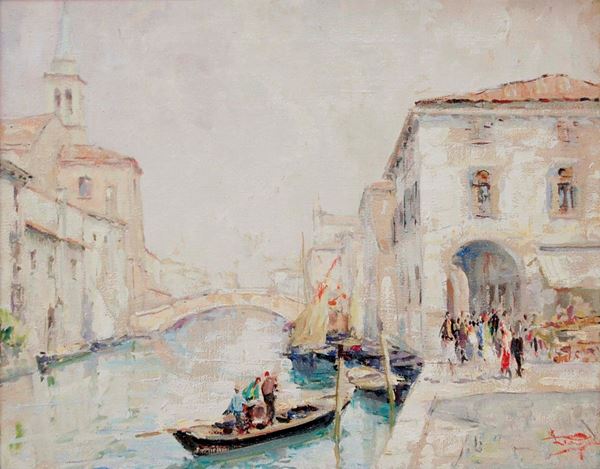
An Italian painter closely identified with Chioggia and the maritime culture of the Adriatic, Luigi Pagan ranks among the leading representatives of Chioggismo. His imagery grew from direct observation of the city, the Canal Vena, its bridges and markets, and the daily labour of its fishing community, transformed into compositions in which local memory acquires a distinctly poetic resonance.
After studying at a boarding school for war orphans, a series of educational and professional experiences took him to Turin, where he encountered the Piedmontese painting tradition. On returning to the lagoon, he refined his artistic training at the Scuola d’Arte dei Carmini and the Venice Academy of Fine Arts. This background enabled him to combine close observation of the landscape with confident draughtsmanship, colour and carefully staged composition.
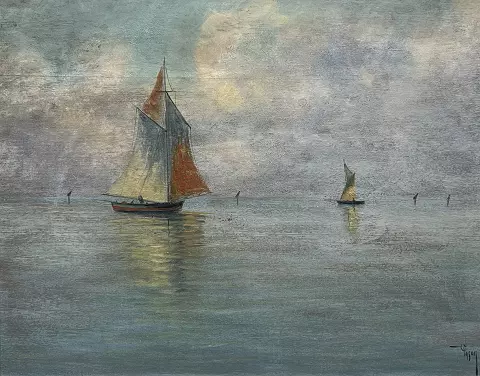
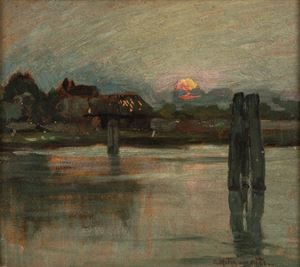
Pagan worked chiefly in oil on canvas or panel and in watercolour. His paintings of the 1940s often feature warm tonalities and deep shadows; after the Second World War his palette became brighter, while diluted oil and watercolour encouraged a more luminous and airy treatment of atmosphere. Alongside views of Chioggia and Venice, he painted harbours, sails, markets and local figures, as well as landscapes produced during stays in Imer, Enego and Fiera di Primiero.
Pagan’s work is represented in Chioggia’s civic collection, where paintings including Veduta sul Canal Vena, Alla pescheria and Armonie chioggiotte document the development of his visual language. In 2008 the Museo Civico della Laguna Sud presented a substantial retrospective accompanied by a monograph. Within this context, Voiliers dans la lagune, an oil on panel presented by Swiss Art Gallery, continues his characteristic dialogue between boats, water and light within this corpus.