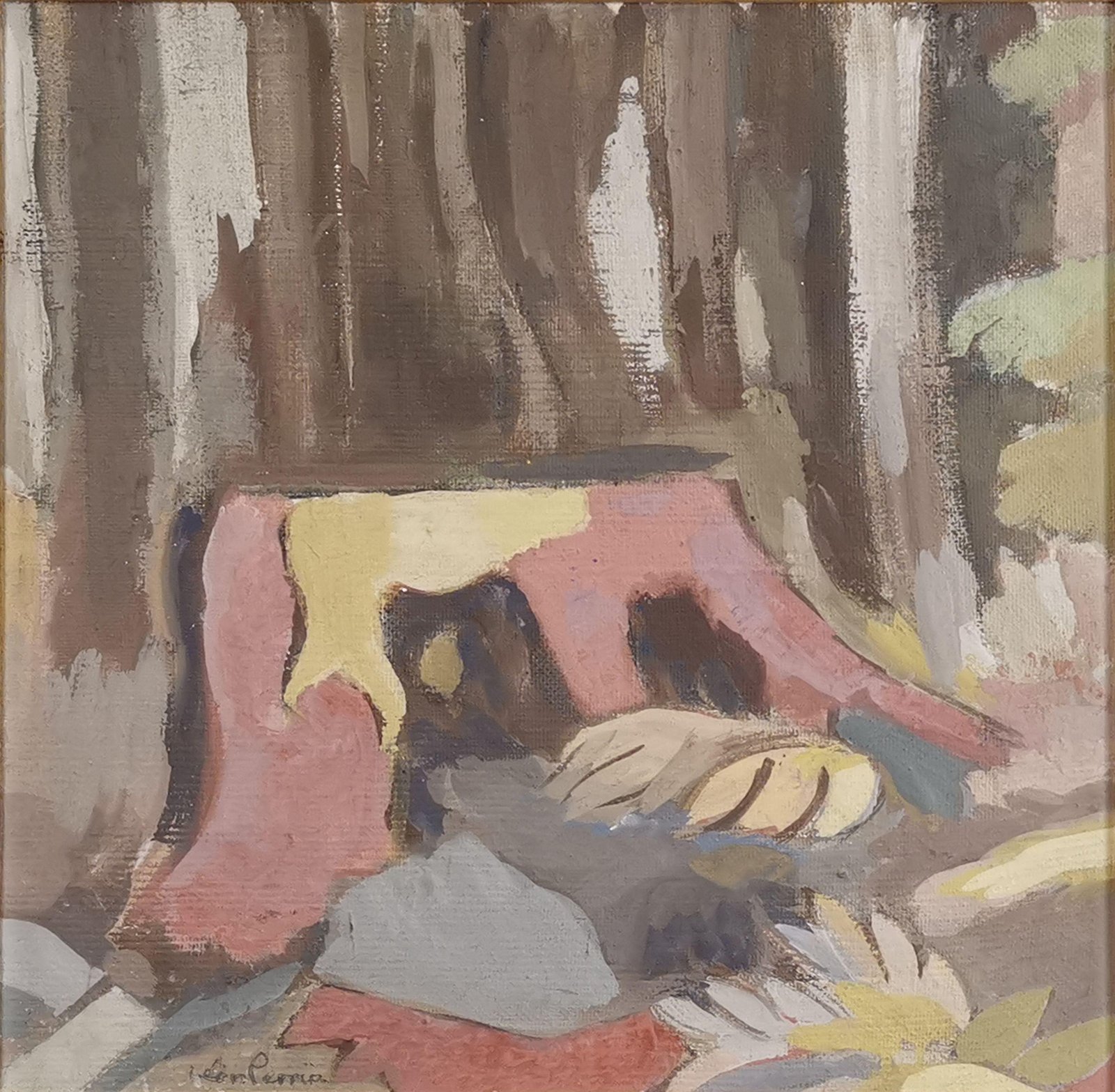
Léon Perrin
Born in 1886.
Died in 1978.
From 1900, Léon Perrin trained at the École d’art in La Chaux-de-Fonds, where he entered as an apprentice engraver and chaser—an initial training that grounded his practice in the handling of materials and applied decoration. In 1907, a study trip to Italy took him to Tuscany, Ravenna and Bologna alongside Charles-Édouard Jeanneret (Le Corbusier), and that same year is associated, according to the source, with a mosaic work entitled Procession des Vierges for the Basilica of Sant’Apollinare Nuovo in Ravenna. During the First World War, he was among the authors of the interior and exterior ornamentation of Le Locle Town Hall, dated 1915–1917, attesting to a significant professional involvement in public decoration.
In personal terms, the source mentions his marriage in January 1914 to Jeanne-Marie-Nathalie Benoît; the couple is said to have had no children (according to the consulted notice). His professional career included teaching art history and drawing at the Gymnasium of La Chaux-de-Fonds from 1925 to 1952, an attribution explicitly ascribed to Wikipedia in the source. His public works include dated sculptures and monuments: the Fontaine de Vie (limestone and granite) in the cemetery of La Chaux-de-Fonds, dated 1932, as well as a Monument «Hommage à Léopold Robert», installed in La Chaux-de-Fonds in 1935.
A work subsequently catalogued under the title Grande Vénus, dated 1954, is noted at the Musée des beaux-arts de La Chaux-de-Fonds, indicating a presence in local collections as reported by the source. The assembled references emphasise a practice combining mosaic, monumental ornamentation and stone sculpture (limestone, granite), together with educational and decorative activity centred on La Chaux-de-Fonds and its surroundings.