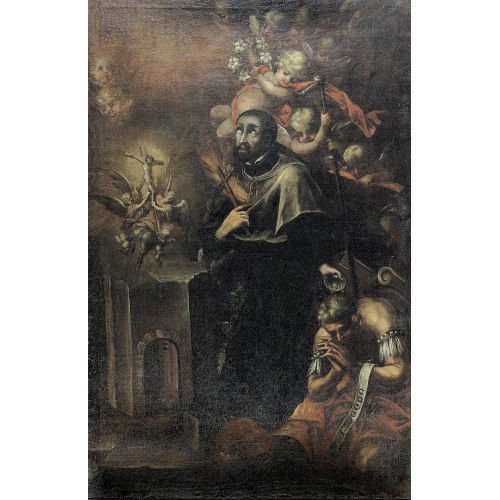
Johann Achert
Born in Rottweil (Germany) in 1655.
Died in Rottweil (Germany) in 1730.
German · Southern German Catholic Baroque · Rottweil school of painting. Narrative sacred painting, altarpieces and Passion cycles.
Johann Achert belongs to the Catholic Baroque tradition of southern Germany and to the painting culture of Rottweil. After attending the local schools, he is documented as a master from 1682. His involvement in civic life—as a guild official in 1711 and an administrator of the town hospital until 1713—accompanied a career supported by religious institutions and regional elites.
His work is dominated by sacred painting and major ecclesiastical commissions. Documented projects include the high-altarpiece of the Franciscan church in Fribourg, completed in 1693, Passion scenes for the Collège Saint-Michel, paintings for the Cistercian abbey of Hauterive and an altarpiece for the Jesuit church in Solothurn. In Germany, he worked at such sites as Beuron, Salem and Weil der Stadt.
His activity in Catholic Switzerland forms an important chapter of his career. The Resurrection of Christ, painted for the chapel at Posat between 1680 and 1693 and now held by the Stadtmuseum Rottweil, illustrates the artist’s movement between south-western Germany and the Fribourg region. In 2023, the painting was shown at the Musée gruérien in Bulle in the exhibition Réformes.
Et Fribourg resta catholique.
Stylistically, Achert is associated with the Rottweil school and displays affinities with Johann Georg Glückher. His mature works favour densely populated narrative compositions, monumental foreground figures and broad spatial settings, often animated by harmonies of red and white. His repertoire includes altarpieces, Passion cycles and images of saints, as well as portraits and decorative painting during the earlier part of his career.
The Rottweil workshop was continued by his son Jakob Christoph Achert. Research by Winfried Hecht progressively expanded the recorded and attributed corpus to more than 140 works, complemented by a surviving sketchbook. The catalogue of the monographic exhibition published in Rottweil in 1980 and subsequent scholarly studies remain the principal foundations for the study of the artist.