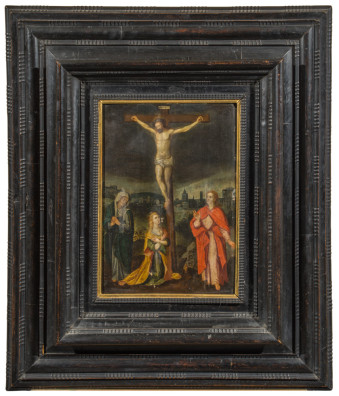
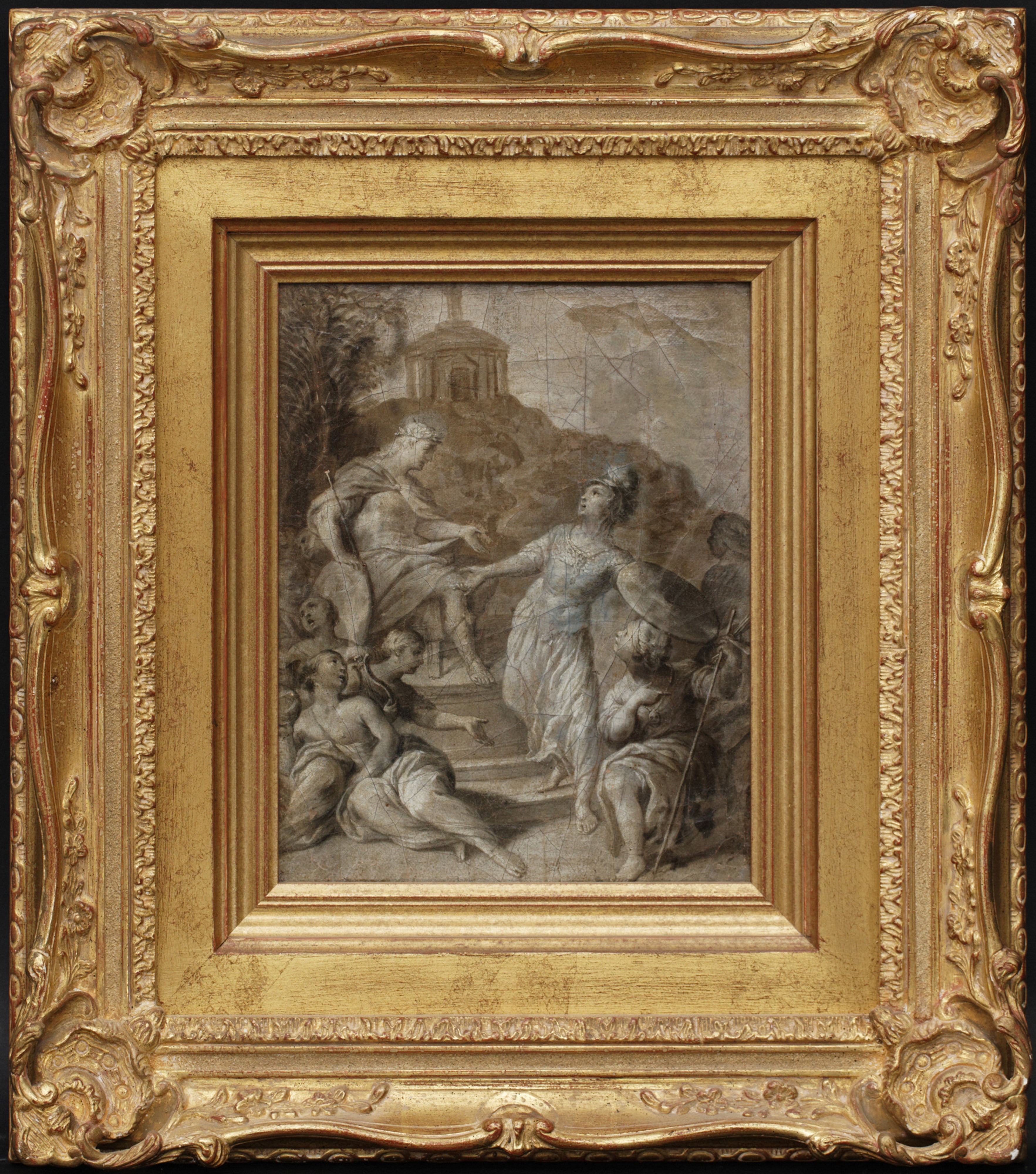
A painter and author of emblem books, Otto van Veen, also known as Vaenius, connected Netherlandish humanist culture with Italian art. Born in Leiden, he travelled to Italy and worked with Federico Zuccari in Rome. Later established in Antwerp, he received princely and religious commissions and numbered Peter Paul Rubens among his pupils. His painted work includes portraits and compositions intended for churches.
The Amorum emblemata, published in 1608, reveal another aspect of his practice. Images designed by Van Veen and engraved by Cornelis Boel accompany mottoes and poems concerning love. Different editions combine different languages; the copy held by the Metropolitan Museum brings together Latin, English and Italian. This exchange between writing and engraving places his work within the learned culture of the illustrated book.
This profile brings together identity references for Otto van Veen and paintings, drawings and works on paper documented in auction catalogues.
Documented auction references
2auction references
2auction houses
Artcurial Beurret Bailly Widmer · Piguet
References include catalogue entries and available results; they do not all represent completed sales.
References excluded from statistics: attributions and special lots
These references are shown separately because of their attribution or lot composition. Each record states the reason.
SwissArtGallery documentary note based on the cited sources. Titles, media and qualifications are provided in the profile language; the original catalogue wording remains available in each record. Profile updated :
George Ricard-Cordingley (1873–1939), also known as Georges Ricard-Cordingley, was born in Lyon to a French father and an English mother. He trained in Lyon and at the Académie Julia…
Arcangelo Salvarani (1882–1953) was born in Quartirolo di Carpi and died in Modena. He worked mainly in watercolour, alongside mural decoration and teaching at the Fermo Corni instit…
Jac Martin-Ferrières (1893–1972), born Jacques-Auguste Martin, was the son of painter Henri Martin. Abandoning scientific studies, he developed an initially pointillist practice befo…