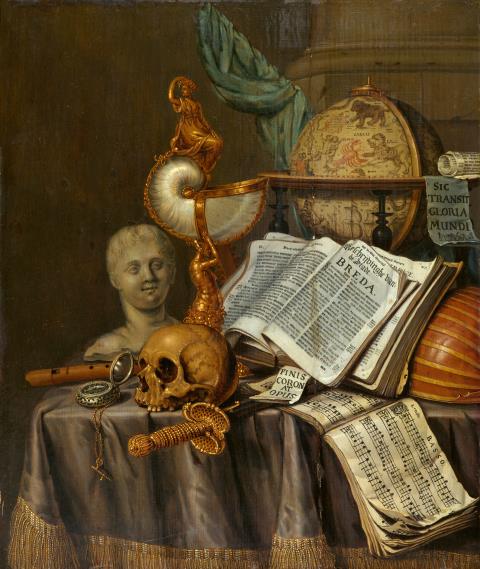
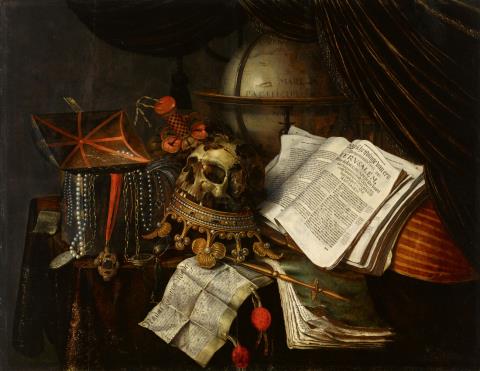
Edwaert Collier, also known by the first name Edward, painted vanitas subjects and trompe-l’œil compositions. In the Rijksmuseum’s Vanitas Still Life, signed in 1662, books, terrestrial and celestial globes, a crown and a watch bring knowledge and power into relation with passing time. The Tokyo composition of 1663 arranges books, manuscripts and a skull along two diagonals; a sheet bears words from Psalm 26.
Another Vanitas Still Life, painted on canvas in 1684 and held by Kunstmuseum Den Haag, demonstrates the continuity of this subject. Collier also developed images of letter racks. In the Tate painting dated around 1699, newspapers, notes and writing tools appear arranged on a board. Oil painting on canvas creates the illusion of objects accessible to sight and touch.
This profile brings together identity references for Evert Collier and paintings, drawings and works on paper documented in auction catalogues.
Documented auction references
3auction references
1auction house
3documented results with prices
Lempertz
References include catalogue entries and available results; they do not all represent completed sales. Attributed works and special lots are excluded from the priced results.
Works recorded at auction
Photograph : Lempertz · Enlarge image ↗
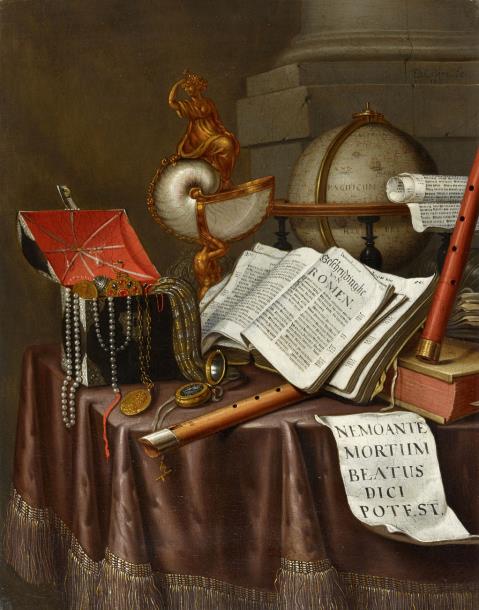
Lempertz · Lot 2096
Vanitasstillleben mit Nautiluspokal und einer Büste
Oil on wood
Original catalogue wording
Vanitasstillleben mit Nautiluspokal und einer Büste Öl auf Holz
SwissArtGallery documentary note based on the cited sources. Titles, media and qualifications are provided in the profile language; the original catalogue wording remains available in each record. Profile updated :
Antonio Marasco (1896–1975) participates in Futurist experimentation from Florence, where he studies with Galileo Chini. His career combines painting, stage design and collective act…
Émile Aubry (1880–1964), born in Sétif, develops a painting informed by classical culture and religious subjects. At the Paris École des Beaux-Arts, he trains in the studios of Jean-…
Sylvain Sauvage (1888–1948), the pseudonym of Félix Roy, works across drawing, printmaking and book design. His activity as an illustrator extends beyond accompanying a narrative to…