Giovanni Ghisolfi studied ancient remains in Rome and worked in close contact with Salvator Rosa. Architecture provides a structural framework for his landscapes, whose clear compositions embody a luminous classicism. His relationship with Rosa is best understood as artistic collaboration.
The Princely Collections of Liechtenstein hold Roman Ruins with the Three Columns of the Temple of Vespasian, an oil painting on canvas measuring 49 by 66 centimetres. The monumental fragment becomes the subject of the painting itself. At the National Gallery of Victoria, Augustus at the Tomb of Alexander, around 1664–1671, uses black chalk with white highlights on brown paper. This sheet, measuring 19.1 by 26 centimetres, brings architectural representation together with the evocation of ancient history.
This profile brings together identity references for Giovanni Ghisolfi and paintings, drawings and works on paper documented in auction catalogues.
Documented auction references
3auction references
2auction houses
1documented result with a price
Lempertz · Schuler
References include catalogue entries and available results; they do not all represent completed sales. Attributed works and special lots are excluded from the priced results.
Works recorded at auction
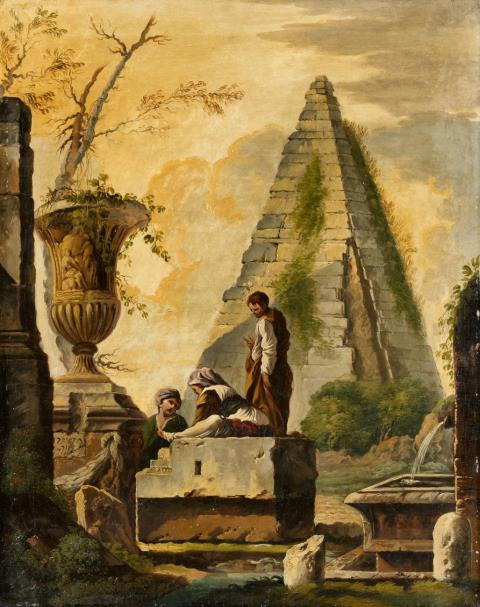
Photograph : Lempertz · Enlarge image ↗
Lempertz · Lot 1090
Zwei Architekturcapriccios mit antiken Ruinen und Figurenstaffage
Oil on canvas
Original catalogue wording
Zwei Architekturcapriccios mit antiken Ruinen und Figurenstaffage Öl auf Leinwand
References excluded from statistics: attributions and special lots
These references are shown separately because of their attribution or lot composition. Each record states the reason.
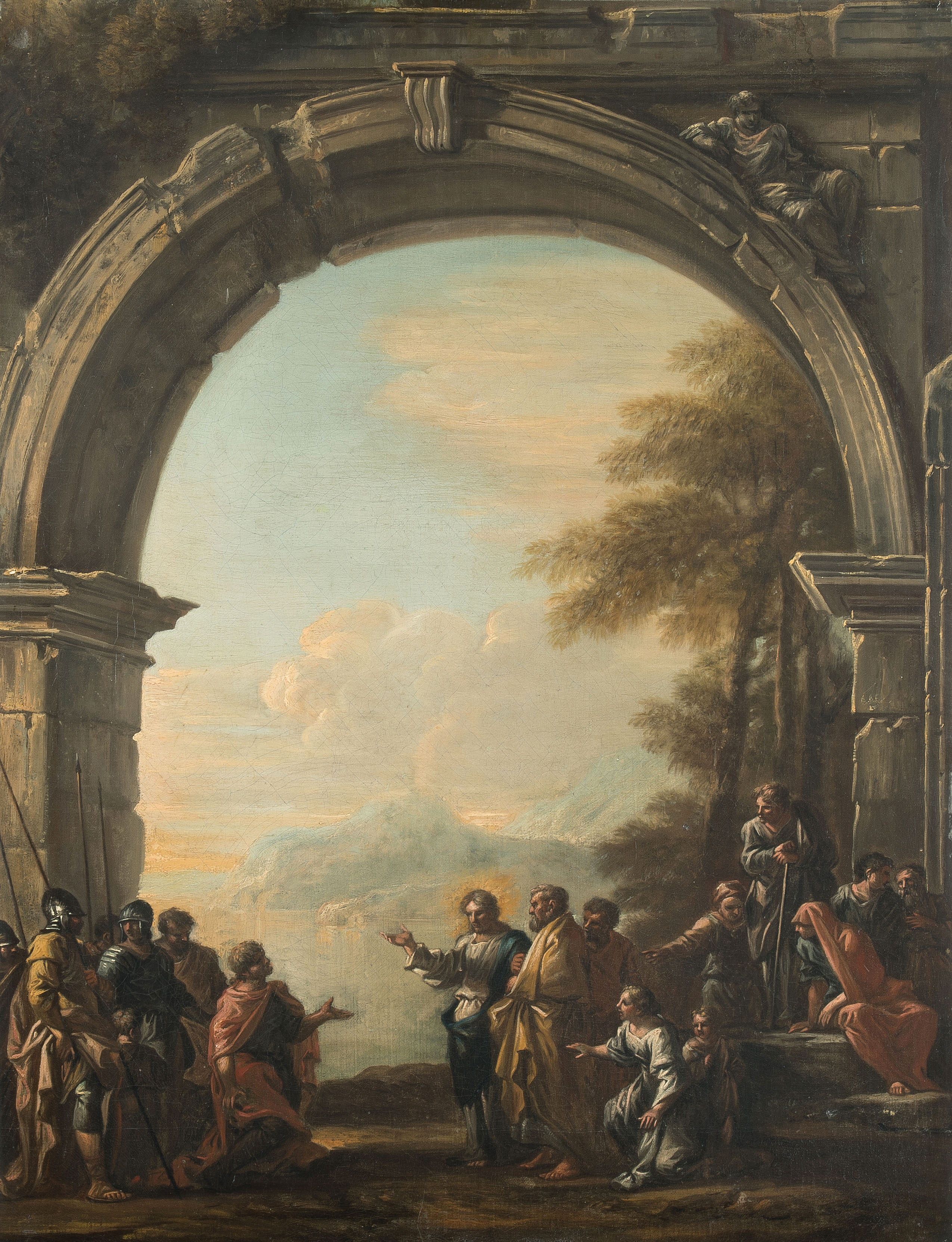
Photograph : Schuler · Enlarge image ↗
Schuler · Lot 3204
Attribué à Ghisolfi, Giovanni — zugeschrieben Der Hauptmann von Kafarnaum fragt Jesus, ob er seinen kranken Diener heilen könne (nach Matthäus 8, 5-13)
Oil on canvas
Original catalogue wording
Attribué à Ghisolfi, Giovanni — zugeschrieben Der Hauptmann von Kafarnaum fragt Jesus, ob er seinen kranken Diener heilen könne (nach Matthäus 8, 5-13) Öl auf Leinwand zugeschrieben
SwissArtGallery documentary note based on the cited sources. Titles, media and qualifications are provided in the profile language; the original catalogue wording remains available in each record. Profile updated :
George Ricard-Cordingley (1873–1939), also known as Georges Ricard-Cordingley, was born in Lyon to a French father and an English mother. He trained in Lyon and at the Académie Julia…
Arcangelo Salvarani (1882–1953) was born in Quartirolo di Carpi and died in Modena. He worked mainly in watercolour, alongside mural decoration and teaching at the Fermo Corni instit…
Jac Martin-Ferrières (1893–1972), born Jacques-Auguste Martin, was the son of painter Henri Martin. Abandoning scientific studies, he developed an initially pointillist practice befo…