Born : 1909Died : 1999Documented citizenships : France
The French painter, illustrator and lithographer André Hambourg brought together painting, printmaking and the printed image throughout his career. Born and died in Paris, he first studied sculpture at the École nationale supérieure des arts décoratifs, in Niclausse’s studio, before entering the Beaux-Arts de Paris in 1927, where he studied painting in Lucien Simon’s studio. In 1933, he was awarded the French West Africa Prize and the Abd-el-Tif Prize, shared with Émile Bouneau, and stayed in North Africa from 1933 to 1939. During a journey through eastern and southern Algeria in 1934, he painted villages and landscapes of the Sahel, as well as their inhabitants. An exhibition devoted to his African work was subsequently presented at the Musée de la France d’Outre-Mer, at the Porte Dorée in Paris.
During the Second World War, after being mobilised and then demobilised in August 1940, Hambourg joined the Resistance in Oran in 1942. He wrote under the pseudonym André Hache for Combattant 43, a weekly newspaper of the French Army, and undertook assignments aboard combat ships, in connection with the Navy Commissariat, to produce illustrated reports. Findlay Galleries states that in 1944 he became the first French delegate of the Four Arts Aid Society and was made a Knight of the Order of Public Health for his assistance to French artists at the Liberation. From 1952, as Official Painter of the Navy, he divided his life between the Normandy coast and Saint-Rémy-de-Provence, two places among his favourite subjects. In 1964, a retrospective in Trouville-sur-Mer presented his work from 1927 to 1964.
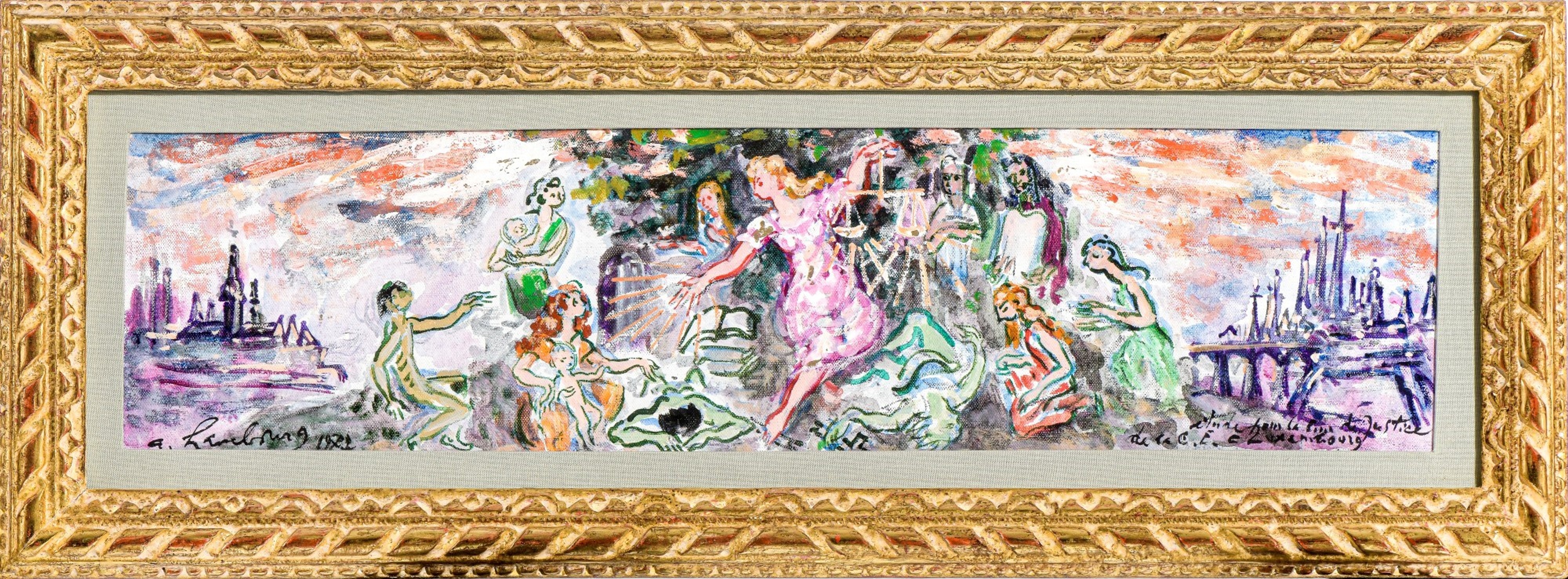
Book illustration formed another aspect of his work. He illustrated, among other works, Terre des hommes by Antoine de Saint-Exupéry and La Pierre d’Horeb by Georges Duhamel. His publications also include Le Retour d’Imray by Rudyard Kipling, published in 1956, and the Manière de montrer les jardins de Versailles, published in 1974, for which he made woodcuts. His work also extended to decorative commissions. In 1972, he created six large panels for the courtroom of the European Court of Justice in Luxembourg, designed to symbolise the Member States and the values of peace and justice. Three years later, he carried out mosaic decoration projects for five schools in Deauville and Trouville.
The presence of his work in public collections is particularly marked by two donations. In 1988, André Hambourg and his wife donated 376 works to the Musée Eugène-Boudin in Honfleur. In 2007, Nicole Rachet donated 71 of his works — paintings, prints and drawings — to the Musée national de la Marine in Paris.
This profile brings together identity references for André Hambourg and paintings, drawings and works on paper documented in auction catalogues.
Documented auction references
5auction references
4auction houses
2documented results with prices
Germann · Piguet · DognyAuction · Dobiaschofsky
References include catalogue entries and available results; they do not all represent completed sales. Attributed works and special lots are excluded from the priced results.
Works recorded at auction
Photograph : Piguet · Enlarge image ↗
Piguet
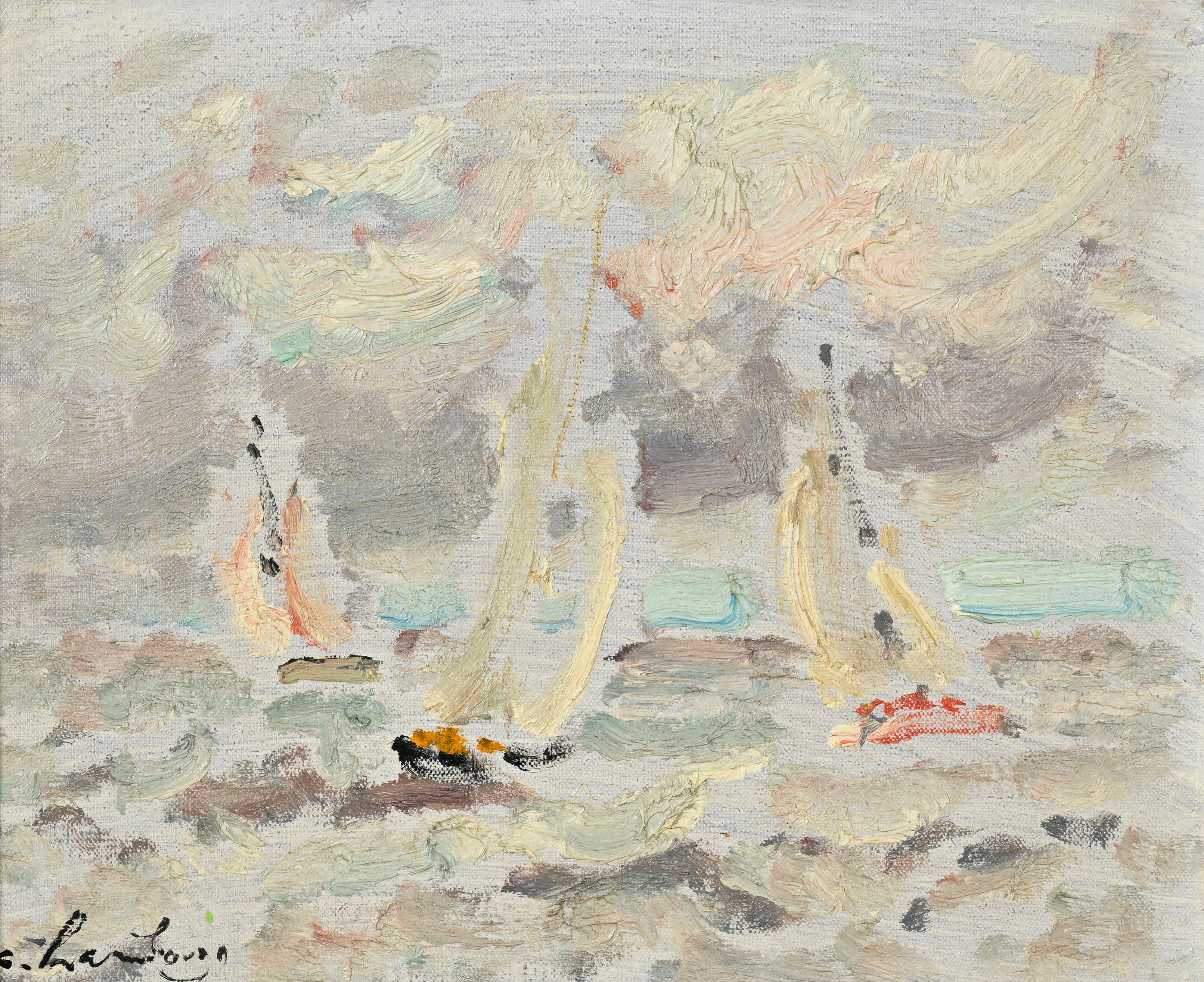
“Rough Sea off Villerville”
Oil on canvas
Original catalogue wording
"Grosse mer au large de Villerville" huile sur toile
References excluded from statistics: attributions and special lots
These references are shown separately because of their attribution or lot composition. Each record states the reason.
Photograph : Piguet · Enlarge image ↗
Piguet
Studies for the Court of Justice of the EC, Luxembourg — Two Works
Oil on canvas mounted on fibreboard and watercolour on paper
Original catalogue wording
Études pour le palais de justice de la C.E., Luxembourg — deux œuvres Huile sur toile marouflée sur panneau de fibres et aquarelle sur papier Lot groupé — prix global
SwissArtGallery documentary note based on the cited sources. Titles, media and qualifications are provided in the profile language; the original catalogue wording remains available in each record. Profile updated :
Born in Lübeck in 1646 under the name Gottfried Kniller, Godfrey Kneller was a portrait painter whose name also appears in the form Gottfried Kneller. His father, Zachary Kniller, a…
Robert Mangold’s painting is distinguished by a minimalist language embodied in carefully defined formats and contours. His series of shaped canvases explore variations on motifs suc…
The French painter Yvonne Canu (1921–2008), born in Meknès, Morocco, developed a Neo-Impressionist practice characterised by a divided brushstroke and the arrangement of juxtaposed c…